| Femmes Fatales | Mar 4 2024 |

Zip your pants and keep them zipped, Harry. I'm going to bed and you aren't coming with me.
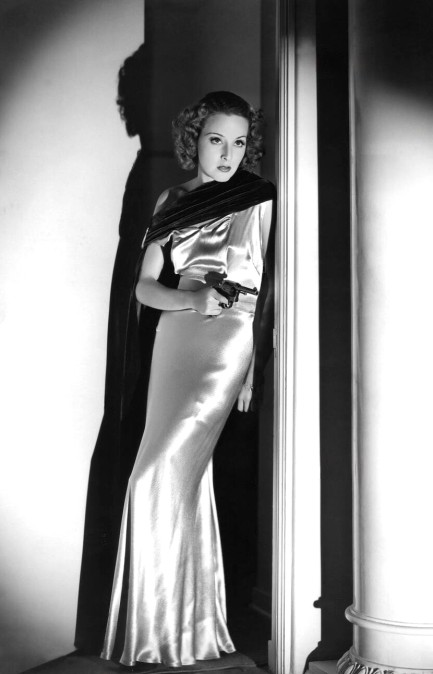
Above is U.S. actress Joan Perry in a promo image made for her 1936 crime drama Shakedown. She appeared in about twenty films beginning in 1935 and was out of acting by 1941, when she married Columbia Pictures co-founder and president Harry Cohn, one of the most hated and feared men in Hollywood. Cohn allegedly attacked actresses, demanded and received sex for film roles, and infamously had mob acquaintances threaten to kill Sammy Davis, Jr. if he kept canoodling with Kim Novak. Perry stayed wedded to the guy for seventeen years, until his death. Afterward, she married twice more, but one union lasted only two years, and the other lasted three. Which goes to show that you never can tell about relationships—or for that matter, people.


| Intl. Notebook | Sep 14 2022 |

Cancans de Paris is always uncanny.
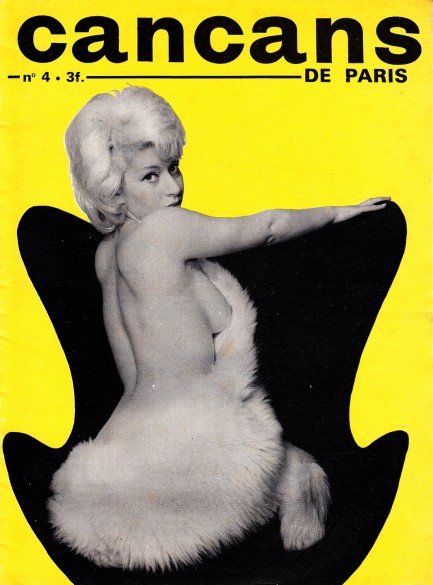
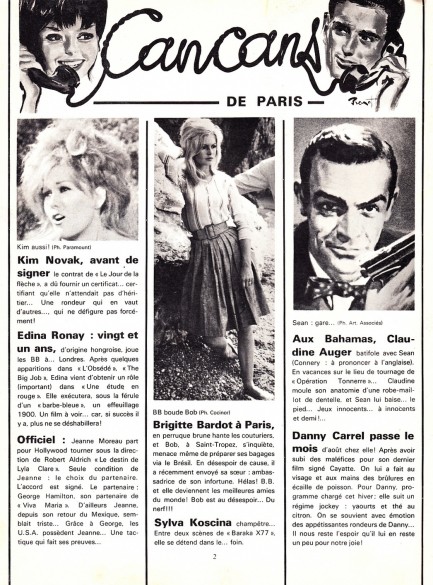
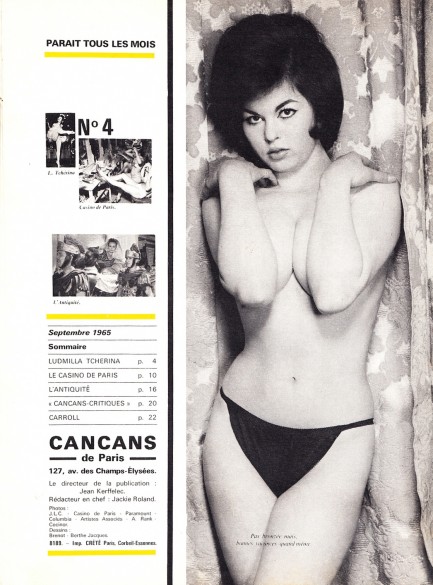
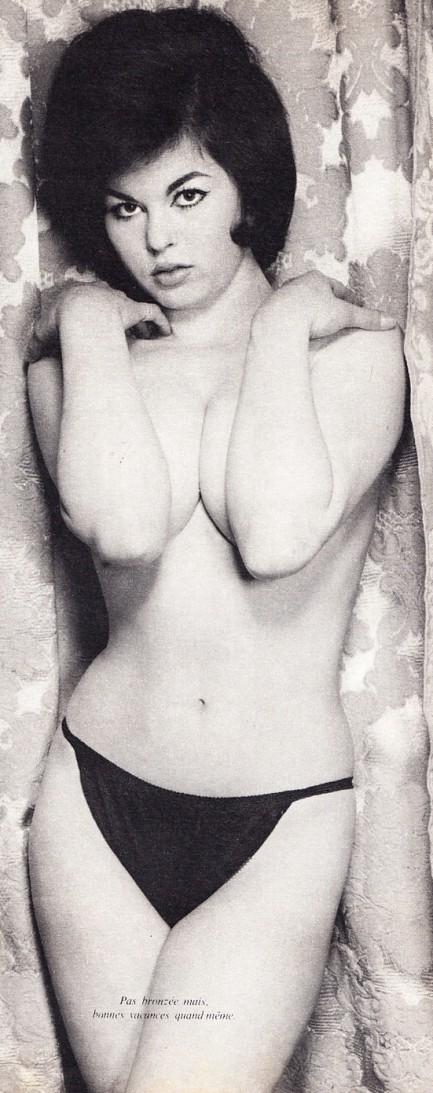
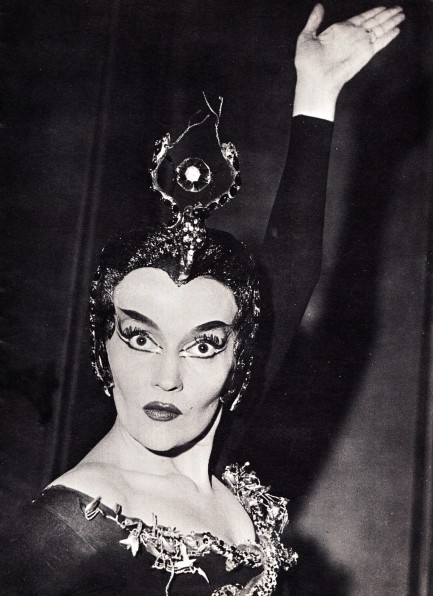
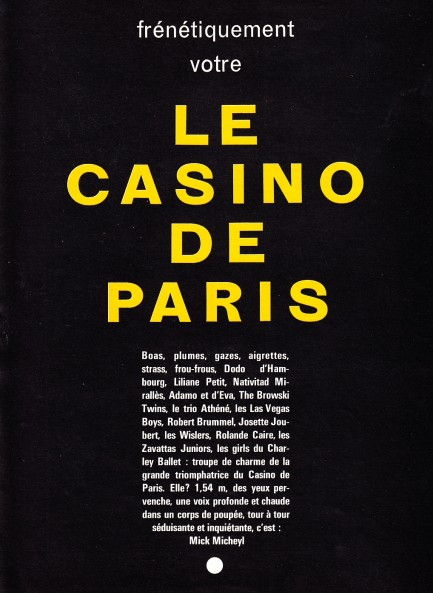
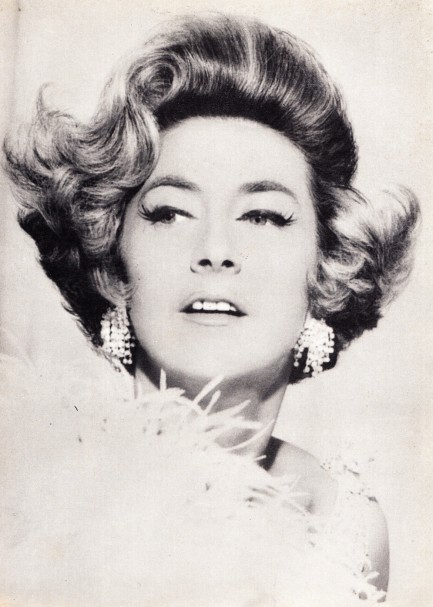
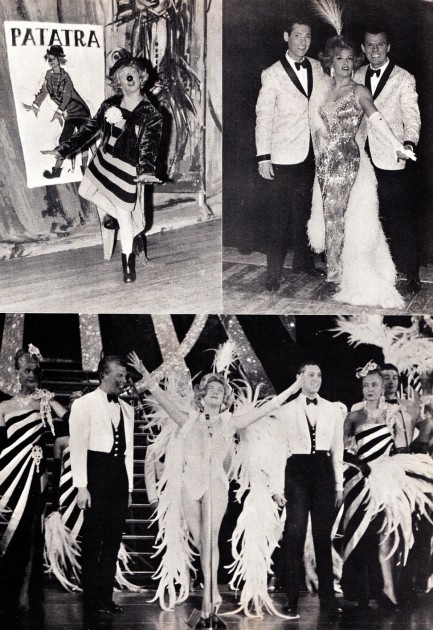
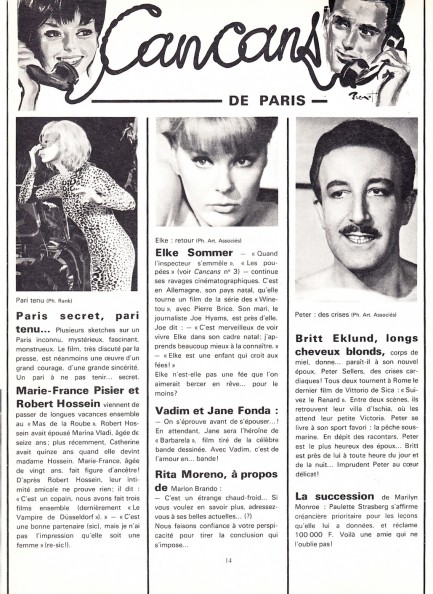
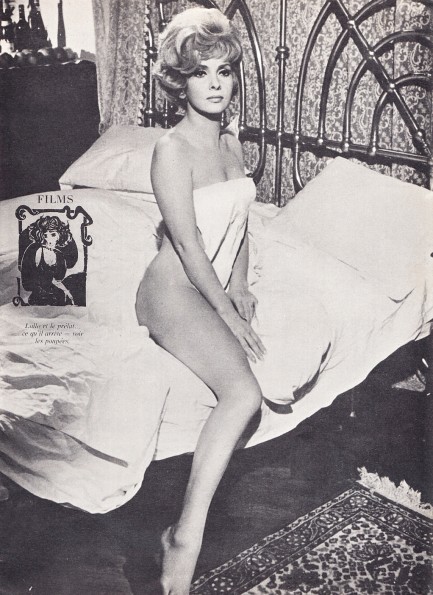
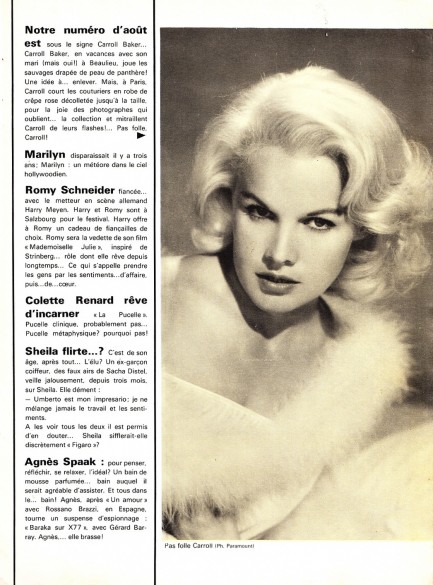
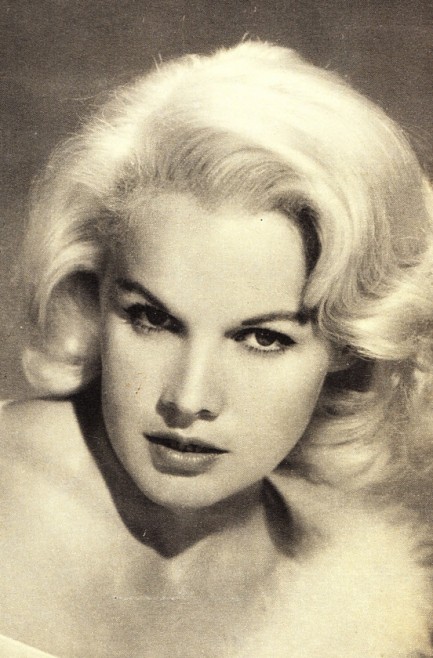
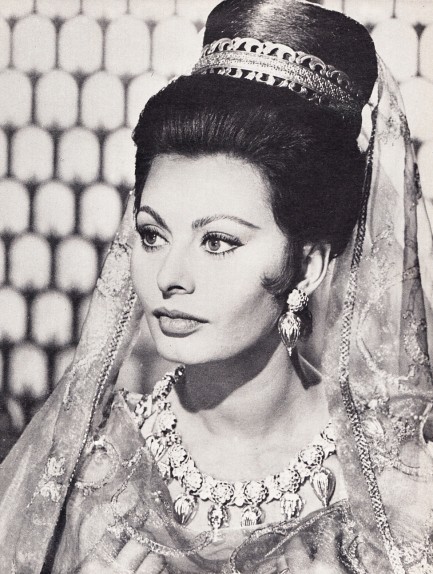
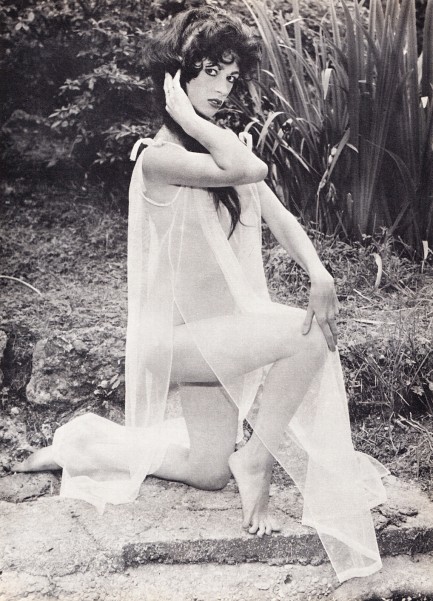
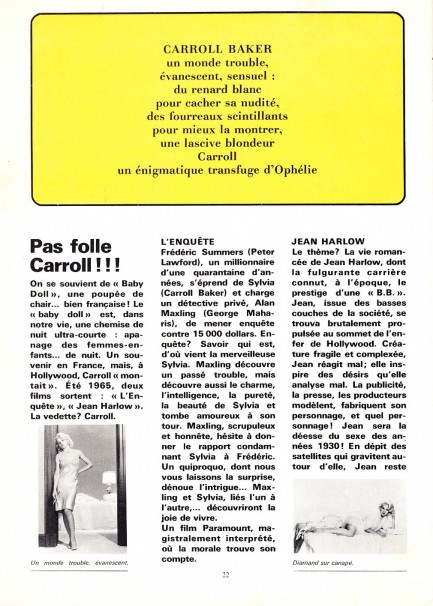
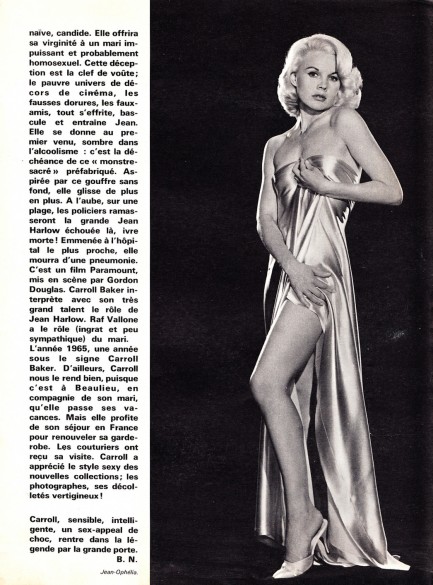
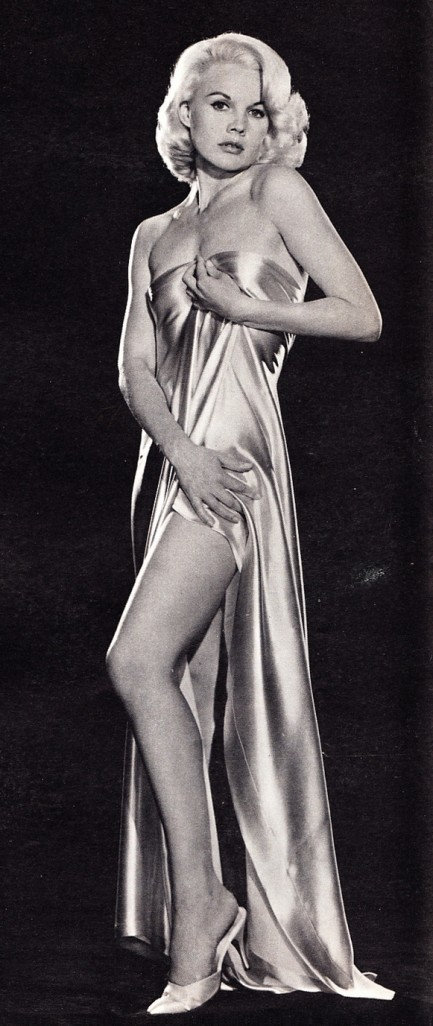
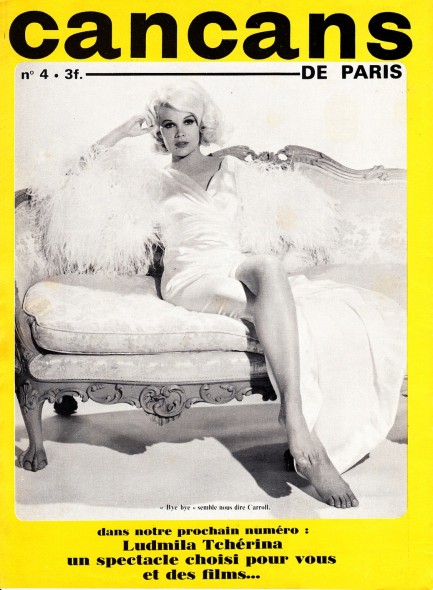
Above: a few pages from the French burlesque publication Cancans de Paris, the seventh time we've taken a look at this mag, with this example dating from September 1965. As always there are mainstream celebrities mixed in with the peelers, including Carroll Baker, Brigitte Bardot, Elke Sommer, Kim Novak, Sean Connery, Sophia Loren, Gina Lollobrigida, and French born ballerina Ludmilla Tchérina. At the top of panel two there's also a minor Raymond Brenot illustration. See some major ones here, and just click the Cancans keywords below if you want to see more issues.
FranceParisCancans de ParisCarroll BakerPeter SellersBrigitte BardotElke SommerKim NovakLudmilla TchérinaSean ConnerySophia LorenGina LollobrigidaRaymond BrenotCarolsburlesque

| Vintage Pulp | Jun 2 2022 |

Sinbad may be the star but it's the dancers who shine brightest.
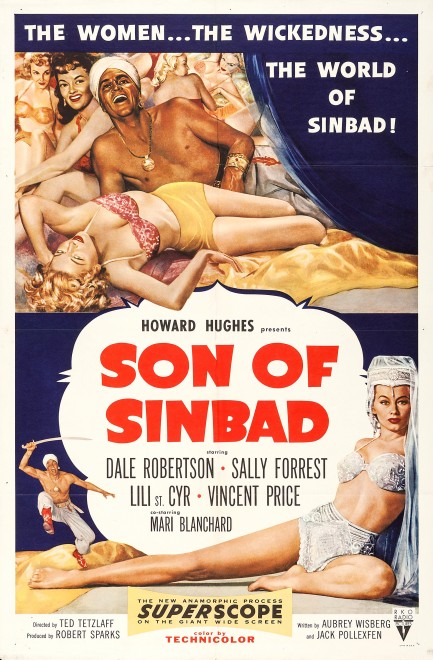
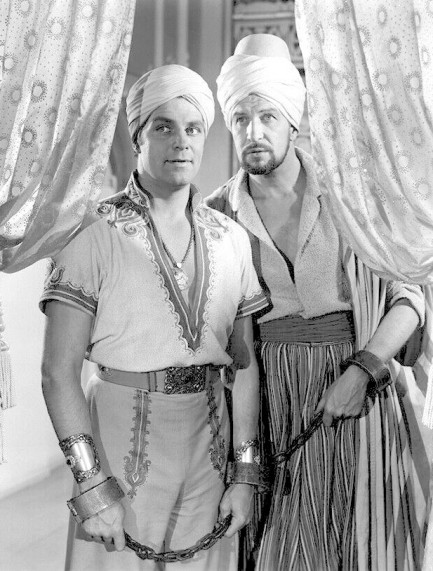
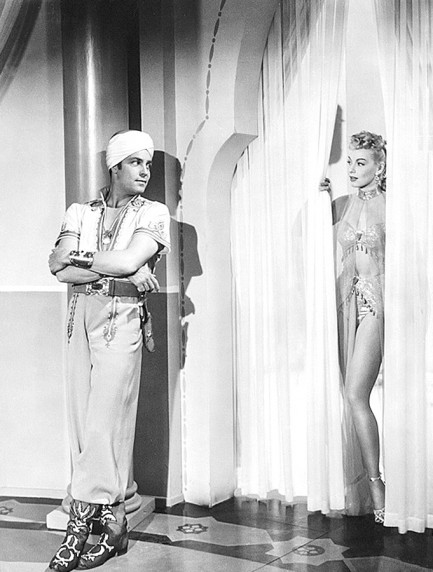
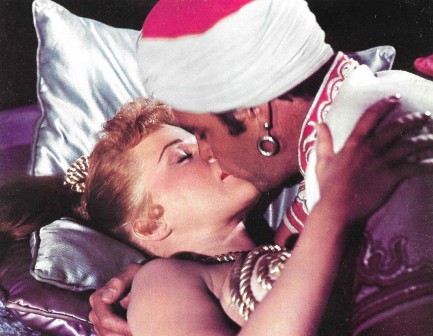
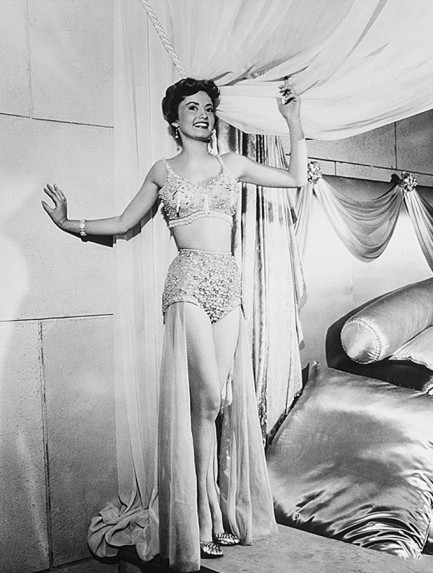
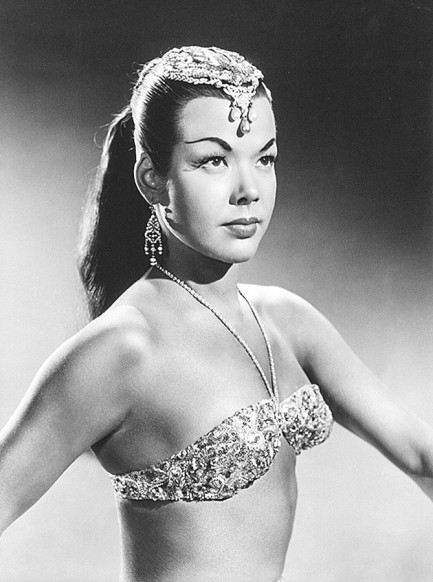
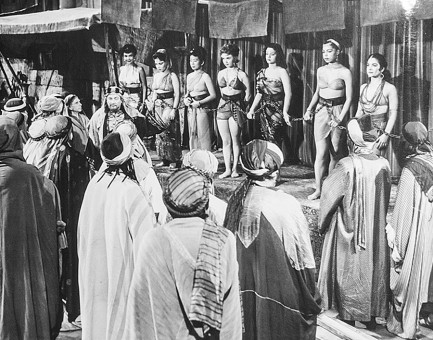
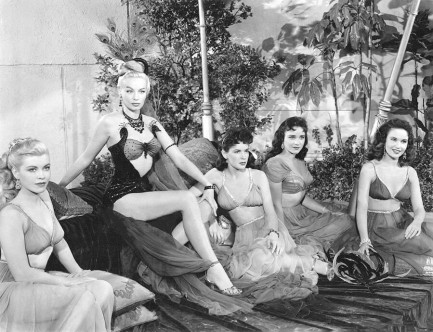
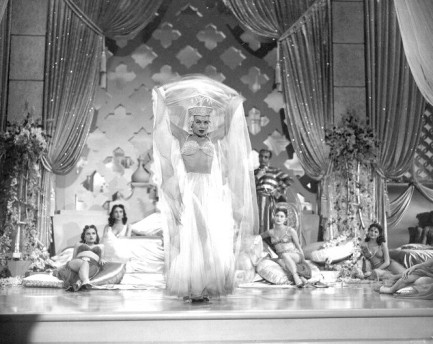
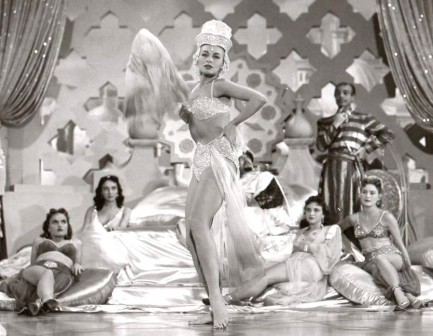
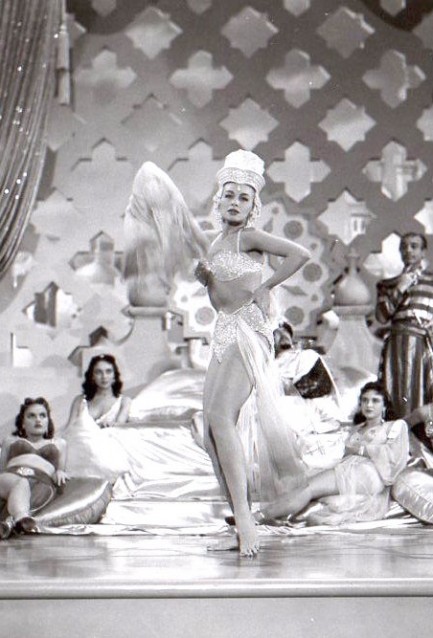
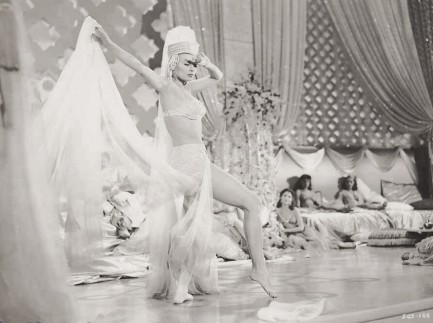
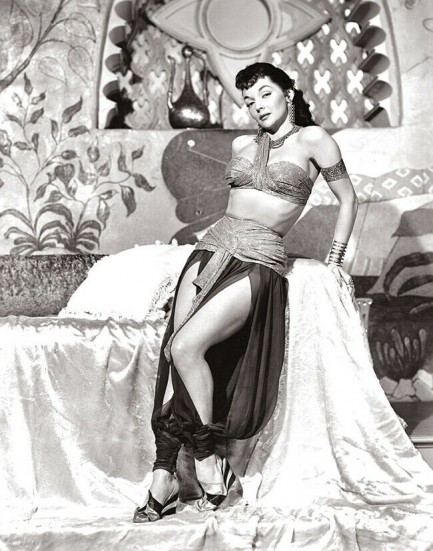
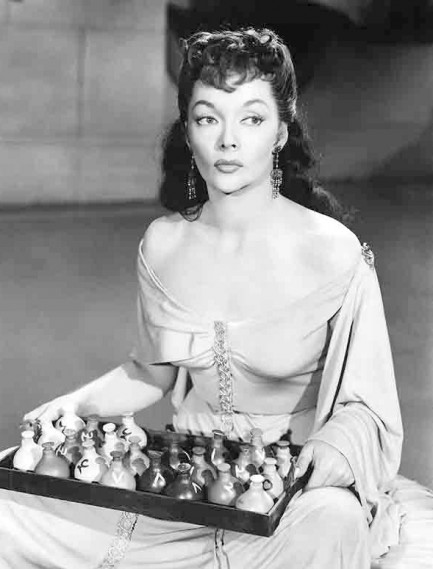
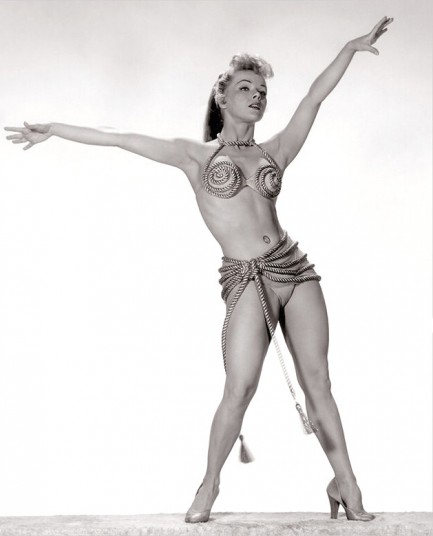
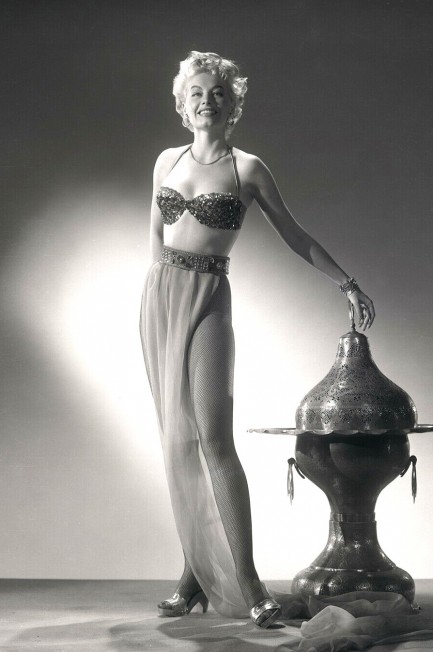
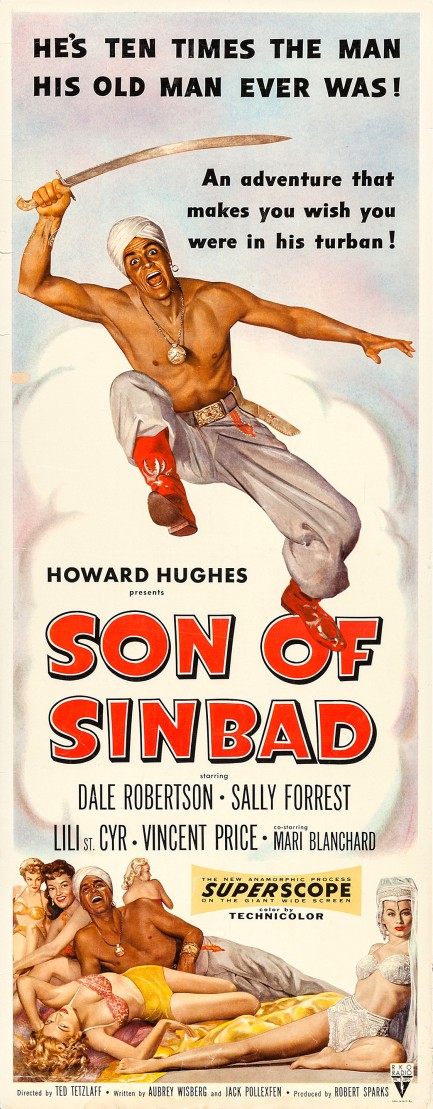
Howard Hughes had an entire slate of personal flaws, not least of which was that he was a frothing racist, but in terms of filmmaking he understood the concept of value-added cinema. He often battled censors, because if he had a beautiful actress on hand he'd build something around her that was as provocative as the market would bear. Jane Russell is his most famous protégée, but he shaped projects for Jean Harlow, Gina Lollobrigida, Faith Domergue, and others. In Son of Sinbad he wanted to show Lili St. Cyr to great advantage, and along the way, in typical fashion, added more, more, and more. He brought aboard MGM dancer-actress Sally Forrest and famed peelers Nejla Ates and Kalantan to compliment St. Cyr, made them all ornately clad harem girls, and ended up with a movie that was nearly banned.
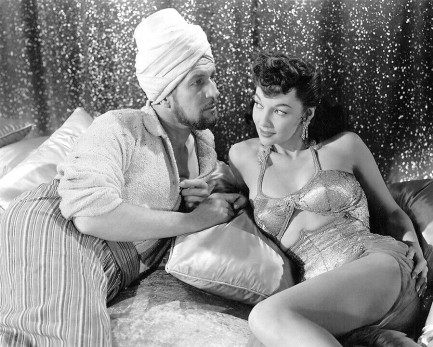
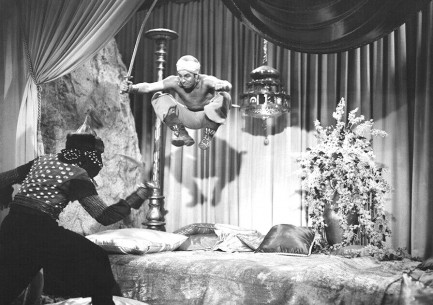
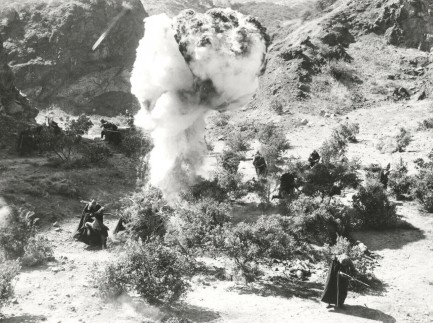
The stars of Son of Sinbad are Dale Robertson as the fictional Sinbad's son and Vincent Price as the historical figure Omar Khayyám, and in the story, which is set in Baghdad, horny Sinbad is busted making time with one of the Sultan's harem girls and is imprisoned along with Omar. In exchange for his freedom Sinbad reveals the existence of Greek fire, a dynamite-like explosive, which could come in handy because the Sultanate is at war with the Tatars. Sinbad doesn't actually have the secret to this weapon himself—it's locked inside the head of his friend Kristina, who can only reveal the process for making it while hypnotized. The Sultan is suitably impressed after a demonstration and agrees to free Sinbad and friends, but due to some palace spying third parties have learned about the weapon, and from that point forward more complications ensue.
While Son of Sinbad is a fantasy adventure with elements of comedy, audiences also knew to expect titillation from RKO Radio Pictures, and the movie leans into that expectation with its sexy costumed dance numbers. Any movie that offers St. Cyr in motion is automatically recommended, and you'll get a sense of why she was probably the most famous burlesque dancer in America, though neither she nor the other dancers remove much clothing. Even so, it's a nice showcase of the burlesque arts, and the dancing offers reason enough to watch the film, and would even if the movie were terrible.
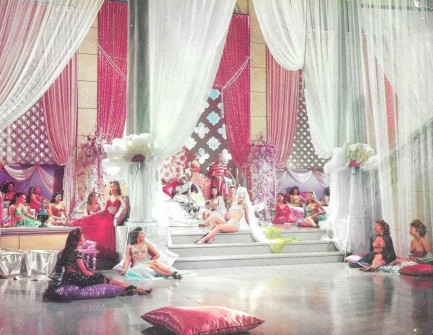
However, the bonus here is that the movie isn't terrible. The lavish sets, beautifully painted backdrops, and colorful costumes transport the viewer—not to ancient Baghdad, but to a magical, soundstage-bound, Technicolor realm similar to that from old Bible flicks. Robertson is fine as Sinbad Jr., but Price, as he tended to do, excels in his second banana role. The man was a born star, and a born ham. As long as you don't expect a masterpiece you'll be entertained. And as a point of added interest, Kim Novak makes a quick and uncredited appearance as a Tatar woman. It was her first screen role, but because the movie was delayed—like many Hughes projects—it was not the first time audiences had seen her. Son of Sinbad did eventually hit cinemas, though, premiering after more than a year of delays, today in 1955.
IranBaghdadRKO Radio PicturesSon of SinbadDale RobertsonMari BlanchardSally ForrestLili St. CyrVincent PriceNejla AtesHoward HughesKalantanKim Novakposter artcinemamovie review

| Hollywoodland | May 22 2021 |

It's shocking how many Hollywood stars did smack.
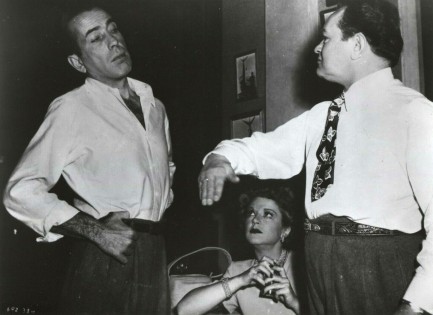
Everybody wants to slap somebody sometime. Luckily, actors in movies do it so you don't have to. The above shot is a good example. Edward G. Robinson lets Humphrey Bogart have it in 1948's Key Largo, as Claire Trevor looks on. In vintage cinema, people were constantly slapping. Men slapped men, men slapped women, women slapped women, and women slapped men. The recipient was usually the protagonist because—though some readers may not realize this—even during the ’40s and 50s, slapping was considered uncouth at a minimum, and downright villainous at worst, particularly when men did it. So generally, bad guys did the slapping, with some exceptions. Glenn Ford slaps Rita Hayworth in Gilda, for example, out of humiliation. Still wrong, but he wasn't the film's villain is our point. Humphrey Bogart lightly slaps Martha Vickers in The Big Sleep to bring her out of a drug stupor. He's like a doctor. Sort of.
In any case, most cinematic slapping is fake, and when it wasn't it was done with the consent of the participants (No, really slap me! It'll look more realistic.). There are some famous examples of chipped teeth and bloody noses deriving from the pursuit of realism. We can envision a museum exhibit of photos like these, followed by a lot of conversation around film, social mores, masculinity, and their intersection. We can also envison a conversation around the difference between fantasy and reality. There are some who believe portryals of bad things endorse the same. But movies succeed largely by thrilling, shocking, and scaring audiences, which requires portraying thrilling, shocking, and frightening moments. If actors can't do that, then ultimately movies must become as banal as everyday llife. Enjoy the slapfest.
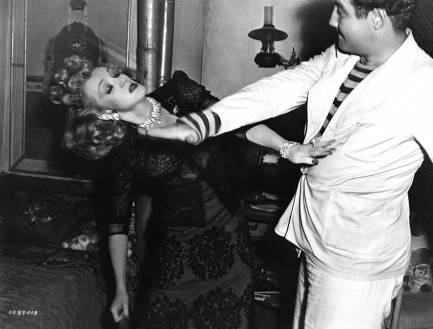 Broderick Crawford slaps Marlene Dietrich in the 1940's Seven Sinners.
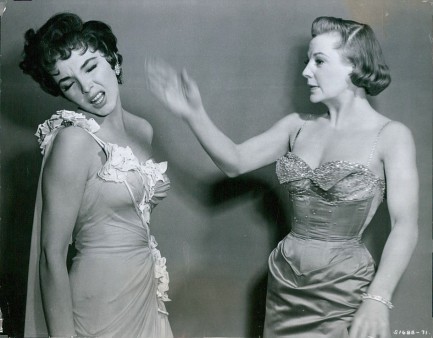 June Allyson lets Joan Collins have it across the kisser in a promo image for The Opposite Sex, 1956.
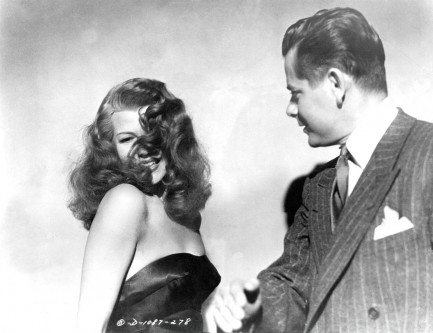 Speaking of Gilda, here's one of Glenn Ford and Rita Hayworth re-enacting the slap heard round the world. Hayworth gets to slap Ford too, and according to some accounts she loosened two of his teeth. We don't know if that's true, but if you watch the sequence it is indeed quite a blow. 100% real. We looked for a photo of it but had no luck.
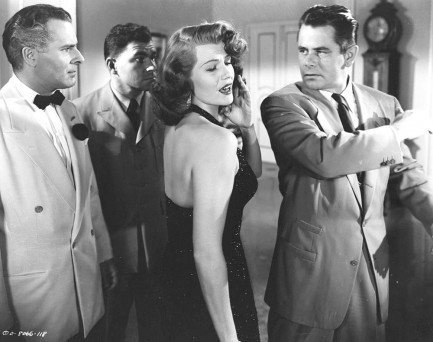 Don't mess with box office success. Ford and Hayworth did it again in 1952's Affair in Trinidad.
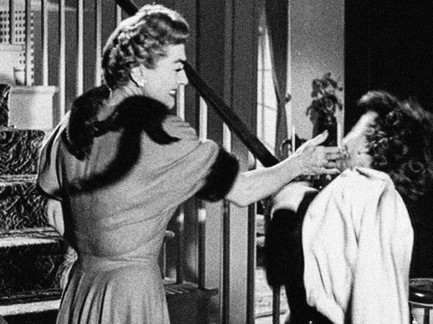 All-time film diva Joan Crawford gets in a good shot on Lucy Marlow in 1955's Queen Bee.
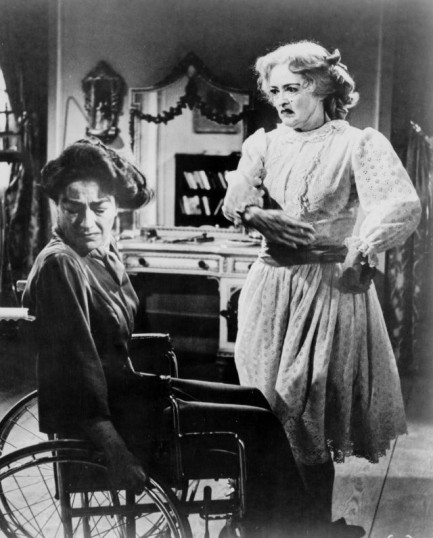 The answer to the forthcoming question is: She turned into a human monster, that's what. Joan Crawford is now on the receiving end, with Bette Davis issuing the slap in Whatever Happened to Baby Jane? Later Davis kicks Crawford, so the slap is just a warm-up.
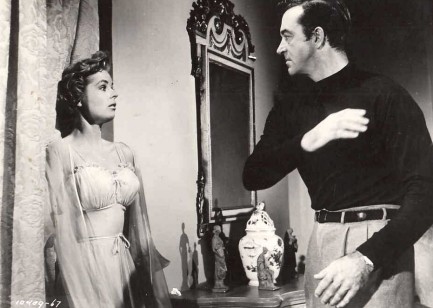 Mary Murphy awaits the inevitable from John Payne in 1955's Hell's Island.
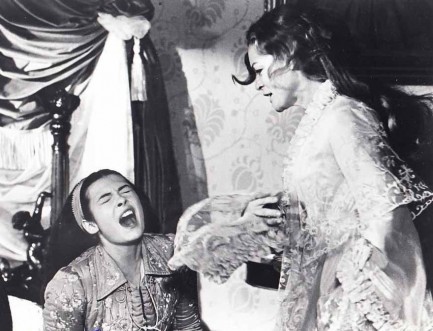 Romy Schneider slaps Sonia Petrova in 1972's Ludwig.
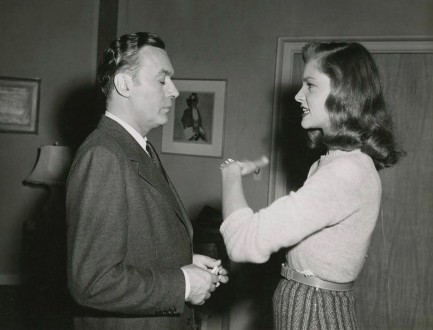 Lauren Bacall lays into Charles Boyer in 1945's Confidential Agent and garnishes the slap with a brilliant snarl.
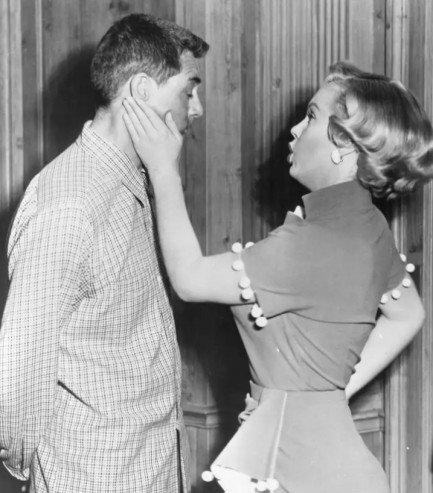 Iconic bombshell Marilyn Monroe drops a smart bomb on Cary Grant in the 1952 comedy Monkey Business.
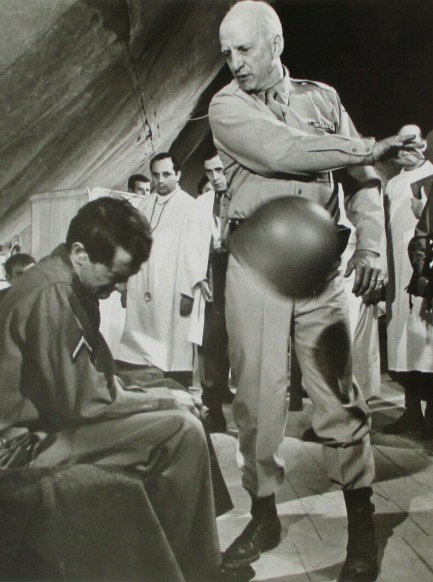 This is the most brutal slap of the bunch, we think, from 1969's Patton, as George C. Scott de-helmets an unfortunate soldier played by Tim Considine.
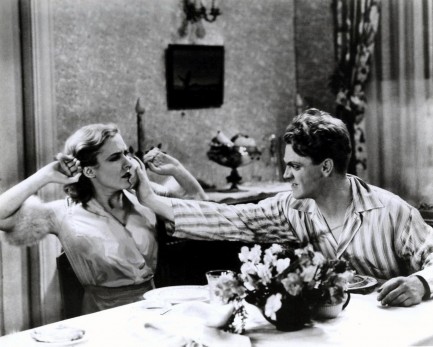 A legendary scene in filmdom is when James Cagney shoves a grapefruit in Mae Clark's face in The Public Enemy. Is it a slap? He does it pretty damn hard, so we think it's close enough. They re-enact that moment here in a promo photo made in 1931.
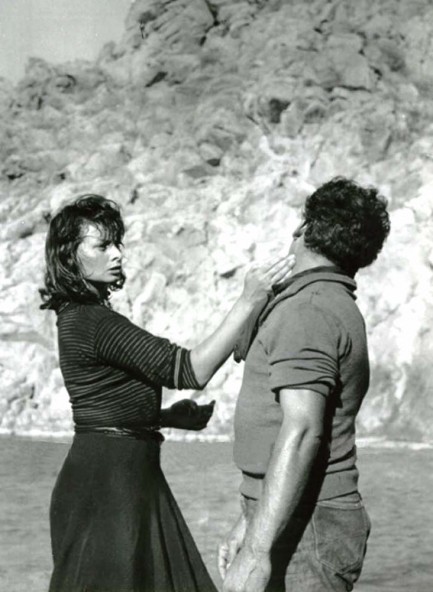 Sophia Loren gives Jorge Mistral a scenic seaside slap in 1957's Boy on a Dolphin.
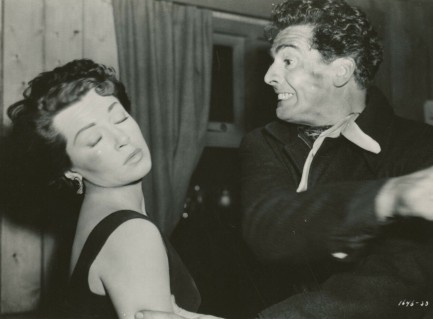 Victor Mature fails to live up to his last name as he slaps Lana Turner in 1954's Betrayed.
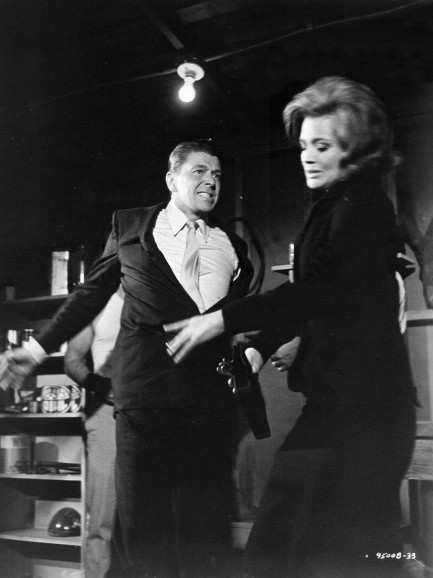 Ronald Reagan teaches Angie Dickinson how supply side economics work in 1964's The Killers.
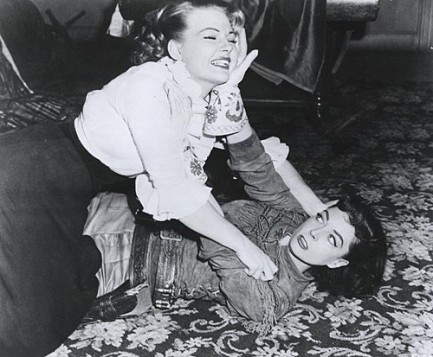 Marie Windsor gets in one against Mary Castle from the guard position in an episode of television's Stories of the Century in 1954. Windsor eventually won this bout with a rear naked choke.
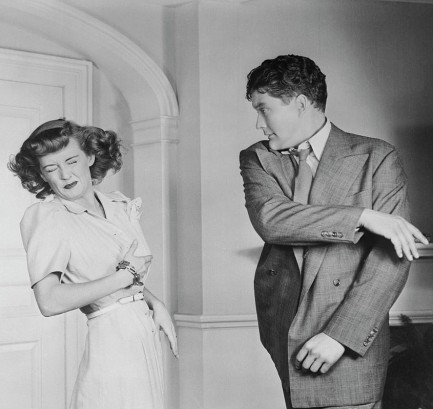 It's better to give than receive, but sadly it's Bette Davis's turn, as she takes one from Dennis Morgan in In This Our Life, 1942.
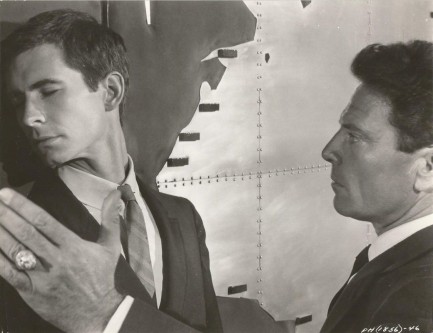 Anthony Perkins and Raf Vallone dance the dance in 1962's Phaedra, with Vallone taking the lead.
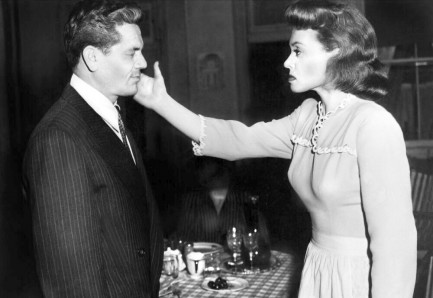 And he thought being inside the ring was hard. Lilli Palmer nails John Garfield with a roundhouse right in the 1947 boxing classic Body and Soul.
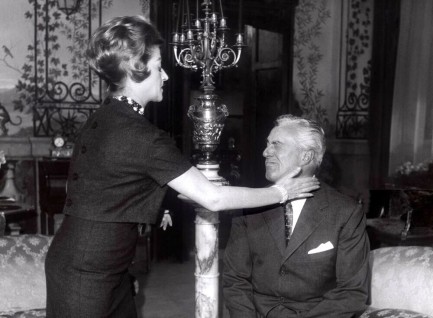 1960's Il vigile, aka The Mayor, sees Vittorio De Sica rebuked by a member of the electorate Lia Zoppelli. She's more than a voter in this—she's also his wife, so you can be sure he deserved it.
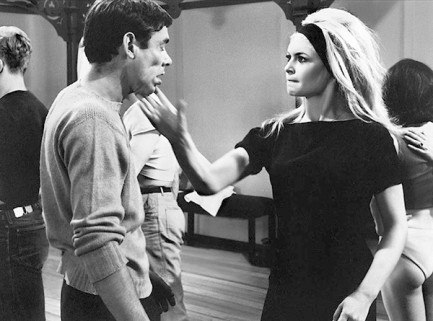 Brigitte Bardot delivers a not-so-private slap to Dirk Sanders in 1962's Vie privée, aka A Very Private Affair.
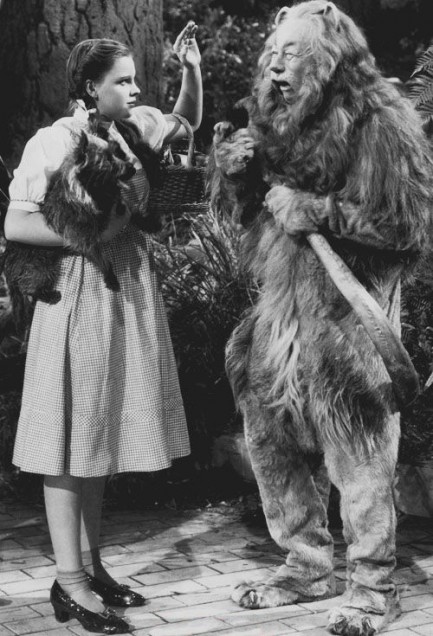 In a classic case of animal abuse. Judy Garland gives cowardly lion Bert Lahr a slap on the nose in The Wizard of Oz. Is it his fault he's a pussy? Accept him as he is, Judy.
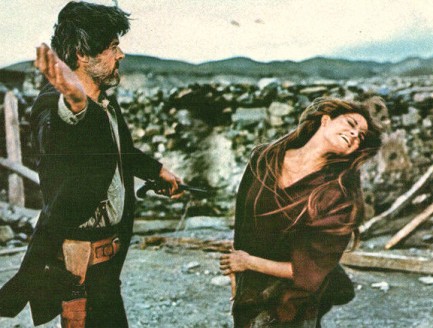 Robert Culp backhands Raquel Welch in 1971's Hannie Caudler.
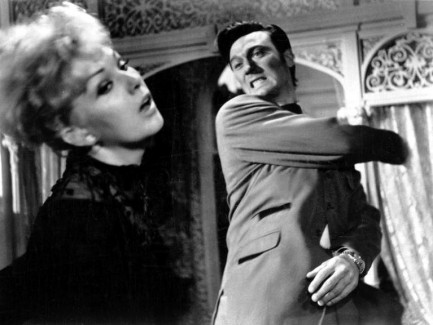 And finally, Laurence Harvey dares to lay hands on the perfect Kim Novak in Of Human Bondage.
 Key LargoSeven SinnersThe Opposite SexGildaThe KillersWhatever Happened to Baby Jane?LudwigConfidential AgentPattonThe Public EnemyBoy on a DolphinOf Human BondageQueen BeeBetrayedStories of the CenturyIn This Our LifePhaedraBody and SoulIl vigileThe MayorThe Wizard of OzHannie CaulderVie privéeA Very Private AffairEdward G. RobinsonHumphrey BogartClaire TrevorMarlene DietrichBroderick CrawfordJune AllysonJoan CollinsGlenn FordRita HayworthBette FordJoan CrawfordMary MurphyJohn PayneRomy SchneiderSonia PetrovaLauren BacallCharles BoyerMarilyn MonroeCary GrantGeorge C. ScottTim ConsidineJames CagneyMae ClarkeSophia LorenJorge MistralJoan CrawfordLucy MarlowVictor MatureLana TurnerMarie WindsorMary CastleDennis MorganRaf ValloneAnthony PerkinsLilli PalmerJohn GarfieldLia ZoppelliKim NovakLaurence HarveyVittorio De SicaDirk SandersBrigitte BardotJudy GarlandBert LahrRaquel WelchRobert CulpRonald ReaganAngie Dickinson

| Hollywoodland | Mar 25 2021 |

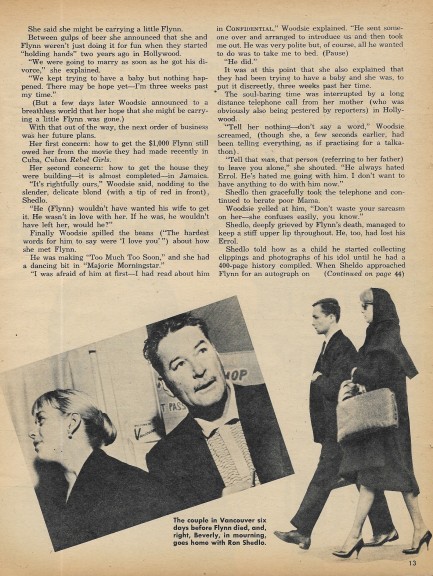
Want to keep a secret? Don't try it in Hollywood.
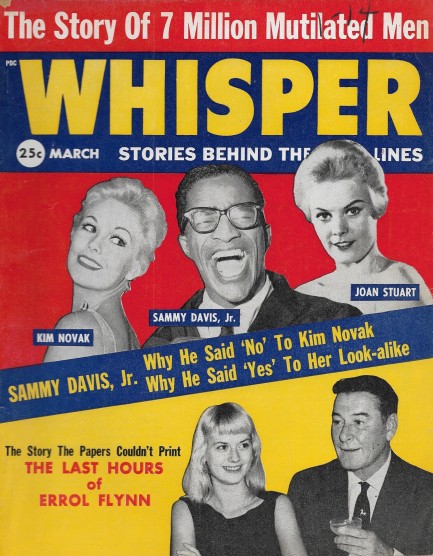
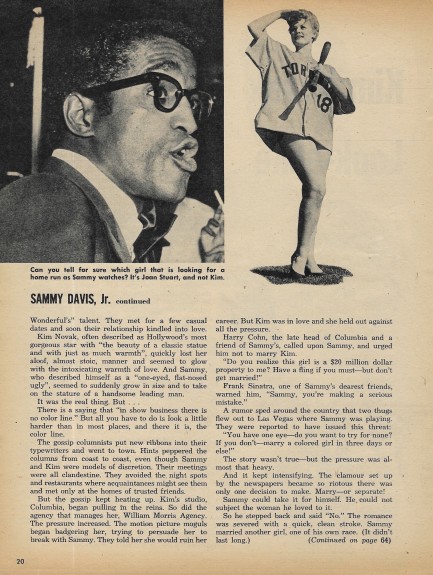
We wonder if any modern celebrity romances will be talked about half a century from now the way the old romances were. The way the Taylor/Burtons and Monroe/DiMaggios were talked about. We doubt it. Mid-century Hollywood and public romance seemed go hand in hand, and near the top of the legendary romance pyramid perches Sammy Davis, Jr.'s and Kim Novak's doomed love. Why doomed? Not to put too fine a point on it, but a 1958 Gallup poll showed that a mere 4% of Americans approved of interracial marriage. Four percent! There has never been a scientific study that showed anything other than deeply entrenched racial inequality and animosity in the U.S., and that includes today. But four percent? That's the dark ages.
We've marveled over Kim Novak before, but in case you need a visual reminder look here. Yeah. So Sammy was smitten, and so was all of America. And Novak? She saw in Sammy... charisma maybe? It wasn't devastating looks. Even Davis spoke of himself disparagingly in terms of physical appeal. But he had it. Everyone said so. His it and Novak's it were magnetically attracted and led to a relationship they tried and failed to keep relatively quiet. It's here, though, where we must note that the many Hollywood insiders who say Davis and Novak were knocking boots don't include Novak. She claims they were never more than friends. But when two megastars continually show up—however discreetly—in public together, people will talk. More importantly, tabloids will talk. And perhaps most concerning of all, Whisper will talk.
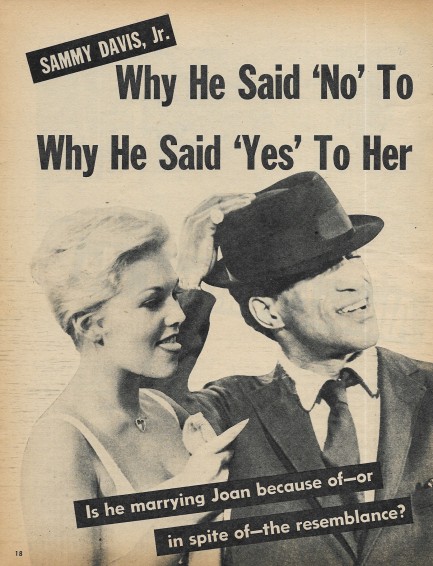
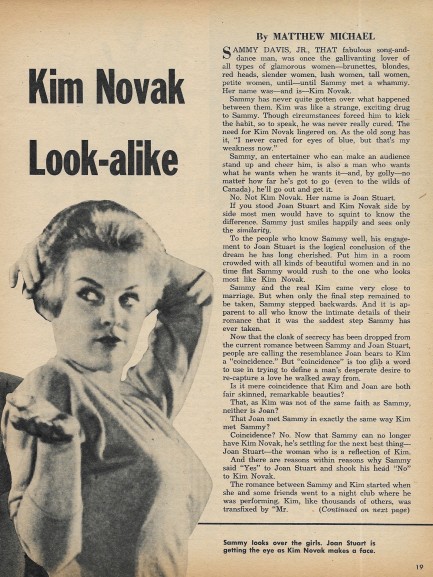
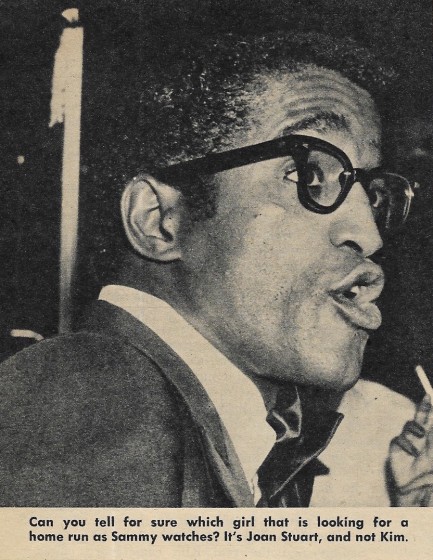
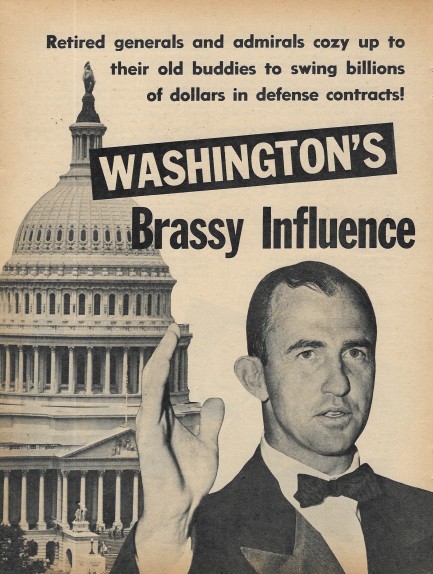
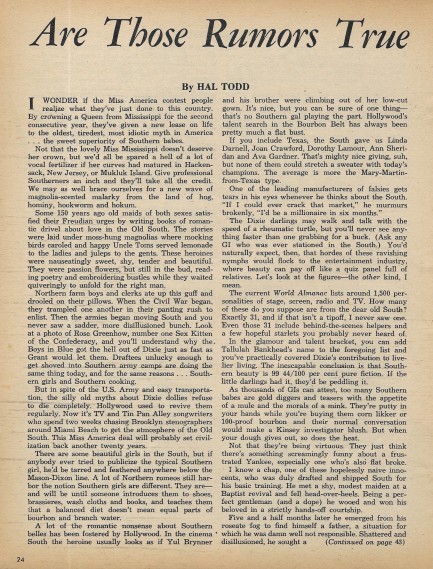
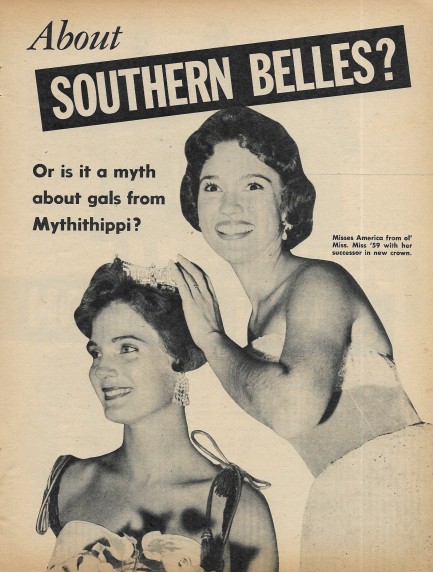
The above issue published this month in 1960 purports to have new info about the maybe-affair that shook Hollywood to its foundations, and also claims to have the scoop on Sammy's post-Kim fling Joan Stuart. We've seen many stories about his Swedish wife Mai Britt—also called a Kim copy by tabloids—but this is the first we've seen about Stuart. She wasn't Davis's first post-Novak partner. He married actress Loray White in 1958, but divorced her in 1960. Rumor is he married her under duress, having been told by certain Mafia figures to marry a black woman or else lose another eye. Whisper says that story isn't true.
Stuart was a Canadian actress, just starting out in show business. Whisper gets quotes from her parents about their daughter's relationship with Davis, and they aren't supportive. Shocking as that may be. The magazine's final take is this: “Boy meets girl. Boy gets girl. Boy loses girl. Boy meets another girl just like the girl he had before. Boy gets girl. And boy seems to be going to keep girl.” Davis did want to keep her, telling friends and reporters he wanted to marry her, but their pairing didn't last. Stuart went on to appear in some television shows and one movie—1978's In Praise of Older Women—but did not have a notable career. Did romance with Sammy Davis, Jr. hurt her? You'd have to think so—with about 96% of the public. We have some scans below, and more from Whisper to come.
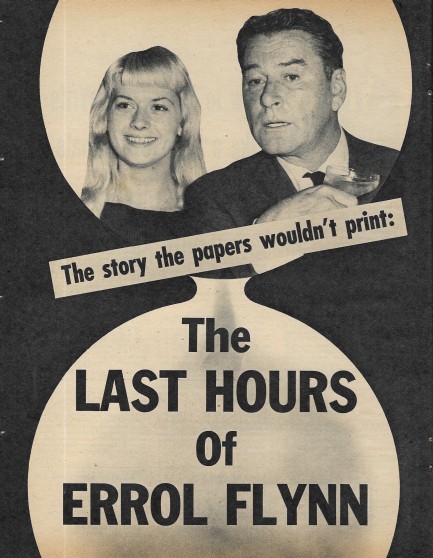
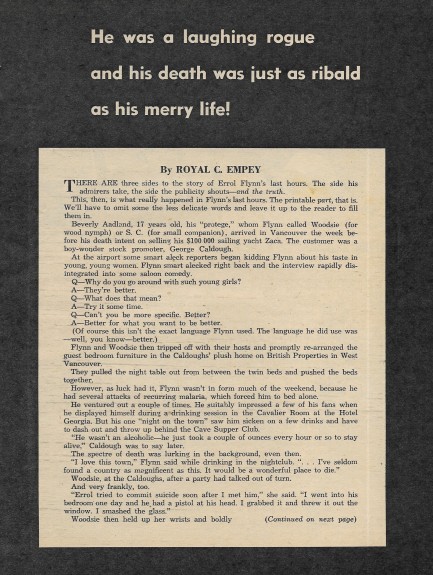
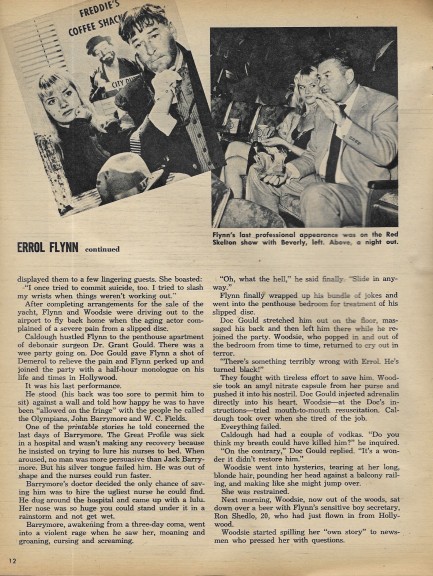
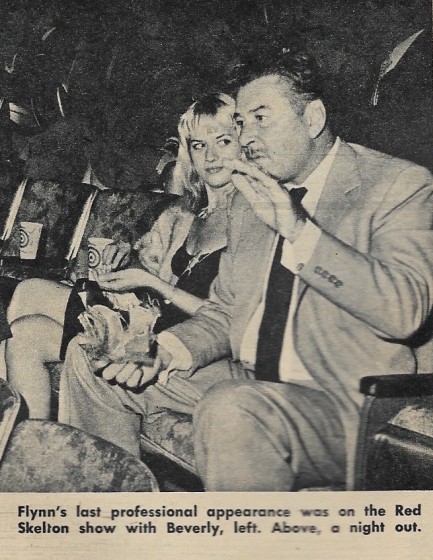

WhisperIn Praise of Older WomenSammy David Jr.Kim NovakJoan StuartLoray WhiteErrol FlynnBeverly AadlandMay Britttabloid

| Vintage Pulp | May 8 2019 |

Spanish art for Casa número 322 may have traveled far from home.
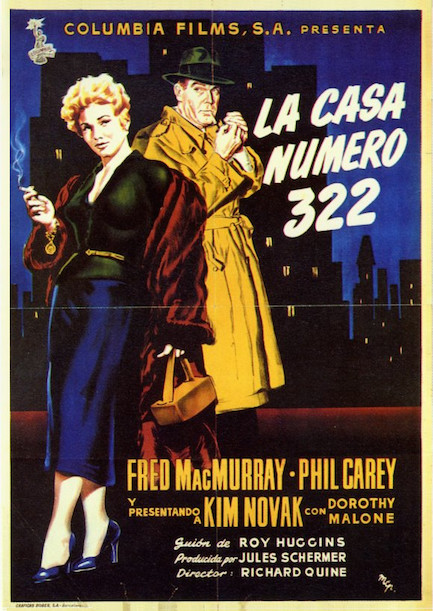
We already showed you a beautiful yellow French promo poster for 1954's Pushover, starring Fred MacMurray and Kim Novak. Above is a cool blue Spanish language promo. This piece is signed MCP, which is the imprimatur used by the Spanish artists Ramon Marti, Josep Clave, and Hernan Pico. So is this a Spanish poster? Well, most online sites say so. But the distributor for Mexico is listed as Columbia Films S.A., and you can see that graphic right on top of the poster. The S.A., by the way, stands for “sociedad anónima,” and is a corporate designation, kind of like Inc., or LLC. The movie's distribution company for Spain is on record as plain old Columbia Films, with no S.A., so we think this poster was used in Mexico, where the movie played as La casa número 322, “house number 322.” There's no exact Mexican release date known for it, but late 1955 is a safe bet. All that said, there's no way we can claim to be correct with 100% surety that this is a Mexican poster. We're extrapolating.
Columbia had distribution branches in various Latin American countries. Its Mexican hub was the most important because Mexico had the most developed Spanish film market in the world. Yes, more than Spain, which was still recovering from civil war. Though dubbed or subtitled versions of foreign movies were routinely shown in Mexico, locally produced flicks were about 20% more popular at the box office on average, according to a 1947 report circulated by the U.S. Consulate in Monterrey. In fact, Mexican films were the most popular in all Latin America, particularly Cuba. Even in Mexico City, where U.S. and European films were more popular than anywhere else in the country, Mexican films took up more than 40% of exhibition time—again as reported by the U.S. Consulate. Why was the consulate studying this? Just wait.
The Mexican movie market isn't as competitive today. The decline was due to three main factors: political pressure that forced Mexico to submit to so-called free trade in mass media, suspicious difficulties obtaining raw film stock from the U.S. for movie productions, and, of course, dirty business tactics by Stateside studios. So that's where the consulate came in—gathering intelligence for both the U.S. government and U.S. business interests. Armed with alarming data about local preferences for local product, U.S. studios forced Mexican exhibitors into “block booking” agreements, which meant that if cinemas wanted to exhibit the best Hollywood films they were also contractually obligated to take on the worst. This was repeated all over Latin America, and those bad films, which were more numerous than the good ones, ate up exhibition hours and kept Mexican films off screens. Pushover, at least, was one of Hollywood's better films.
The Mexican movie market isn't as competitive today. The decline was due to three main factors: political pressure that forced Mexico to submit to so-called free trade in mass media, suspicious difficulties obtaining raw film stock from the U.S. for movie productions, and, of course, dirty business tactics by Stateside studios. So that's where the consulate came in—gathering intelligence for both the U.S. government and U.S. business interests. Armed with alarming data about local preferences for local product, U.S. studios forced Mexican exhibitors into “block booking” agreements, which meant that if cinemas wanted to exhibit the best Hollywood films they were also contractually obligated to take on the worst. This was repeated all over Latin America, and those bad films, which were more numerous than the good ones, ate up exhibition hours and kept Mexican films off screens. Pushover, at least, was one of Hollywood's better films.
MexicoCubaSpainMonterreyMexico CityColumbia PicturesColumbia Film S.A.Estudio MCPLa casa número 322PushoverFred MacMurrayKim NovakRamon MartiJosep ClaveHernan Picoposter artcinemafilm noir

| Vintage Pulp | Feb 11 2019 |

Mortal man finds himself at the whims of a goddess in 1954's Pushover.
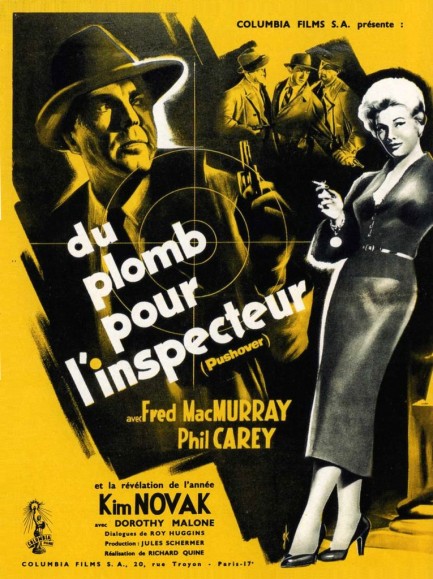
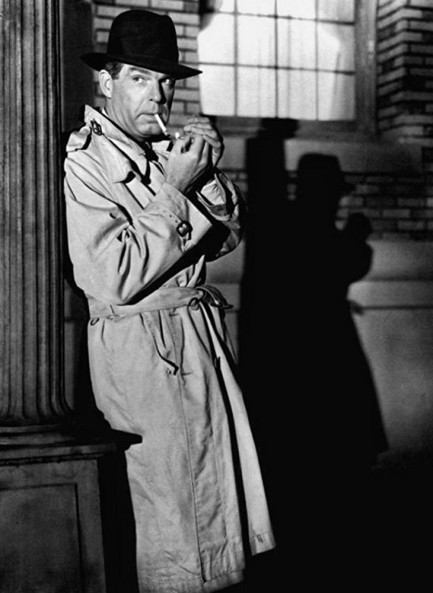
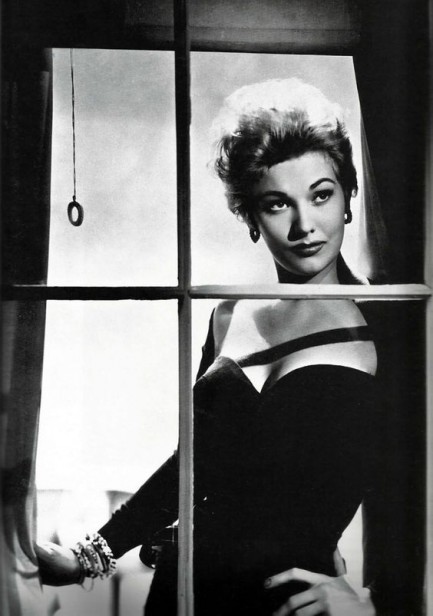
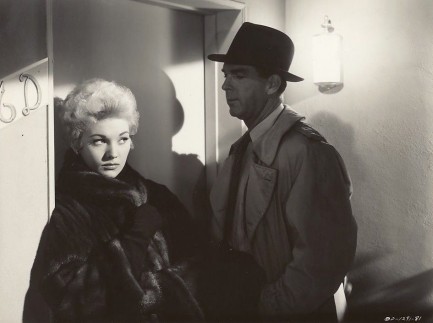
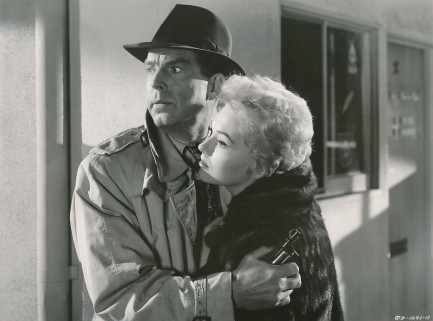
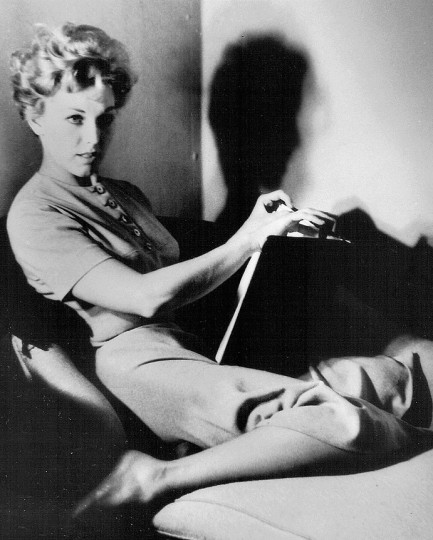
We love this bold yellow poster for Du plomb pour l'inspecteur, which was originally made in the U.S. and known as Pushover. Most important item to note here is that this is Kim Novak's first credited role, when she was aged twenty-one and looked freshly delivered to Earth on a sunbeam. Fred MacMurray plays a cop assigned to get close to her in order to snare her gangster boyfriend. MacMurray is only mortal, unlike Novak, so he immediately falls in love with her and begins seeing her outside his official duties. Not long after that he's plotting to steal her man's cache of $210,000 in bank loot. That would be about two million dollars in today's money, which is no insignificant amount. Any man would compromise his principles for that, but he'd do so even more readily for a chance to nuzzle Novak. There are a lot of old movies out there that hinge on lust as a motivating factor, but in this one it really makes sense. Performance-wise Novak can't act well yet, but like MacMurray, you'll overlook her flaws. After opening in the U.S. in 1954 Pushover premiered in France today in 1955.
FrancePushoverDu plomb pour l'inspecteurFred MacMurrayKim NovakPhilip CareyDorothy Maloneposter artcinemamovie reviewfilm noir

| Hollywoodland | Sep 8 2018 |

The Lowdown has the scoop on a fantastic plastic.
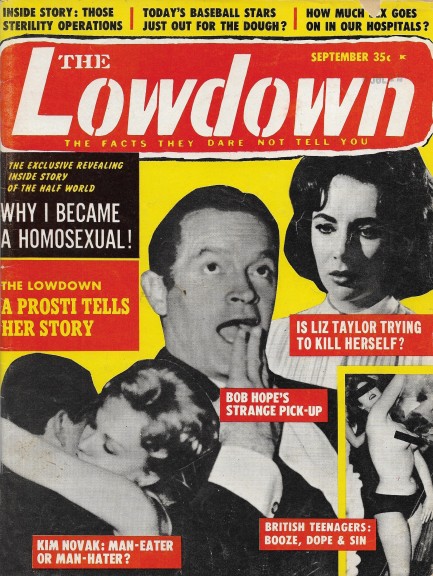
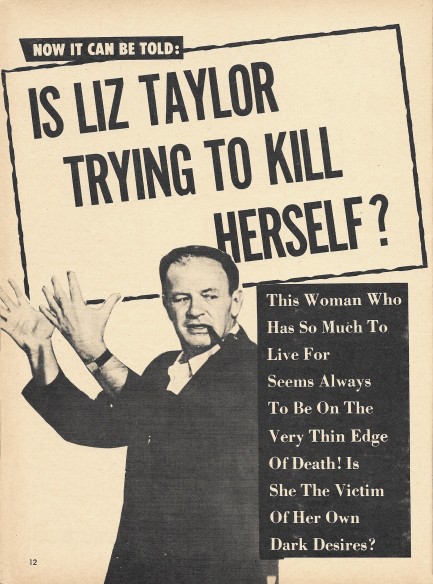
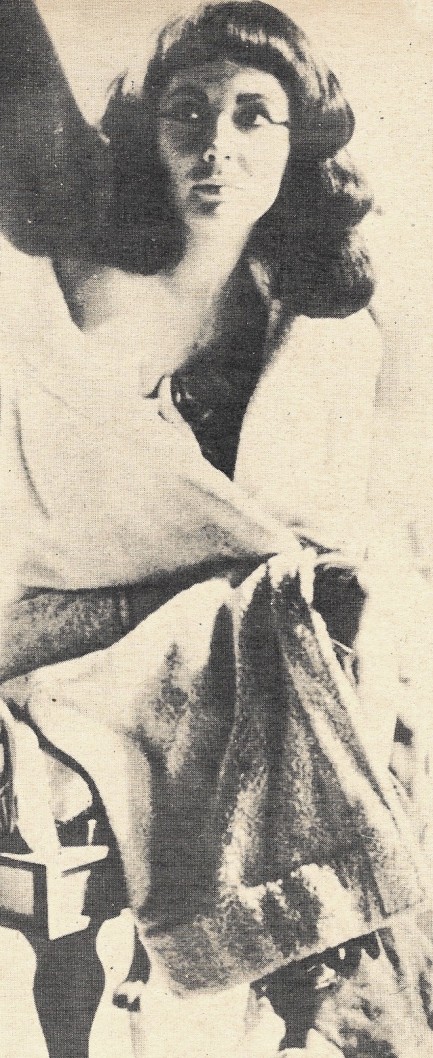
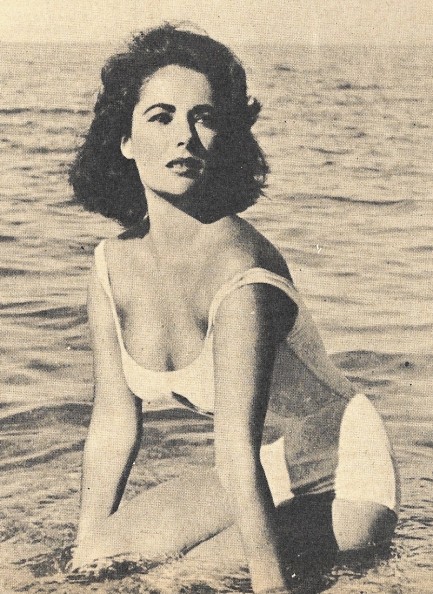
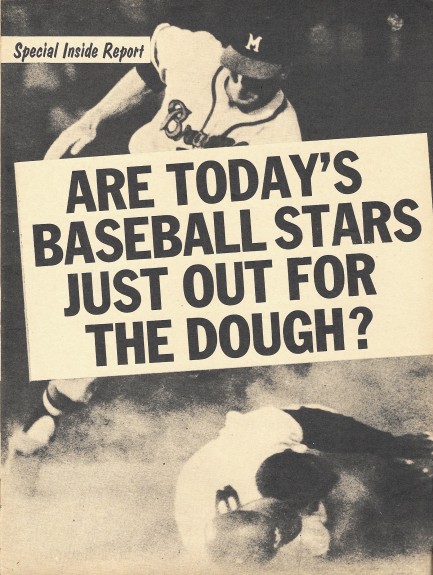
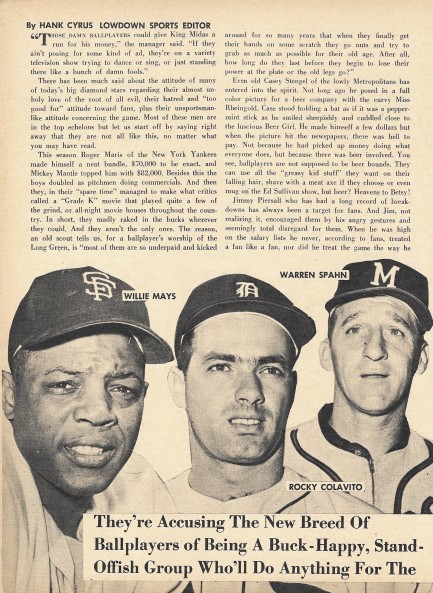
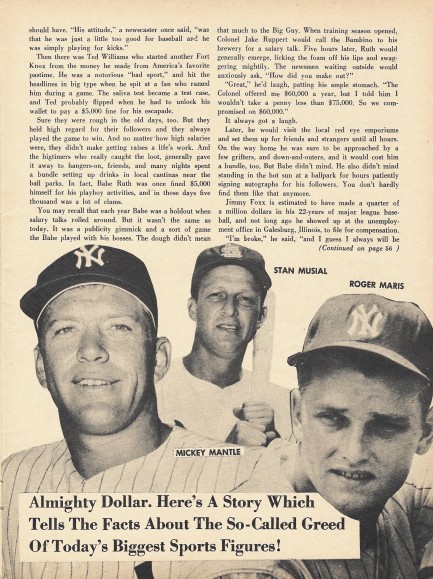
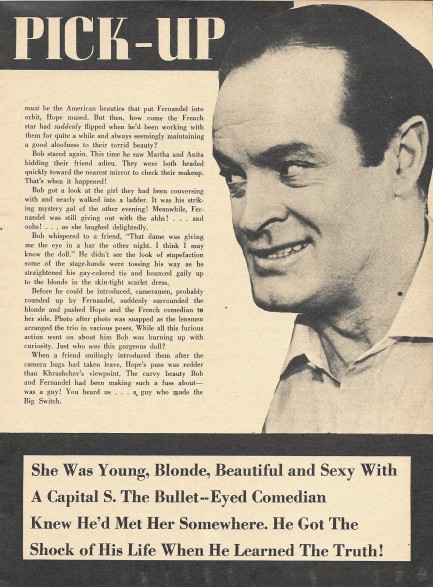
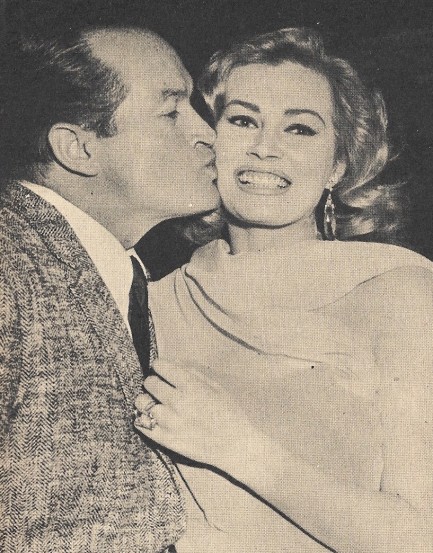
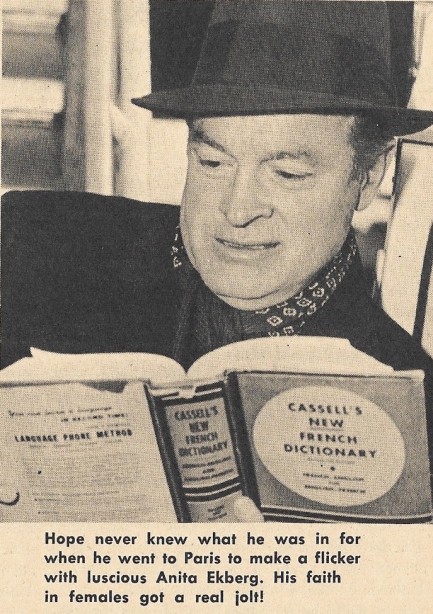
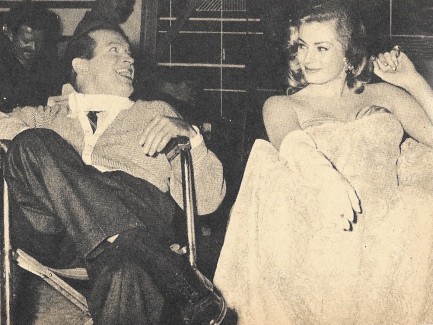
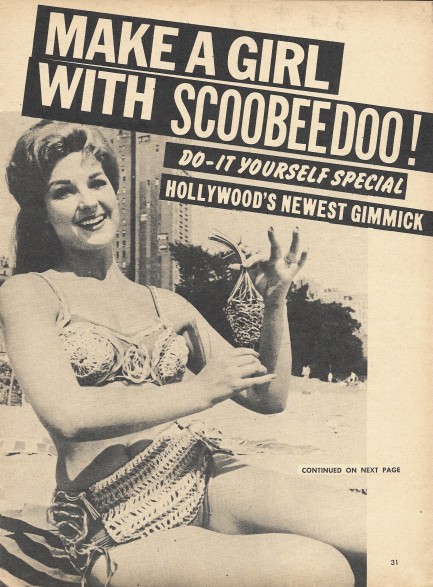
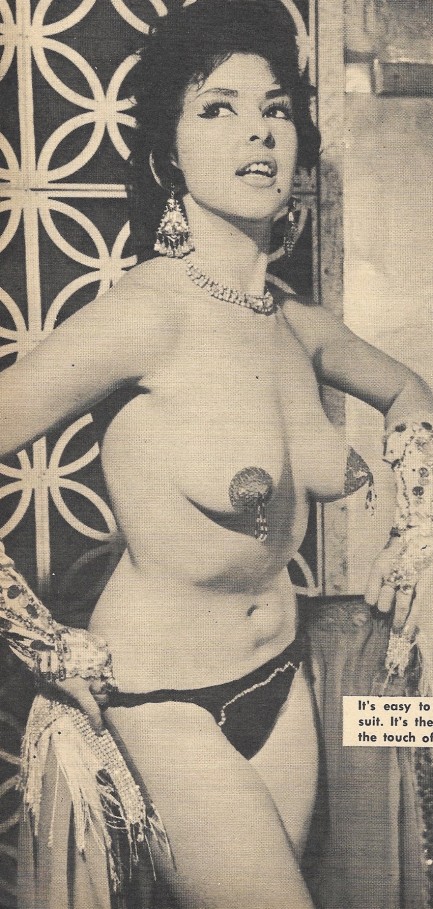
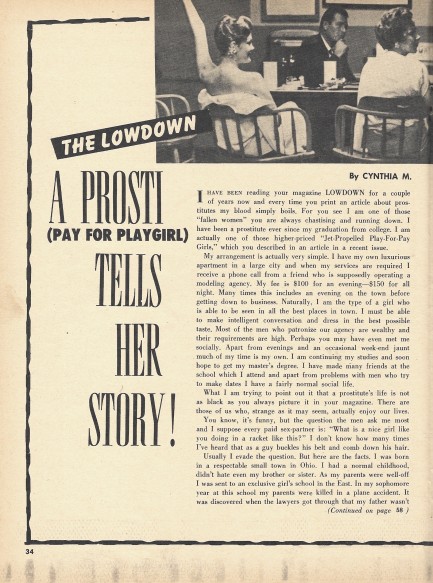
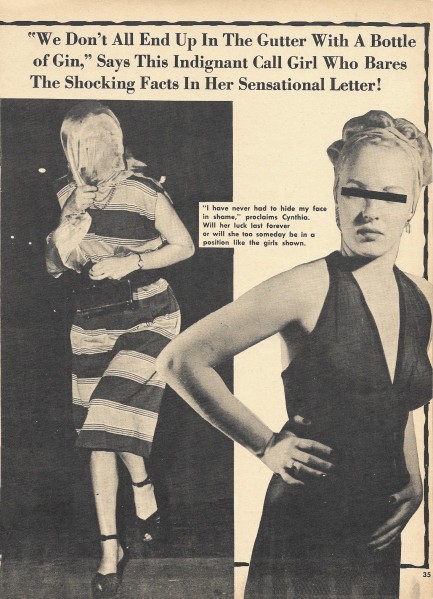
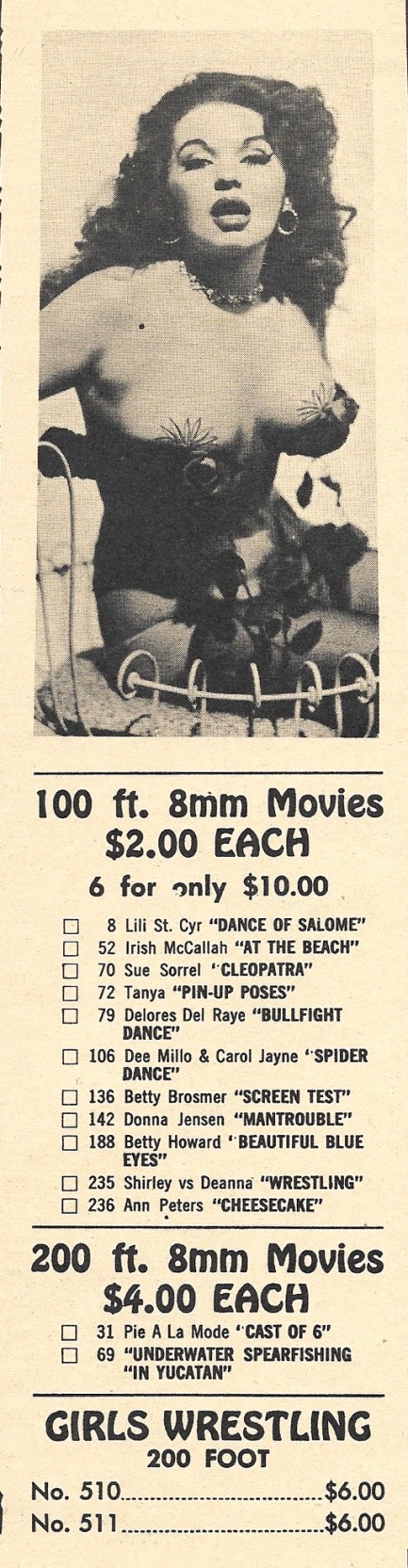
Today we're back to tabloids with an issue of The Lowdown published this month in 1962. The cover features Bob Hope goofing around, Elizabeth Taylor looking serious, Kim Novak nuzzling, and a random naked party girl randomly partying naked. Inside the issue are stories on Hope getting the hots for trans star Coccinelle in a French nightclub, Novak raking a series of suitors over the coals, and baseball players succumbing to greed. So much material in these tabloids, and so little time to highlight a story or two. But forced to make a choice, we're opting to discuss a piece on something called Scoobeedoo. How can we not? We all remember the cartoon, and now this story seemed guaranteed to tell us where the name of the legendary dog came from. We never knew we wanted to know that. But when we saw the word Scoobeedoo we realized, yes, we want to know.
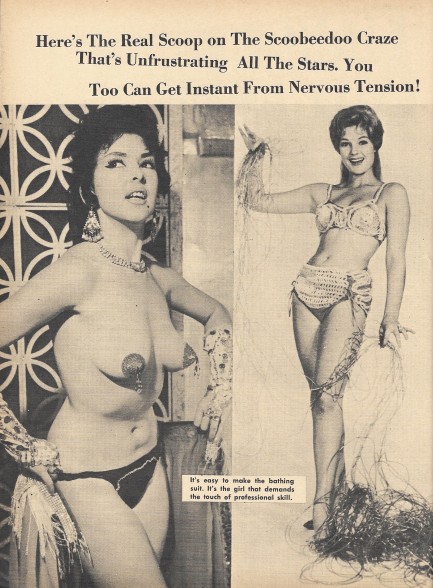
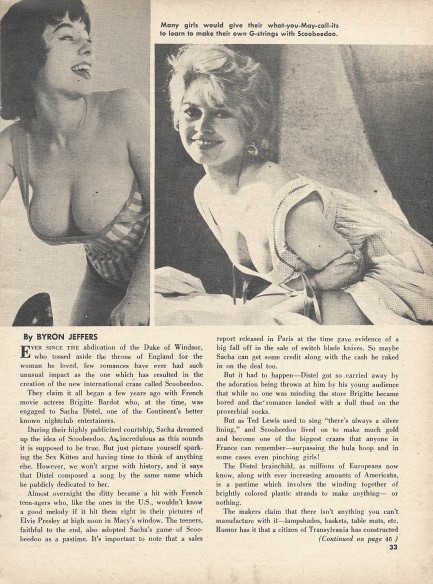
Lowdown describes Scoobeedoo as a craze and a do-it-yourself gimmick. Apparently, it was popularized when French singer Sacha Distel wrote a 1958 song of the same name. But he didn't invent it—he just sang about it. The actual thing was invented by a French plastics company and called Scoubidou. It was basically a spool of brightly colored plastic cord that could be woven or tied to make—well, whatever you wanted. You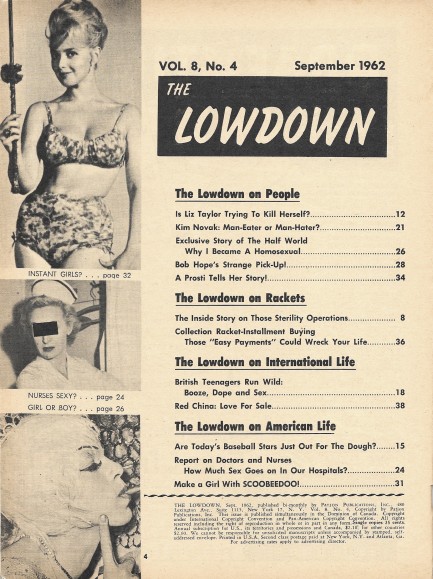
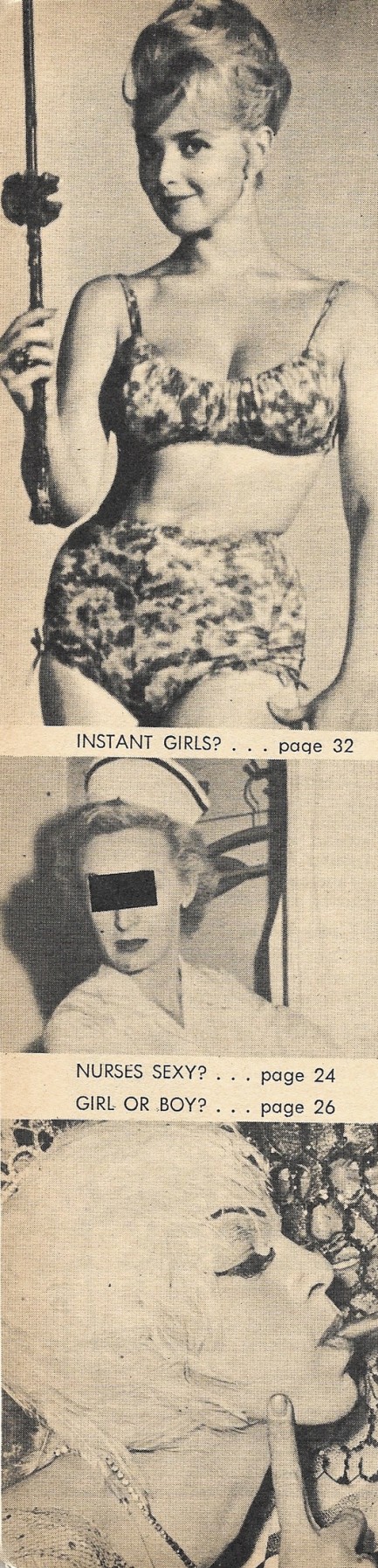 could make lampshades, baskets, placemats, keychains. A California man famously used it to make bikinis. We imagine it would work for household repairs, light sexual bondage, whatever you needed it for. The stuff was as popular as the hula hoop for a while. Apparently figures in the electrical industry even complained that a shortage of wiring insulation was due to Scoubidou because it used the same type of plastic.
Readers above a certain age will already know about all this, of course, but we had no idea. We weren't around back then. And that, succinctly, is why we maintain this website—because we learn about a past we never experienced. But surprisingly Scoubidou isn't just the past. It apparently still exists. It even has a Wikipedia entry with examples of the many things you can make (but no bikinis). So this was a very informative issue of The Lowdown, all things considered. The only thing we're bummed about is that our Scoubidou research provided no actual confirmation that the cartoon dog Scooby-Doo got his name from the toy. But he had to, right? Maybe a reader has the answer to that. In the meantime we have more than twenty scans below for your enjoyment and other issues of The Lowdown you can access by clicking the magazine's keywords at bottom.
could make lampshades, baskets, placemats, keychains. A California man famously used it to make bikinis. We imagine it would work for household repairs, light sexual bondage, whatever you needed it for. The stuff was as popular as the hula hoop for a while. Apparently figures in the electrical industry even complained that a shortage of wiring insulation was due to Scoubidou because it used the same type of plastic.Readers above a certain age will already know about all this, of course, but we had no idea. We weren't around back then. And that, succinctly, is why we maintain this website—because we learn about a past we never experienced. But surprisingly Scoubidou isn't just the past. It apparently still exists. It even has a Wikipedia entry with examples of the many things you can make (but no bikinis). So this was a very informative issue of The Lowdown, all things considered. The only thing we're bummed about is that our Scoubidou research provided no actual confirmation that the cartoon dog Scooby-Doo got his name from the toy. But he had to, right? Maybe a reader has the answer to that. In the meantime we have more than twenty scans below for your enjoyment and other issues of The Lowdown you can access by clicking the magazine's keywords at bottom.
Update: a reader does have the answer. One of you always does. J. Talley wrote this:
The series was originally rejected by CBS executives, who thought the presentation artwork was too frightening for children and that the show must be the same. CBS Executive Fred Silverman was listening to Frank Sinatra's “Strangers In The Night” (with the scatted lyric “dooby-dooby-doo”) on the flight to that ill-fated meeting. After the show was rejected, a number of changes were made: the Hanna-Barbera staff decided that the dog should be the star of the series instead of the four kids, and renamed him Scooby-Doo after that Sinatra lyric. The spooky aspects of the show were toned down slightly, and the comedy aspects tuned up. The show was re-presented, accepted, and premiered as the centerpiece for CBS's 1969-1970 Saturday Morning season.
Thanks, J. That's another hole in our historical knowledge successfully filled in. Is it any surprise Sinatra was involved somehow? That guy really got around.
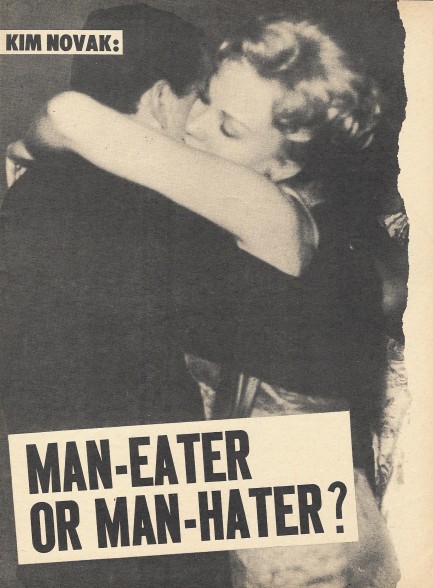
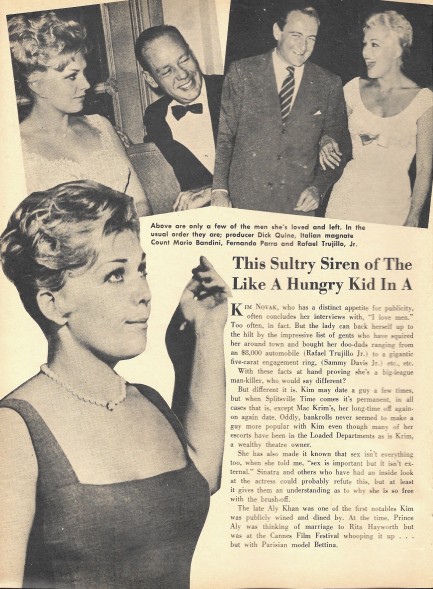
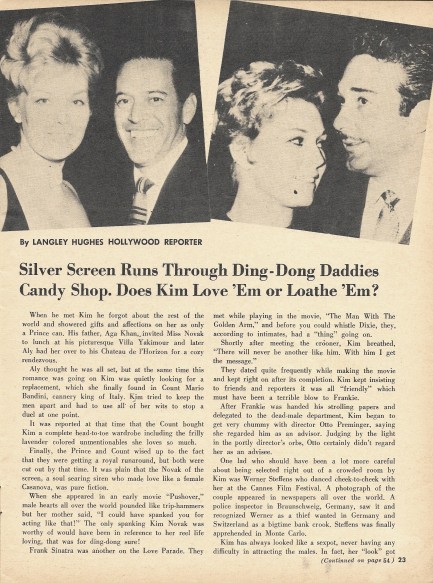
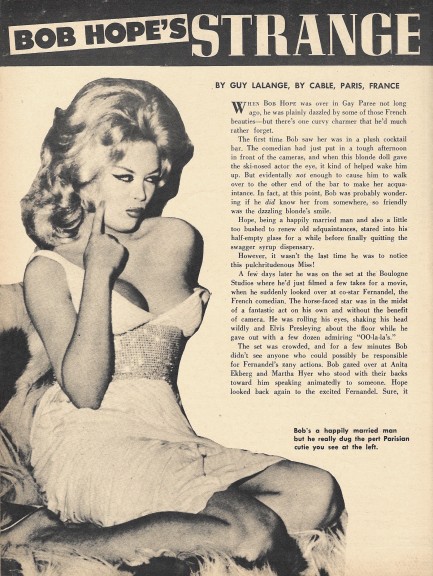
LowdownBob HopeAnita EkbergKim NovakElizabeth TaylorWillie MaysWarre SpahnRocky ColavitoMickey MantleStan MusialRoger MarisRafael Trujillo Jr.CoccinelleSacha Disteltabloid

| Femmes Fatales | Jul 6 2018 |

How can I be making your mouth water? I haven't even put the food in the pot yet.
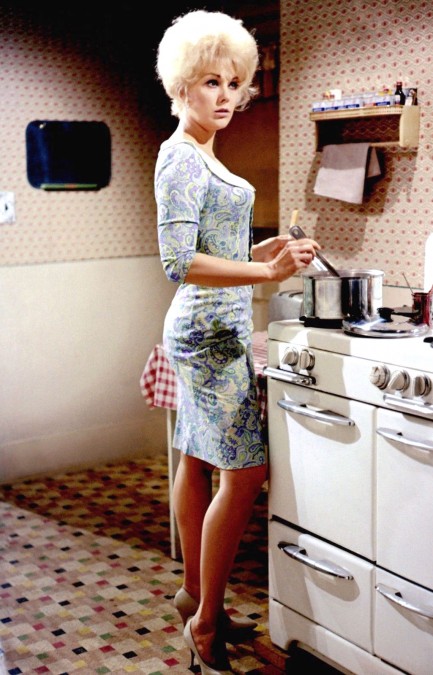
This shot of superstar Kim Novak was made when she was filming Billy Wilder's 1964 comedy Kiss Me, Stupid. This was one of Novak's most memorable characters—Polly the Pistol, party girl with attitude, waitress at a roadhouse called the Belly Button, and sometime prostitute. The movie is worth it for her alone, but she happens to co-star with Dean Martin and he's always a bonus.

| Vintage Pulp | May 9 2018 |

There's nothing harder than facing your worst fear.
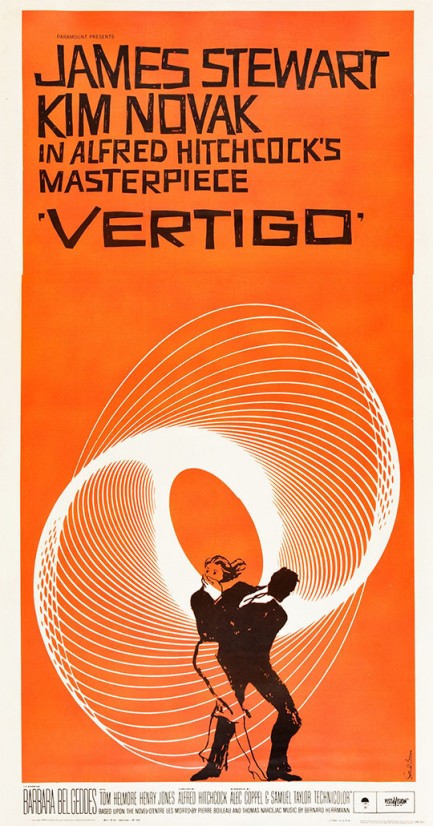
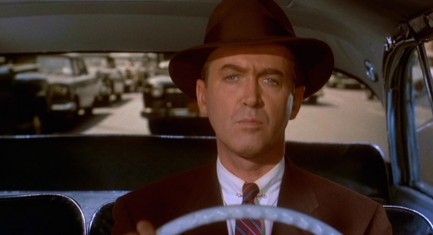
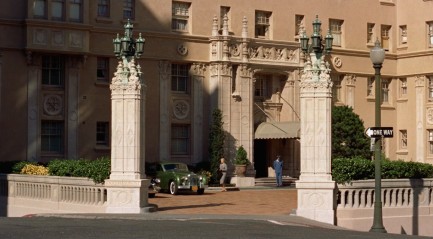
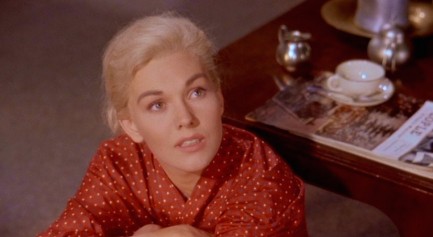
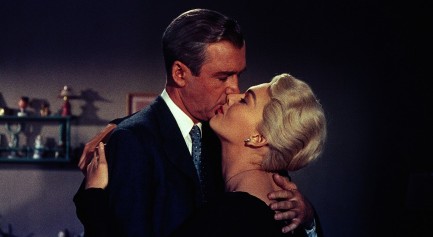
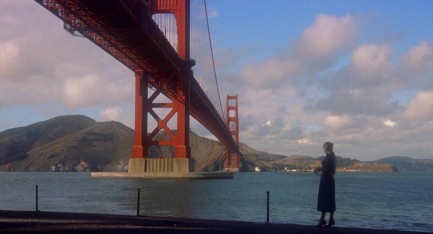
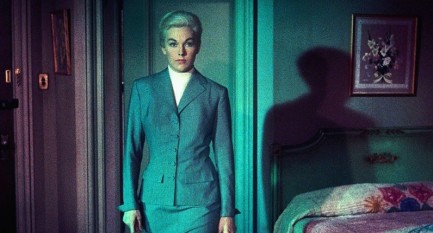
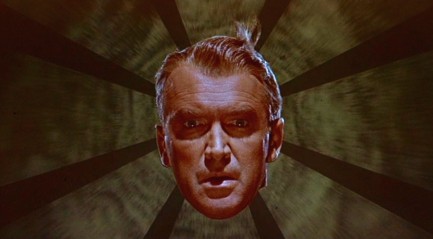
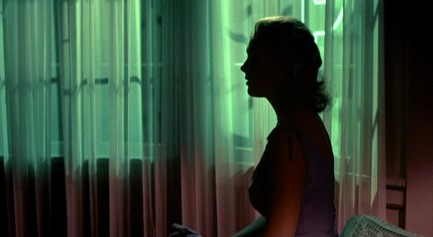
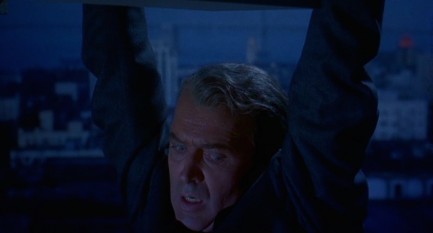
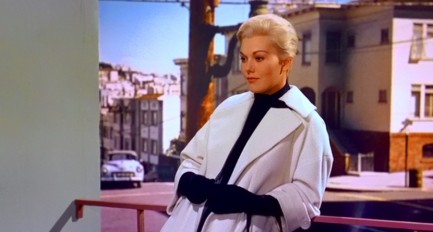
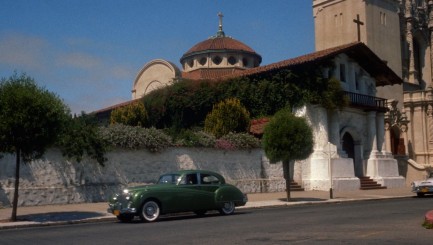
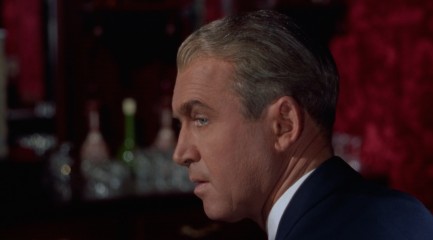
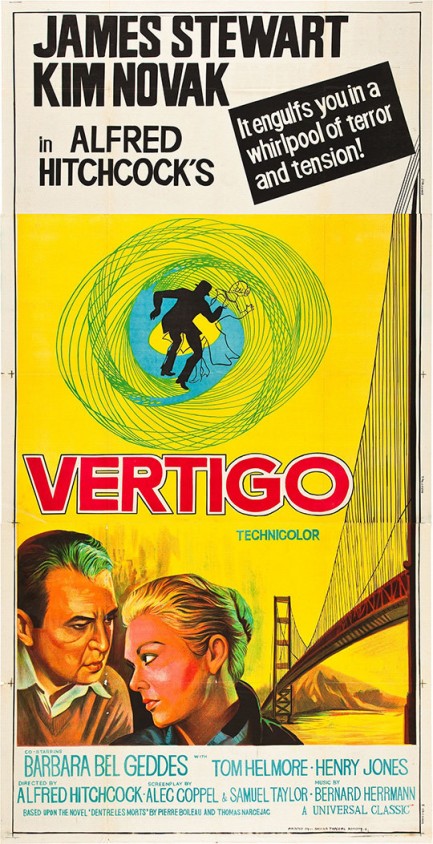
The poster for Alfred Hitchcock's 1958 thriller Vertigo, designed by Saul Bass, is one of the most famous and influential promos ever made. Bass actually can't take full credit for it—he oversaw its creation, but the unique spiral pattern was made by John Whitney and the figures were drawn by Art Goodman. Bass and Co. made a couple of similar versions of the poster for the film's U.S. run. We showed you one a while back, and now the above version completes the pair. If you haven't seen Vertigo, we can't tell you much that hasn't already been written. Four years after starring in Rear Window Jimmy Stewart plays another damaged man for Hitchcock, a San Francisco detective who has of fear of heights, the result of a rooftop chase gone wrong. He later gets involved in a mystery that puts his acrophobia to the ultimate test. Many say this is Hitchcock's best movie. We don't think so, but it's definitely a landmark, particularly as it relates to co-star Kim Novak's role, its opening action sequence, and its reliance upon San Francisco locations to help tell its story. In fact, the latter aspect was why the film's world premiere took place in San Francisco today in 1958. Below you see some screen grabs, along with a beautiful promo poster that was made for the movie's run in India. Put Vertigo in your queue.
IndiaSan FranciscoVertigoAlfred HitchcockKim NovakJames StewartSaul BassJohn WhitneyArt Goodmanposter artcinema