 It's shocking how many Hollywood stars did smack. 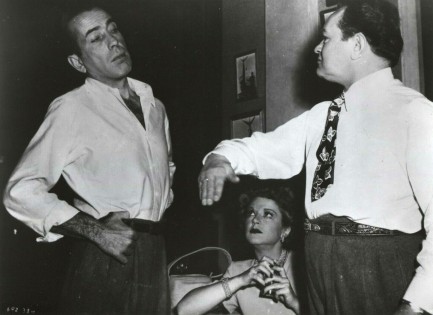
Everybody wants to slap somebody sometime. Luckily, actors in movies do it so you don't have to. The above shot is a good example. Edward G. Robinson lets Humphrey Bogart have it in 1948's Key Largo, as Claire Trevor looks on. In vintage cinema, people were constantly slapping. Men slapped men, men slapped women, women slapped women, and women slapped men. The recipient was usually the protagonist because—though some readers may not realize this—even during the ’40s and 50s, slapping was considered uncouth at a minimum, and downright villainous at worst, particularly when men did it. So generally, bad guys did the slapping, with some exceptions. Glenn Ford slaps Rita Hayworth in Gilda, for example, out of humiliation. Still wrong, but he wasn't the film's villain is our point. Humphrey Bogart lightly slaps Martha Vickers in The Big Sleep to bring her out of a drug stupor. He's like a doctor. Sort of. In any case, most cinematic slapping is fake, and when it wasn't it was done with the consent of the participants (No, really slap me! It'll look more realistic.). There are some famous examples of chipped teeth and bloody noses deriving from the pursuit of realism. We can envision a museum exhibit of photos like these, followed by a lot of conversation around film, social mores, masculinity, and their intersection. We can also envison a conversation around the difference between fantasy and reality. There are some who believe portryals of bad things endorse the same. But movies succeed largely by thrilling, shocking, and scaring audiences, which requires portraying thrilling, shocking, and frightening moments. If actors can't do that, then ultimately movies must become as banal as everyday llife. Enjoy the slapfest.
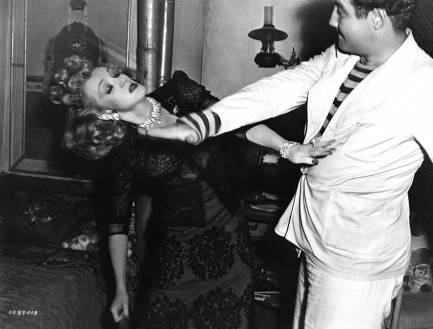 Broderick Crawford slaps Marlene Dietrich in the 1940's Seven Sinners. Broderick Crawford slaps Marlene Dietrich in the 1940's Seven Sinners.
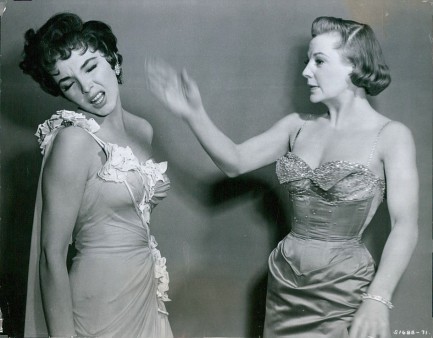 June Allyson lets Joan Collins have it across the kisser in a promo image for The Opposite Sex, 1956. June Allyson lets Joan Collins have it across the kisser in a promo image for The Opposite Sex, 1956.
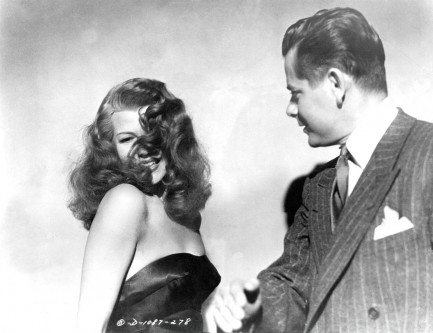 Speaking of Gilda, here's one of Glenn Ford and Rita Hayworth re-enacting the slap heard round the world. Hayworth gets to slap Ford too, and according to some accounts she loosened two of his teeth. We don't know if that's true, but if you watch the sequence it is indeed quite a blow. 100% real. We looked for a photo of it but had no luck. Speaking of Gilda, here's one of Glenn Ford and Rita Hayworth re-enacting the slap heard round the world. Hayworth gets to slap Ford too, and according to some accounts she loosened two of his teeth. We don't know if that's true, but if you watch the sequence it is indeed quite a blow. 100% real. We looked for a photo of it but had no luck.
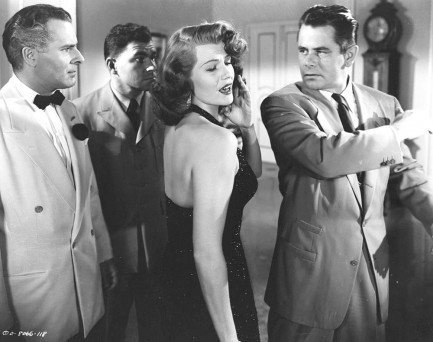 Don't mess with box office success. Ford and Hayworth did it again in 1952's Affair in Trinidad. Don't mess with box office success. Ford and Hayworth did it again in 1952's Affair in Trinidad.
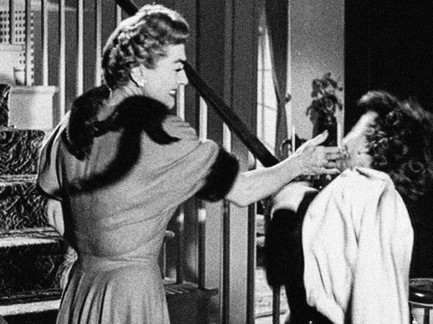 All-time film diva Joan Crawford gets in a good shot on Lucy Marlow in 1955's Queen Bee. All-time film diva Joan Crawford gets in a good shot on Lucy Marlow in 1955's Queen Bee.
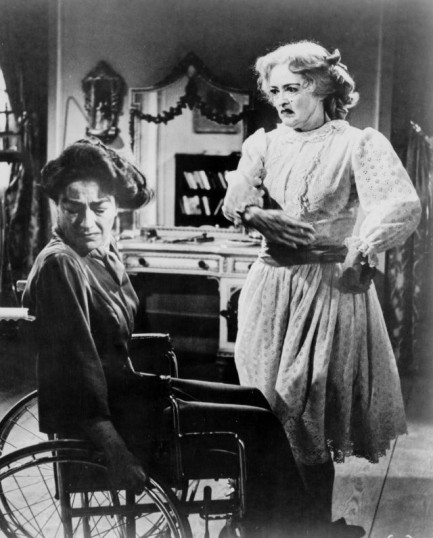 The answer to the forthcoming question is: She turned into a human monster, that's what. Joan Crawford is now on the receiving end, with Bette Davis issuing the slap in Whatever Happened to Baby Jane? Later Davis kicks Crawford, so the slap is just a warm-up. The answer to the forthcoming question is: She turned into a human monster, that's what. Joan Crawford is now on the receiving end, with Bette Davis issuing the slap in Whatever Happened to Baby Jane? Later Davis kicks Crawford, so the slap is just a warm-up.
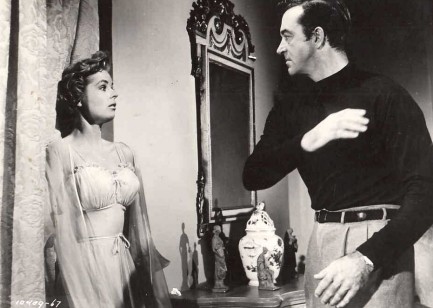 Mary Murphy awaits the inevitable from John Payne in 1955's Hell's Island. Mary Murphy awaits the inevitable from John Payne in 1955's Hell's Island.
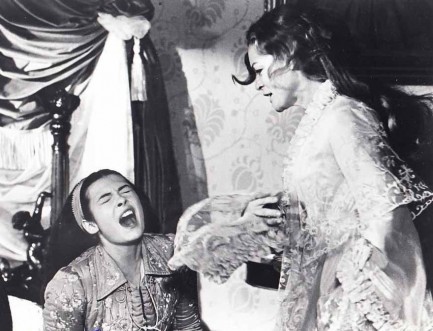 Romy Schneider slaps Sonia Petrova in 1972's Ludwig. Romy Schneider slaps Sonia Petrova in 1972's Ludwig.
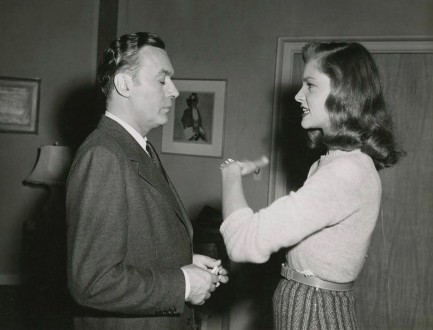 Lauren Bacall lays into Charles Boyer in 1945's Confidential Agent and garnishes the slap with a brilliant snarl. Lauren Bacall lays into Charles Boyer in 1945's Confidential Agent and garnishes the slap with a brilliant snarl.
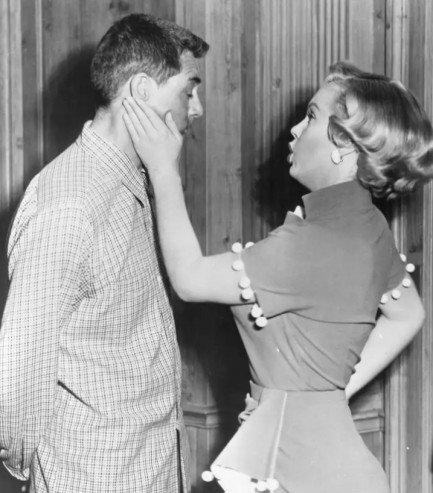 Iconic bombshell Marilyn Monroe drops a smart bomb on Cary Grant in the 1952 comedy Monkey Business. Iconic bombshell Marilyn Monroe drops a smart bomb on Cary Grant in the 1952 comedy Monkey Business.
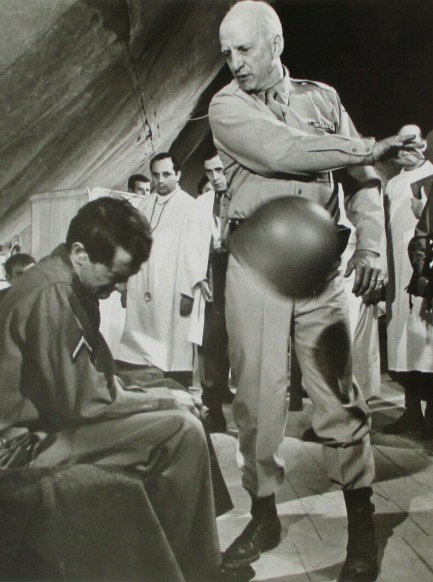 This is the most brutal slap of the bunch, we think, from 1969's Patton, as George C. Scott de-helmets an unfortunate soldier played by Tim Considine. This is the most brutal slap of the bunch, we think, from 1969's Patton, as George C. Scott de-helmets an unfortunate soldier played by Tim Considine.
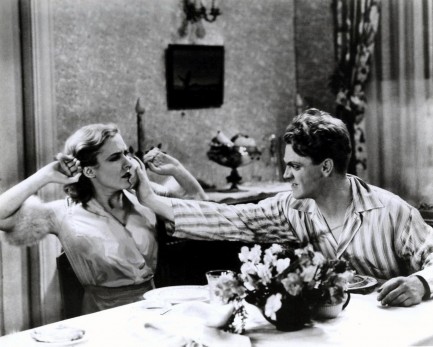 A legendary scene in filmdom is when James Cagney shoves a grapefruit in Mae Clark's face in The Public Enemy. Is it a slap? He does it pretty damn hard, so we think it's close enough. They re-enact that moment here in a promo photo made in 1931. A legendary scene in filmdom is when James Cagney shoves a grapefruit in Mae Clark's face in The Public Enemy. Is it a slap? He does it pretty damn hard, so we think it's close enough. They re-enact that moment here in a promo photo made in 1931.
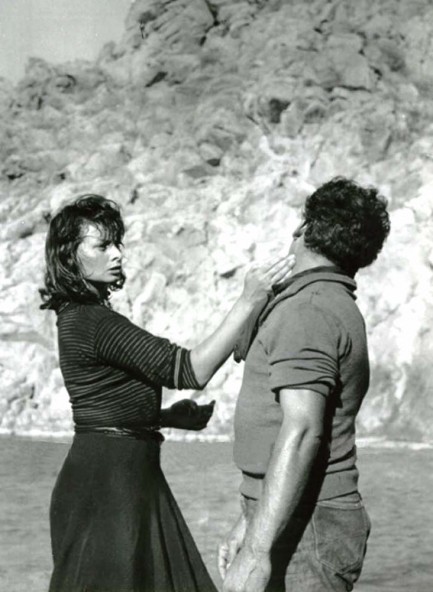 Sophia Loren gives Jorge Mistral a scenic seaside slap in 1957's Boy on a Dolphin. Sophia Loren gives Jorge Mistral a scenic seaside slap in 1957's Boy on a Dolphin.
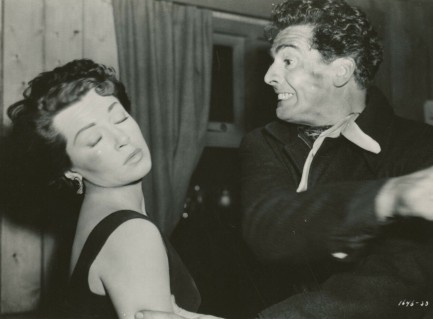 Victor Mature fails to live up to his last name as he slaps Lana Turner in 1954's Betrayed. Victor Mature fails to live up to his last name as he slaps Lana Turner in 1954's Betrayed. 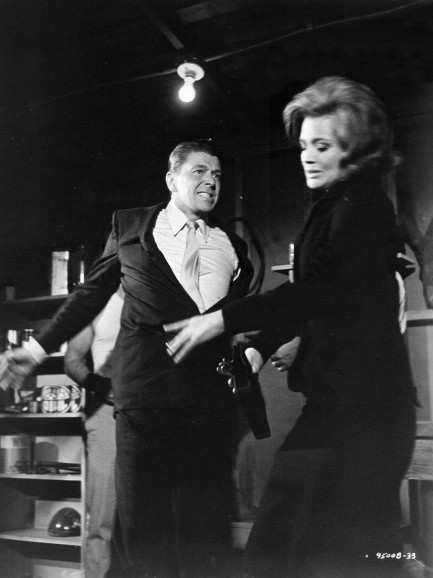 Ronald Reagan teaches Angie Dickinson how supply side economics work in 1964's The Killers. Ronald Reagan teaches Angie Dickinson how supply side economics work in 1964's The Killers.
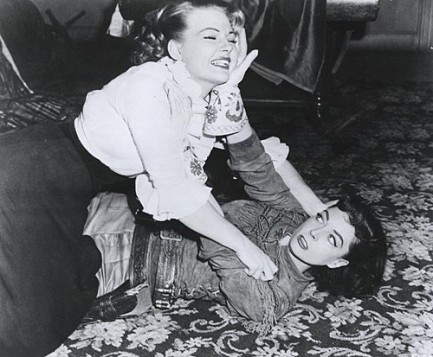 Marie Windsor gets in one against Mary Castle from the guard position in an episode of television's Stories of the Century in 1954. Windsor eventually won this bout with a rear naked choke. Marie Windsor gets in one against Mary Castle from the guard position in an episode of television's Stories of the Century in 1954. Windsor eventually won this bout with a rear naked choke.
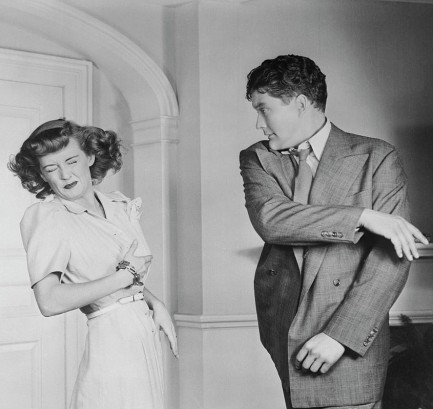 It's better to give than receive, but sadly it's Bette Davis's turn, as she takes one from Dennis Morgan in In This Our Life, 1942. It's better to give than receive, but sadly it's Bette Davis's turn, as she takes one from Dennis Morgan in In This Our Life, 1942.
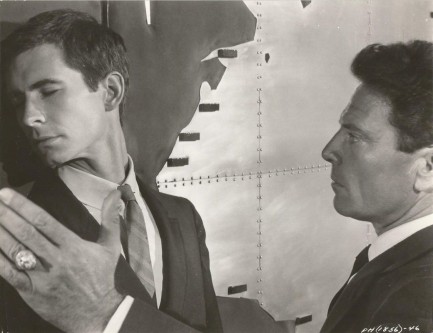 Anthony Perkins and Raf Vallone dance the dance in 1962's Phaedra, with Vallone taking the lead. Anthony Perkins and Raf Vallone dance the dance in 1962's Phaedra, with Vallone taking the lead.
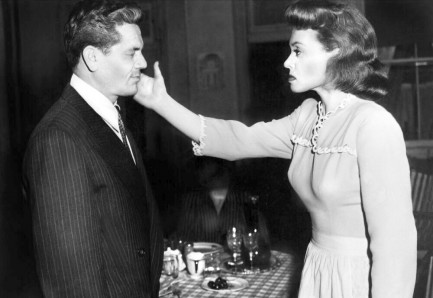 And he thought being inside the ring was hard. Lilli Palmer nails John Garfield with a roundhouse right in the 1947 boxing classic Body and Soul. And he thought being inside the ring was hard. Lilli Palmer nails John Garfield with a roundhouse right in the 1947 boxing classic Body and Soul.
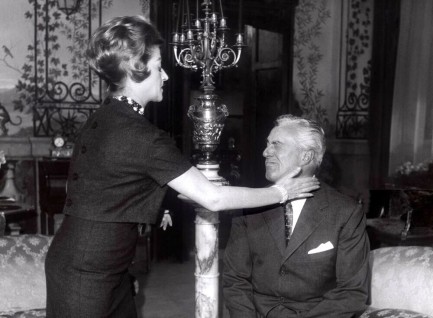 1960's Il vigile, aka The Mayor, sees Vittorio De Sica rebuked by a member of the electorate Lia Zoppelli. She's more than a voter in this—she's also his wife, so you can be sure he deserved it. 1960's Il vigile, aka The Mayor, sees Vittorio De Sica rebuked by a member of the electorate Lia Zoppelli. She's more than a voter in this—she's also his wife, so you can be sure he deserved it.
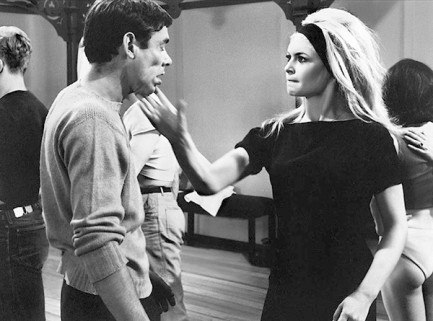 Brigitte Bardot delivers a not-so-private slap to Dirk Sanders in 1962's Vie privée, aka A Very Private Affair. Brigitte Bardot delivers a not-so-private slap to Dirk Sanders in 1962's Vie privée, aka A Very Private Affair.
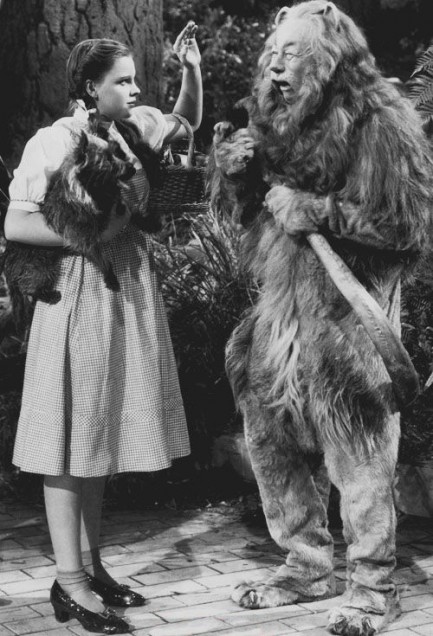 In a classic case of animal abuse. Judy Garland gives cowardly lion Bert Lahr a slap on the nose in The Wizard of Oz. Is it his fault he's a pussy? Accept him as he is, Judy. In a classic case of animal abuse. Judy Garland gives cowardly lion Bert Lahr a slap on the nose in The Wizard of Oz. Is it his fault he's a pussy? Accept him as he is, Judy.
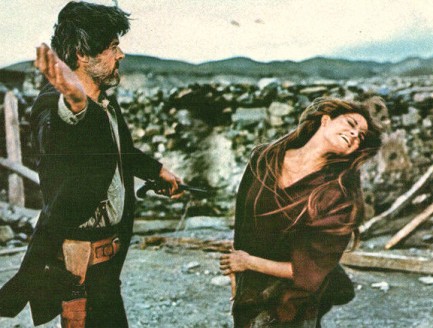 Robert Culp backhands Raquel Welch in 1971's Hannie Caudler. Robert Culp backhands Raquel Welch in 1971's Hannie Caudler.
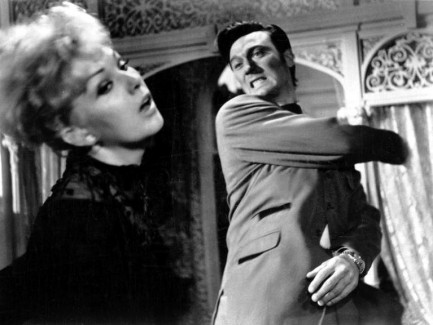 And finally, Laurence Harvey dares to lay hands on the perfect Kim Novak in Of Human Bondage. And finally, Laurence Harvey dares to lay hands on the perfect Kim Novak in Of Human Bondage.
 First do no harm—to your bank account. 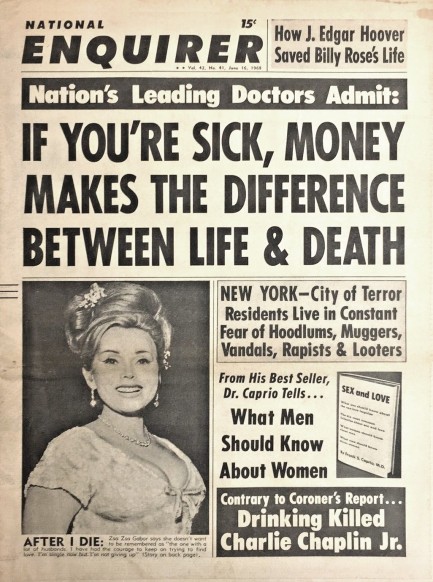
National Enquirer wins the 1968 Obvious Award with this header articulating the entire essence of U.S. healthcare. The quote is attributed to “the nation's leading doctors,” but here's the thing—if this group were actually the nation's leading doctors there would be no problem of people dying due to lack of funds. The reality is that the American Medical Association—the nation's actual leading doctors—for decades consistently opposed national health care programs, so the headline should read: If You're Sick Money Makes the Difference Between Life & Death. Nation's Leading Doctors Are Fine with That.
The primary mandate of unions is to obtain the highest possible compensation for its members, so one can hardly be surprised at the AMA's opposition to changing a profitable system. Still, its history with national healthcare probably isn't widely known enough. The group's lobbying efforts defeated President Harry Truman’s plans for universal healthcare back during the 1940s, and similar un-Hippocratic mobilizations slowed or stopped attempts by later presidents. The AMA is also the group that paid then-actor Ronald Reagan to record that famous 1961 spoken word LP claiming Medicare—aka trying to help seniors live longer—would lead to a socialist dictatorship. You can check that out at this link.
Elsewhere on Enquirer's cover, serial bride Zsa Zsa Gabor explains that after she dies she doesn't want to be remembered as “the one with a lot of husbands,” but rather someone who “had the courage to keep on trying to find love.” She didn't get her wish. And the funny part is that in 1968, when she foresaw her future reputation, she wasn't finished marrying. Not even close. Having already walked down the aisle on five happy occasions, she ended up making the trip four more times. We have a lot on Zsa Zsa in the website. This rare pin-up for example. If you want to see more just click her keywords below.
 Politics turn out to be hell—literally. 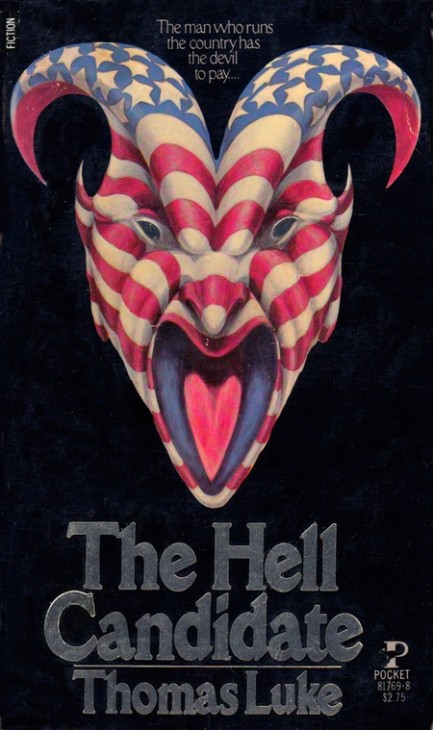
The Hell Candidate, which was written by Graham Masterton using the pseudonym Thomas Luke, first appeared in bookstores in July 1980. Ronald Reagan, who unwittingly provided Luke with inspiration, became the Republican nominee for president the same month. The book did well, but was almost forgotten until recently. In the last few months we've seen completely worn copies of the paperback version for sale online for $150. We got ours for $13 because, fortunately, not everyone researches book prices before they post them on an auction site. Why do people suddenly want to read The Hell Candidate again? Well, it has to do with the campaign of a certain Donald J. Trump. While the parallels are interesting and terrifying, the important aspect of the book is that it deals with contemporary American politics. Its lesson is that horrible candidates appear because voters secretly like them. Do we agree? Not entirely. But considering how useless most U.S. political candidates are, it's a point worth consideration. The basic idea in The Hell Candidate is that an otherwise affable politician of moderately conservative bent named Hunter Peal is possessed by Satan and becomes a profane, warmongering, sexually violent monster. His aides and friends are horrified by the change in his personality and are sure he's doomed to flame out on the campaign trail, but a strange thing happens—the American people love him. His promises of violent action against foreign enemies and unrestrained plenty on the home front propel him closer and closer to the Oval Office. His promises are impossible. They're simply a means to power. But they keep working. From his early campaign stops in the sticks to massive rallies in major cities, candidate Peal utilizes doublespeak, tricks, illusions, and tortures to rise onto political center stage. He's beyond ruthless. Early in the book he rapes his wife eight times in one night—and admits it with pride. Later he dispatches a debate opponent by magically afflicting him with diarrhea. Yeah, it's that kind of book.
Could such a story really be worth reading? We think so. There's real terror, and some moments of insight, like this one:
“Suddenly you're prepared to rationalize all those weird things you saw at Allen's Corners, and suddenly you're prepared to rationalize the fact that good old Hunter Peal has turned into a raving rightwing fascist [snip] and you know why? Because you're like every other creep around every other presidential candidate. If the candidate looks like he's winning then you'll forgive him anything. Rape, murder, fraud—anything.”
“Hunter isn't guilty of any of those things.”
“He raped his wife didn't he?”
While The Hell Candidate is unambiguously a political allegory of at least minor historical significance, and it's also a unique horror novel, it's additionally an early-to-mid example of transgressive fiction—in fact a defining example, though it's never appeared on a list of such books we've ever seen. But consider—transgressive fiction deals with characters who break free of perceived social norms in violent, sexual, or illicit ways, and such characters often seem mentally ill or nihilistic. Hunter Peal, once possessed, pointedly destroys all boundaries of socially acceptable behavior through repeated acts of profanity, depravity, cruelty, and shockingly lethal violence. Meanwhile other characters spend ample time misunderstanding his satanic nature, instead discussing whether he's merely gone insane.
It's similar in some ways to American Psycho—a landmark transgressive book critics mostly failed to understand. Peal becomes an embodiment of America's impulses toward violence in the same way Patrick Bateman becomes an embodiment of runaway capitalism. The books are also similar in that their violence is so vivid that merely reading it can make you feel complicit. That Peal's victims are sometimes forced through mind control to respond to his blood-drenched brutality as though they're in the throes of sexual ecstasy will do a number on your head. But this is the Devil we're talking about. Such sexualized hyperviolence fits—at least in terms of how he's conceptualized in Western lore. Masterton pulls no punches. The Hell Candidate is visceral, pornographic, and utterly enervating, often terrible to experience, but a modern pulp masterpiece.
 Did she or didn’t she?  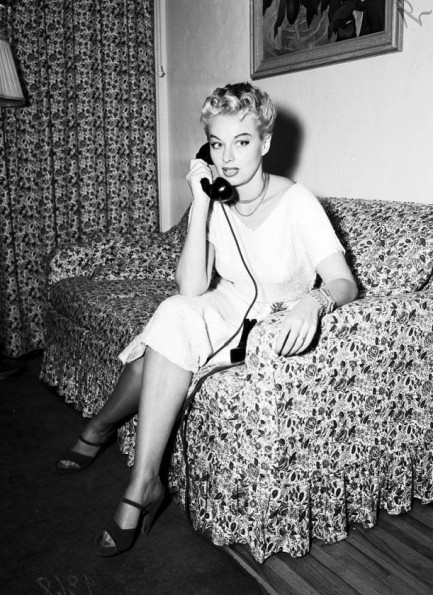
These two photos showing burlesque dancer Lili St. Cyr were shot today in 1951 for a Los Angeles Examiner story about St. Cyr’s legal difficulties. On 23 February of that year she had begun performing at Ciro’s supper club in Hollywood. It was a different type of club for her—it lacked the intimacy of her normal venues, and would sap some of the heat from her act, but the place was world famous and considered by the smart set to be classy. It had hosted Edith Piaf, Marlene Dietrich, Duke Ellington, and Dinah Washington. Of late it was facing stiff competition from Macambo’s, a Brazilian themed joint across the street, and owner Herman Hover wanted to make a splash with St. Cyr. He spent thousands refurbishing the stage just for her, and she would be the first burlesque dancer to transition from men’s clubs to L.A.’s most famous supper club. On premiere night celebs such as Ronald Reagan, Nancy Davis, Franchot Tone, Barbara Payton, Lex Barker, Mickey Rooney, and Los Angeles mayor Fletcher Bowron watched her strip down to toned perfection as they ate dinner and sipped drinks. Other celebs that visited that summer included Bette Davis, Humphrey Bogart, and Clark Gable. During St. Cyr’s residency she varied her act, but a standard bit was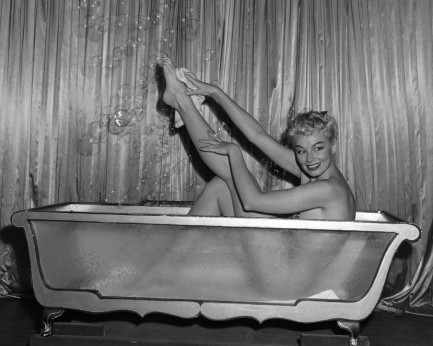 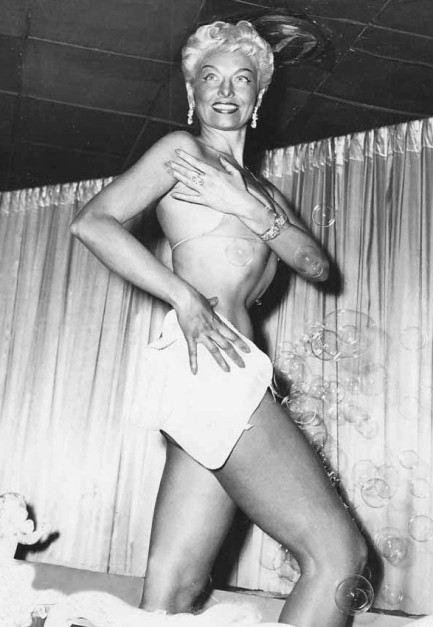 entitled "An Interlude Before Evening," and involved being helped from her clothing by her maid Sadie before slipping nude into a bathtub. But the nudity was an illusion, the cleverest part of her act, achieved through a combination of lighting, positioning, flesh-colored underwear, and sheer athleticism as she slipped quickly from behind a towel and into the sudsy tub. entitled "An Interlude Before Evening," and involved being helped from her clothing by her maid Sadie before slipping nude into a bathtub. But the nudity was an illusion, the cleverest part of her act, achieved through a combination of lighting, positioning, flesh-colored underwear, and sheer athleticism as she slipped quickly from behind a towel and into the sudsy tub. On 18 October a group of Los Angeles sheriff’s deputies, who were trying to enforce a countywide ban against stripping, arrested St. Cyr and Herman Hover. The charges were the usual slate. St. Cyr called upon celebrity lawyer Jerry Giesler—an event the two Examiner photos at top are supposed to be illustrating—and Giesler proceeded to help turn what was already a media boon for St. Cyr into a full bonanza. Giesler was a showman, and he loved cases that had the potential to increase his fame. He made assorted sensational statements to the press, including one in which he promised to have his client perform her bath routine in the courtroom, and another in which he opined that putting together a jury of peers required empaneling a dozen strippers. He described St. Cyr as merely trying to improve her station in life, just an industrious woman trying to carve herself a piece of American pie. The press ate it up. 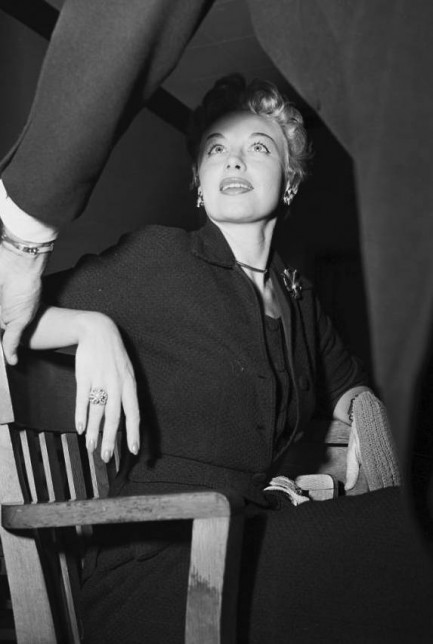 The trial was scheduled for early December in the Beverly Hills Courthouse. Giesler kept the jury—which wasn’t all strippers, but at least was mostly female—laughing with his continual antics. He introduced St. Cyr’s rhinestone encrusted bra and g-string as people’s exhibits A and B. He drew diagrams on a blackboard illustrating how different observers' vantage points toward the stage were blocked by St. Cyr's maid. He flustered police officials by making them discuss in detail such such terms as “bump,” “grind,” and “half-bump,” and followed that up by putting Herman Hover on the witness stand and having him demonstrate those moves. The sight of the portly Hover attempting burlesque sent ripples of laughter through the courtroom. Years later Giesler wrote: “I can honestly say I succeeded in having her case laughed into a not-guilty verdict.” The trial was scheduled for early December in the Beverly Hills Courthouse. Giesler kept the jury—which wasn’t all strippers, but at least was mostly female—laughing with his continual antics. He introduced St. Cyr’s rhinestone encrusted bra and g-string as people’s exhibits A and B. He drew diagrams on a blackboard illustrating how different observers' vantage points toward the stage were blocked by St. Cyr's maid. He flustered police officials by making them discuss in detail such such terms as “bump,” “grind,” and “half-bump,” and followed that up by putting Herman Hover on the witness stand and having him demonstrate those moves. The sight of the portly Hover attempting burlesque sent ripples of laughter through the courtroom. Years later Giesler wrote: “I can honestly say I succeeded in having her case laughed into a not-guilty verdict.” That may have been true, but St Cyr’s icy demeanor was also an important factor. The women found her elegant and remote—the opposite of what they had expected. And the cops did their part for St. Cyr's defense by being terrible witnesses. One claimed that she emerged from the tub completely nude (the normal conclusion to her Interlude, and just as illusory). Another said she wore undies but that he could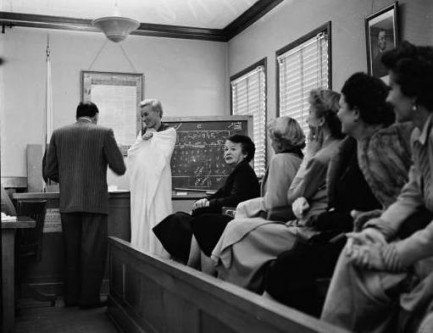 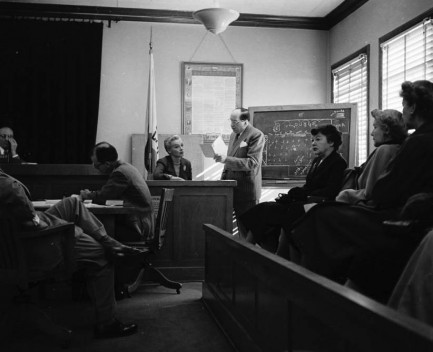 see the outline of her “private parts,” which he discerned in enough detail to determine “were shaven.” The inconsistencies were epic. Some said she caressed herself, others weren’t sure. Another described her towel as “about twenty, twenty-four inches.” In reality it was three times that size. It was as if St. Cyr's dance had dumbfounded the cops. see the outline of her “private parts,” which he discerned in enough detail to determine “were shaven.” The inconsistencies were epic. Some said she caressed herself, others weren’t sure. Another described her towel as “about twenty, twenty-four inches.” In reality it was three times that size. It was as if St. Cyr's dance had dumbfounded the cops. The confusion has extended even to the present day. For a performance that lasted barely fifteen minutes, it has had an amazing amount of conflicting information attached to it. Columnist Army Archerd claimed St. Cyr was indeed nude that night (clearly wrong, according to multiple testimonies); Sheila Weller’s book Dancing at Ciro’s claims an “all-male” jury (it was mostly female) was taken to Ciro’s to see the act (Giesler tried, but the judge said no); some sources claim St. Cyr performed a reverse strip, beginning nude in the tub and emerging to be slowly dressed by her maid (indeed, that was an oft-performed variation, so it is certainly possible it happened that night). Who's right, and who's wrong? Short of using a time machine to return to October 1951 there's no way to tell. At the end of the six-day trial the jury acquitted St. Cyr following a mere seventy-eight minutes of deliberations. There had been no indecent exposure. At least not that night. All St. Cyr’s biographers agree on this much—she was shy and regal offstage, but her performances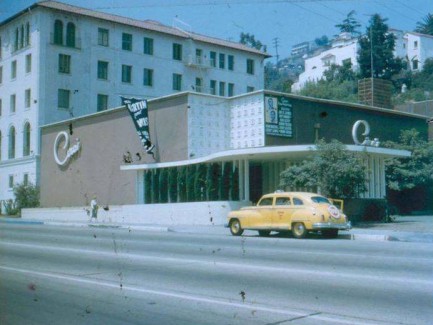 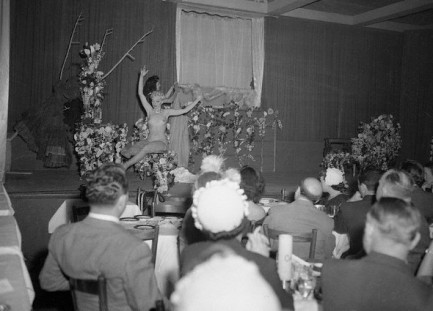 freed her to inhabit different characters. Despite her assertions that she always wore at least a g-string and bra, she definitely performed topless on occasion, as shown by the above photo taken at Ciro’s during early 1951. freed her to inhabit different characters. Despite her assertions that she always wore at least a g-string and bra, she definitely performed topless on occasion, as shown by the above photo taken at Ciro’s during early 1951. Sheriff’s deputies had gone to the club already intent upon arresting her based on what they had heard about the act, which may have influenced their testimony—i.e., they didn’t see her nude, but knew she had done it before. St. Cyr admitted in court she knew police were in the audience, thus she was especially careful that night. But what of other nights? Maybe Army Archerd did what columnists do—took an event he witnessed on one night and pretended it happened on a more useful one. Maybe St. Cyr, on occasions when she knew the cops were far away, flashed her audience to generate buzz. It’s likely we’ll never know what really happened, but that merely adds to the St. Cyr mystique. Did she or didn’t she? Only her maid knew for sure.
 Police Gazette conveniently forgets who invented what and when. 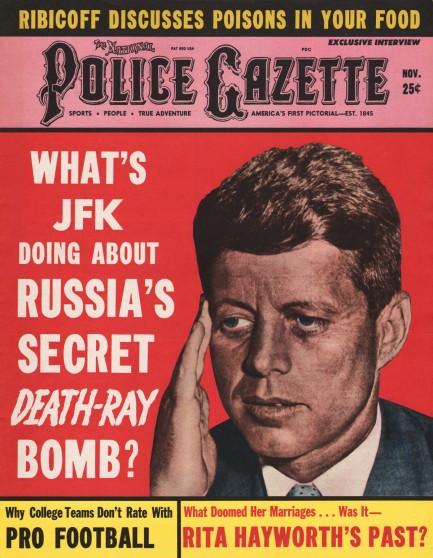
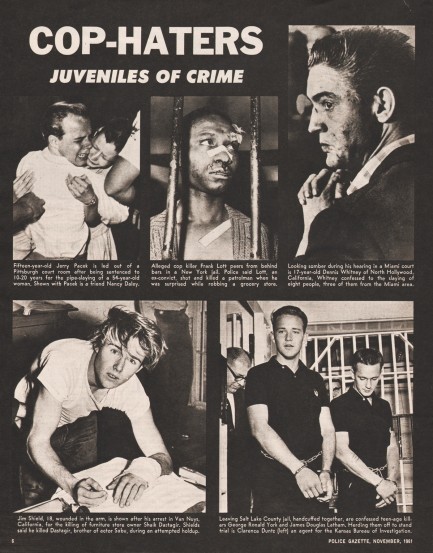
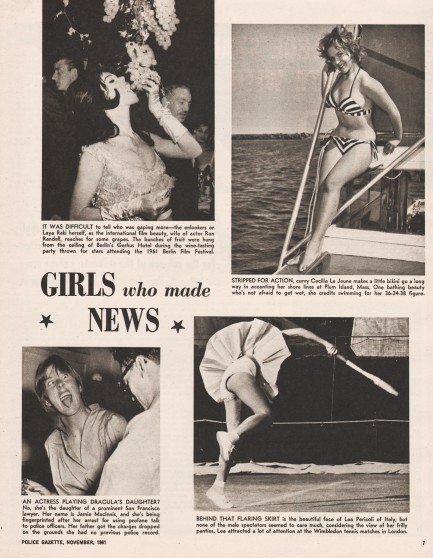
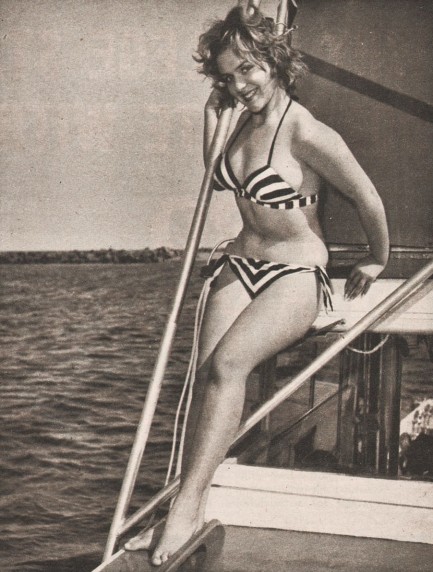
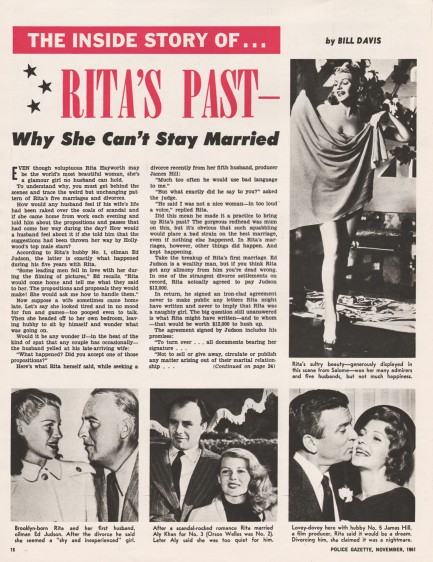
Police Gazette editors hit the panic button with this November 1961 cover claiming the Soviets have a death ray bomb. For a mere twenty-five cents readers were able to acquire new nightmare material by reading about this superweapon, which in the story is called an n-bomb. They’re of course referring to a neutron bomb, which by releasing deadly unshielded neutrons would minimize destruction and contamination of property but maximize human death. Not quite rays, so much as a wave emitted by a massive air burst, but still, the new element it brought to the nuclear party was wantonly scattered neutrons, so, okay—rays it is. It must have been a real stunner for Gazette’s millions of readers to learn of this horrific weapon, but unless the Russian scientist who brainstormed it into existence was named Sam Cohen we have to call bullshit on this tall tale, for it was Samuel T. Cohen—an American physicist—who conceived and developed the neutron bomb. Cohen was an ex-Manhattan Project scientist who spent his career in nukes. He promoted his bomb relentlessly, defending it as “the most sane and moral weapon ever devised,” because “when the war is over, the world is still intact.” See, this is what can happen when you live in a military bubble—Cohen defined morality not by the neutron bomb’s extra-lethal effects on actual living and feeling humans, but by the survival of (reusable) material assets. At its most compact it could blast an area scarcely a mile across, however only a blind man could fail to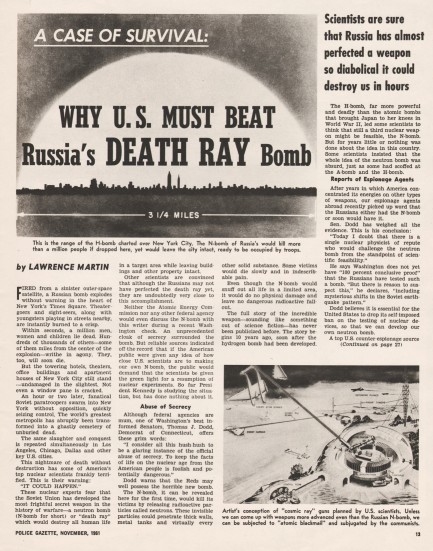 see that tactical neutron weapons were simply the thin edge of a wedge opening a tightly sealed nuclear door. see that tactical neutron weapons were simply the thin edge of a wedge opening a tightly sealed nuclear door. Of course, once the Soviets caught wind of this abomination they developed their own neutron bomb, prompting the U.S. to accelerate its program (see: arms race), until Ronald Reagan ordered 700 finished warheads to be deployed in Europe. It was only mass protest by Europeans—those ungrateful victims of two previous devastating continental wars—that thwarted Reagan’s plans. They realized that neutron weapons made nuclear war more likely, not less likely. If this wasn’t clear enough at the time, it became crystalline when China announced in 1999 that it had built its own neutron bomb. As you have probably deduced by now, the entire point of the Gazette’s death ray story is to urge President John F. Kennedy to get off his ass and develop an American n-bomb to counter the Soviet one. You almost have to wonder if the text was fed to Gazette editors from Sam Cohen’s office. Moving on, Gazette wouldn’t be Gazette without at least a little Hitler, so in addition to the death ray feature it offers up photos of Adolf relaxing with Eva Braun at a retreat in the Bavarian Alps. In contrast to the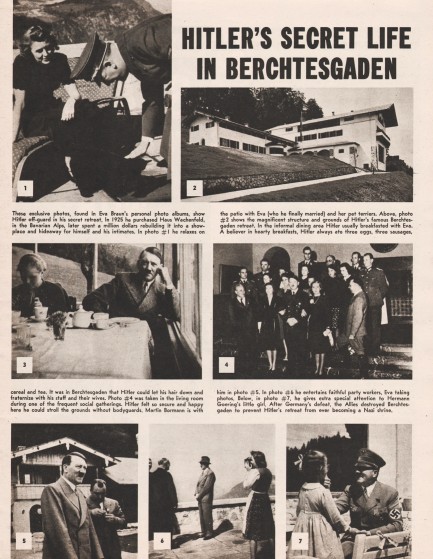 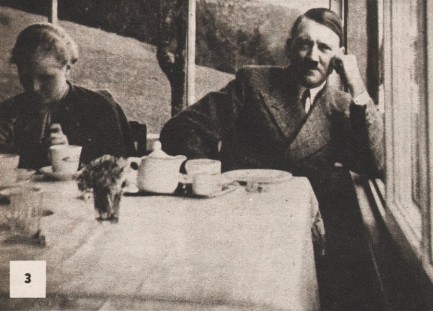 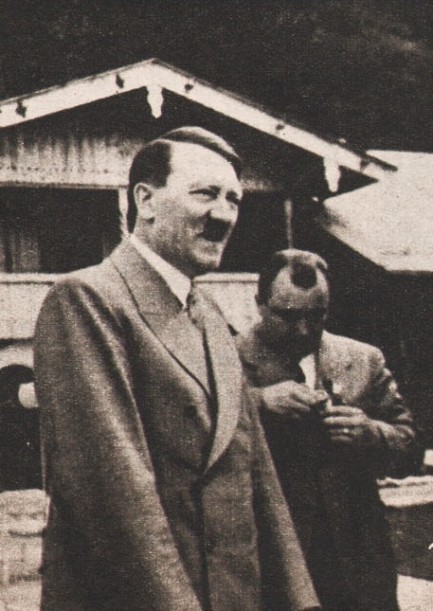 many stories about Hitler living in bitter, defeated isolation in South America, here readers see happy Hitler, socializing during the 1930s with friends and compatriots. Next up, Gazette gives readers their fix of celebrity content with Rita Hayworth, who had been married five times and whose problem the editors are only too happy to diagnose—in their esteemed opinion she’s just too wild to be tamed. And lastly, Gazette presses panic button number two by tying the nascent civil rights movement to communist agitation from overseas. This is a tabloid tale that was told often in the 1960s because, well, we don’t know why exactly—presumably because who besides the puppets of foreign governments would ever deign to demand equal rights? Anyway, we have a few scans below, and an entire stack of early 1970s Gazettes we hope to get to soonish. many stories about Hitler living in bitter, defeated isolation in South America, here readers see happy Hitler, socializing during the 1930s with friends and compatriots. Next up, Gazette gives readers their fix of celebrity content with Rita Hayworth, who had been married five times and whose problem the editors are only too happy to diagnose—in their esteemed opinion she’s just too wild to be tamed. And lastly, Gazette presses panic button number two by tying the nascent civil rights movement to communist agitation from overseas. This is a tabloid tale that was told often in the 1960s because, well, we don’t know why exactly—presumably because who besides the puppets of foreign governments would ever deign to demand equal rights? Anyway, we have a few scans below, and an entire stack of early 1970s Gazettes we hope to get to soonish.
   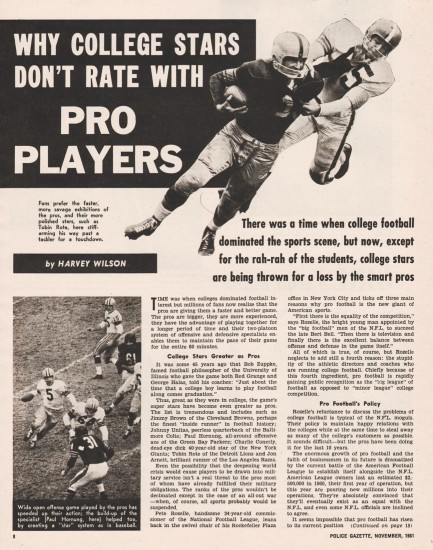 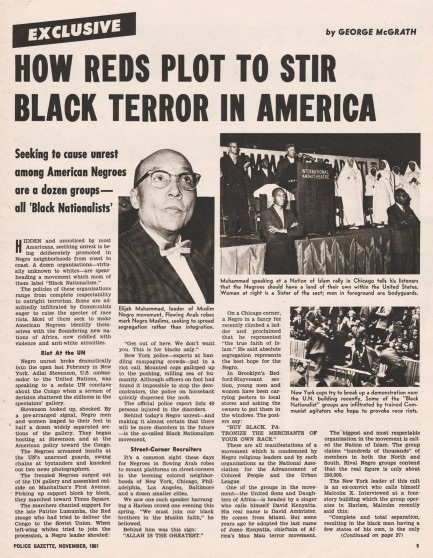 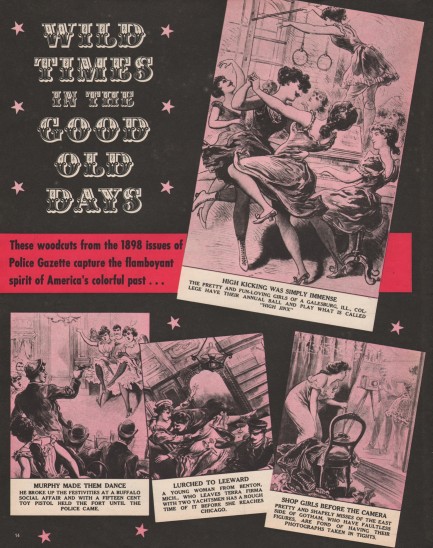 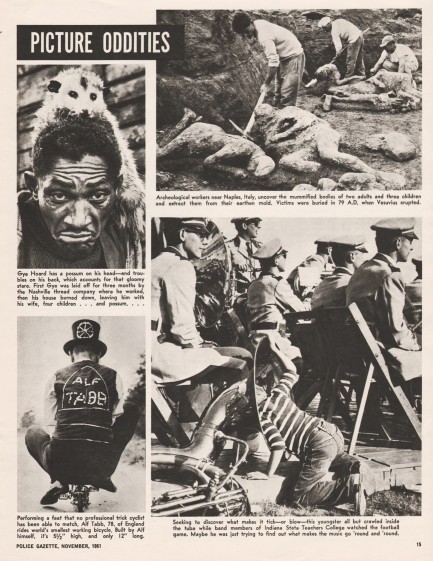 
 Our civilization has avoided nuclear destruction so far, but has it been by design or chance? 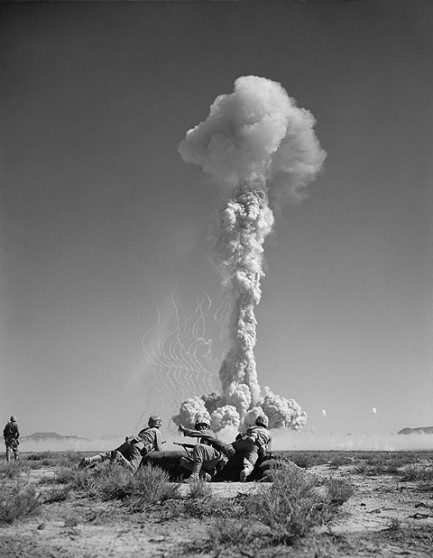
This debris cloud was generated yesterday in 1952 by the nuclear blast codenamed Dog, which was part of Operation Tumbler-Snapper, a series of tests that occurred at the Nevada Test Site that year. The people you see in the image are just a few of the 2,100 marines who observed the explosion. Last month Chatham House released a sobering nuclear study showing that there have been thirteen incidents since 1962 that qualify as “near use” of nuclear weapons. In two of those—the famed Oleg Penkovsky incident and the less famous but more serious Stanislaw Petrov incident—nuclear holocaust may have been averted only because individuals disobeyed orders. Chatham House also details many instances of “sloppy practice.” Two examples: President Jimmy Carter once left the U.S. nuclear launch codes in a suit that was taken to the dry cleaners, and in 1981 when Ronald Reagan was shot, his bloody pants containing the launch codes ended up in the hands of FBI agents who had no authorization to possess them. There are instances of sloppy practice from as recently as 2013. If you’re in the mood for some sobering reading, the report is here.
 Ronald Reagan gets the maximum Confidential treatment. 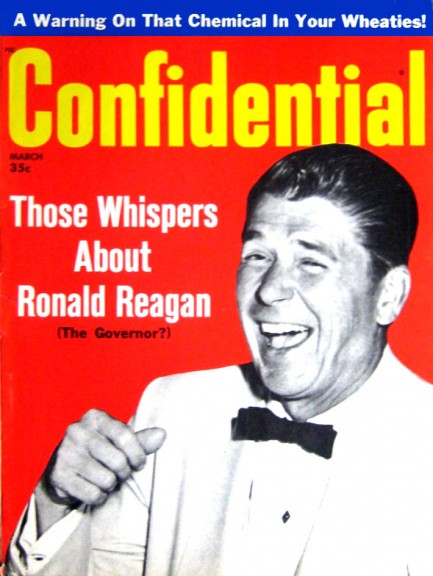
The old tabloids really savaged politicians. Liberals and conservatives alike got their turn and in this issue of Confidential from March 1967, Ronald Reagan gets roasted. The story by Roger Baldwin brands Reagan an “ex-pinko,” whispers about his “hushed-up divorce,” notes that a portion of his following is a “nut fringe,” and mentions “race-hate rumors” that surround him. There’s a line in all caps: Ronald Reagan Elected President. It’s a neat little trick, because he’d just been sworn in as Governor of California two months earlier, but the writer is actually referencing Reagan’s 1946 election to the presidency of the Screen Actors Guild, and using that event to hint at his 1968 White House ambitions (which, by the way, are derided as “a passion for power”). We won’t comment on the veracity of Baldwin’s claims, but his portrayal of Reagan does make us think of something that isn’t mentioned about Hollywood actors very often, if ever. Consider—none of them would make even a fraction of the money they do without their strong trade union, which means they owe what they have to the liberal ideal of worker solidarity. And yet many actors (and for that matter many athletes, also made fantastically rich largely thanks to unionization) are conservatives. It’s a bit of a paradox, don’t you think? In any case, Reagan survived Confidential’s scathing attack and made that all-caps line—Ronald Reagan Elected President—come true, not in 1968, but twelve years later.
 And while you're at it can you nuke me a cinnamon roll? 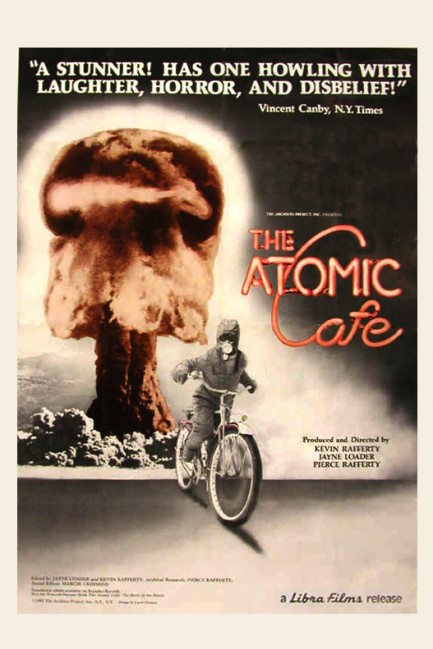
Put together by co-directors Jayne Loader and Kevin Rafferty, the documentary Atomic Café consists entirely of 50s and 60s-era film clips—many of them U.S. Army-produced—compiled into a sometimes hilarious, but ultimately devastating indictment of the American government’s deliberate (and successful) attempt to control public opinion about the nuclear bomb. It features archival footage of everyone from Ronald Reagan to J. Edgar Hoover, all of them doing their part to manipulate the citizenry, and shows us government-produced public service films so filled with fallacies you marvel that people were capable of believing them. Our favorite moment comes when an obese man is shown falling in his shower to illustrate that daily life has plenty of risk, thus there’s no need to fear a nuclear bomb. And we also get a doofus turtle named Bert advising us to duck and cover in the event of an attack, which is pretty glib advice coming from a creature born with nature’s bomb shelter on its back. But the most revealing and poignant part of this film is seeing America’s elation at having an atomic bomb turn so quickly and so overwhelmingly to terror upon learning the Soviets had figured it out too. The Atomic Café opened in the U.S. today in 1982.
 1950s tabloid aired Tinseltown’s dirty laundry to millions every month. 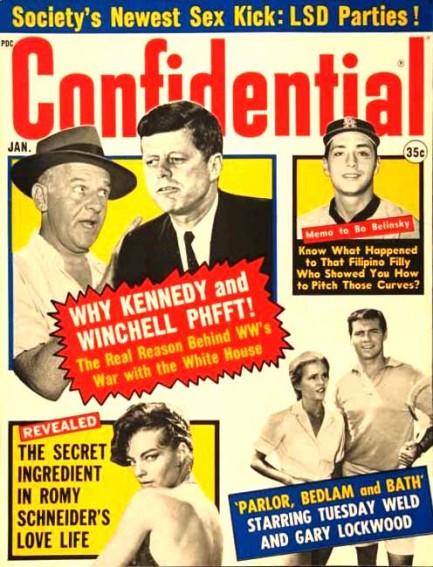
This month in 1952, right wing scandal rag Confidential hit newsstands for the first time. It was owned by Robert Harrison, who got his start in publishing at the New York Graphic, one of the earliest celebrity scandal sheets. Confidential was based in New York City, but its focus was Hollywood and its environs. To gather information Harrison cultivated a vast network of west coast informants—everyone from hotel concierges to taxicab dispatchers. The magazine was lurid, filled with doctored photos, and shamelessly exploitative of hot-button social fears. A typical issue might accuse Hollywood glitterati of using illegal drugs, sympathizing with communists, associating with other races, or working for the mob.
The formula worked. Within two years Confidential grew into a bestselling magazine. It screamed from American newsstands about interracial affairs, LSD parties, and backalley abortions, always in a glaring red-yellow motif that would become its visual trademark. Humphrey Bogart once famously called Robert Harrison “The King of Leer,” sentiments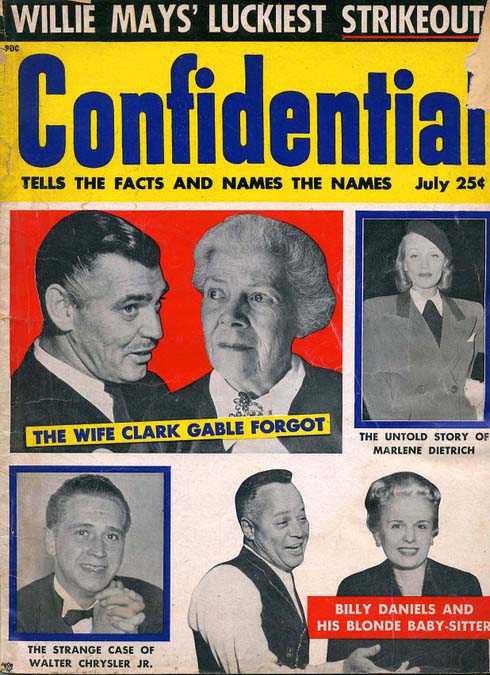 which were echoed throughout Hollywood. Stars were galled not just by the magazine’s constant attacks, but the fact that they originated from three-thousand miles away. It meant Confidential either fabricated its stories, or gathered info by means of spies. Neither possibility was pleasing to consider. which were echoed throughout Hollywood. Stars were galled not just by the magazine’s constant attacks, but the fact that they originated from three-thousand miles away. It meant Confidential either fabricated its stories, or gathered info by means of spies. Neither possibility was pleasing to consider.
Hollywood began fighting back. Ronald Reagan, who at the time was a snitch for Tinseltown’s hated blacklisters, chaired a committee that smeared Confidential staff. Postmaster General Arthur Summerfield 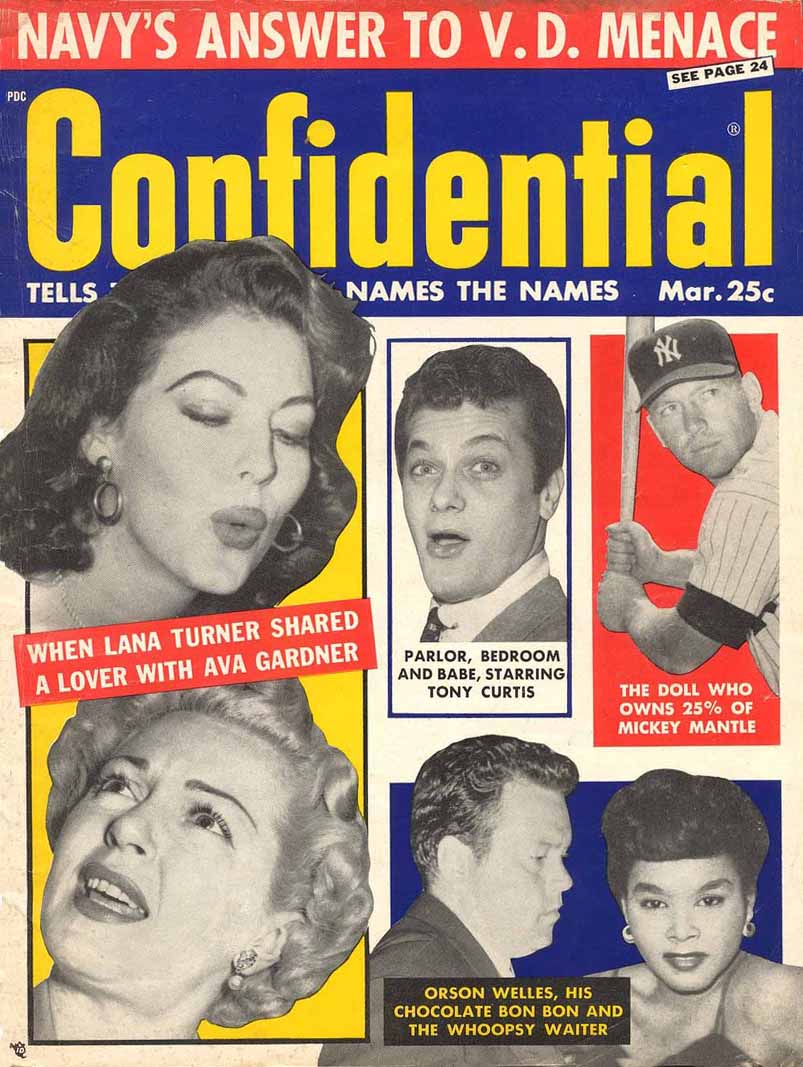 at one point banned mail delivery of the magazine. In 1957 the Kraft Commission put Robert Harrison on trial for conspiracy to publish criminal libel. The trial ended in a plea deal, but not before Hollywood stars realized their greatest ally was the legal system. Lawsuits kept Confidential in litigation from that point forward, and Harrison finally sold out in 1958.
The new owners managed to keep Confidential going, but mindful of lawsuits the magazine had lost under Harrison in 1956 and 1957, operated more cautiously. Soon, readers began to suspect the tabloid was no longer living up to its stated credo: “Telling the facts and naming the names”. Confidential stopped flying off newsstands. Sales dipped to a third what they had been at their zenith. A 1970s shift in editorial focus toward hippie counterculture did little to reverse fortunes, and Confidential finally folded in 1978.
Though defunct, its twenty-two year run was a success by almost any standard. Confidential outlasted a dozen competitors, and its influence extends into today’s newsstand tabloids, Hollywood-oriented television shows, celeb blogs, and even popular fiction. Author James Ellroy’s 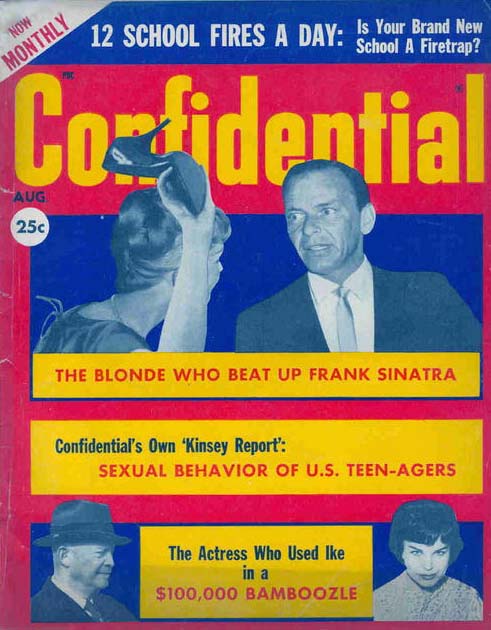 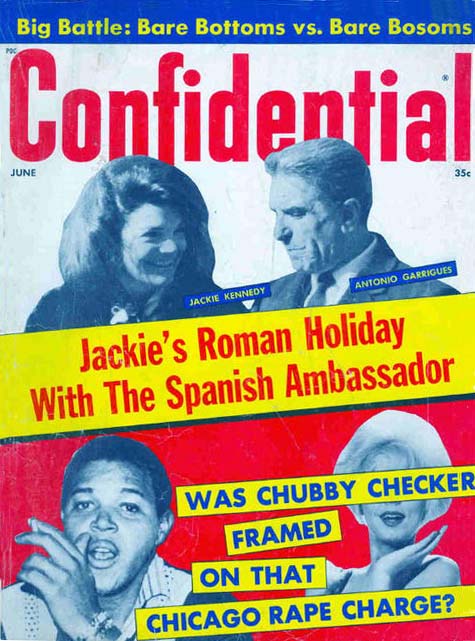 award-winning pulp thrillers frequently reference Hush Hush, a Confidential copycat. And Pultizer Prize winning columnist Stephen Hunter wrote a bestselling thriller about the Mafia’s presence in Hot Springs, Arkansas during the 1950s, a subject Confidential covered in its very first issue. award-winning pulp thrillers frequently reference Hush Hush, a Confidential copycat. And Pultizer Prize winning columnist Stephen Hunter wrote a bestselling thriller about the Mafia’s presence in Hot Springs, Arkansas during the 1950s, a subject Confidential covered in its very first issue.
|
 |
The headlines that mattered yesteryear.
1945—Mussolini Is Arrested
Italian dictator Benito Mussolini, his mistress Clara Petacci, and fifteen supporters are arrested by Italian partisans in Dongo, Italy while attempting to escape the region in the wake of the collapse of Mussolini's fascist government. The next day, Mussolini and his mistress are both executed, along with most of the members of their group. Their bodies are then trucked to Milan where they are hung upside down on meathooks from the roof of a gas station, then spat upon and stoned until they are unrecognizable. 1933—The Gestapo Is Formed
The Geheime Staatspolizei, aka Gestapo, the official secret police force of Nazi Germany, is established. It begins under the administration of SS leader Heinrich Himmler in his position as Chief of German Police, but by 1939 is administered by the Reichssicherheitshauptamt, or Reich Main Security Office, and is a feared entity in every corner of Germany and beyond. 1937—Guernica Is Bombed
In Spain during the Spanish Civil War, the Basque town of Guernica is bombed by the German Luftwaffe, resulting in widespread destruction and casualties. The Basque government reports 1,654 people killed, while later research suggests far fewer deaths, but regardless, Guernica is viewed as an example of terror bombing and other countries learn that Nazi Germany is committed to that tactic. The bombing also becomes inspiration for Pablo Picasso, resulting in a protest painting that is not only his most famous work, but one the most important pieces of art ever produced. 1939—Batman Debuts
In Detective Comics #27, DC Comics publishes its second major superhero, Batman, who becomes one of the most popular comic book characters of all time, and then a popular camp television series starring Adam West, and lastly a multi-million dollar movie franchise starring Michael Keaton, then George Clooney, and finally Christian Bale. 1953—Crick and Watson Publish DNA Results
British scientists James D Watson and Francis Crick publish an article detailing their discovery of the existence and structure of deoxyribonucleic acid, or DNA, in Nature magazine. Their findings answer one of the oldest and most fundamental questions of biology, that of how living things reproduce themselves.
|

|
|
It's easy. We have an uploader that makes it a snap. Use it to submit your art, text, header, and subhead. Your post can be funny, serious, or anything in between, as long as it's vintage pulp. You'll get a byline and experience the fleeting pride of free authorship. We'll edit your post for typos, but the rest is up to you. Click here to give us your best shot.
|
|