The unburnable Hitomi Kozue finally strikes gold. 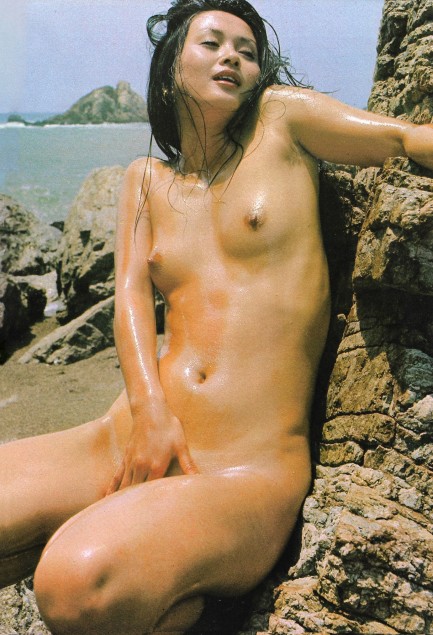 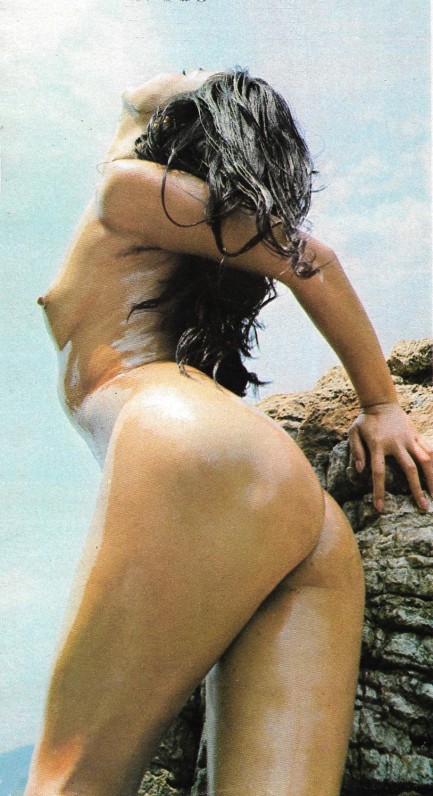
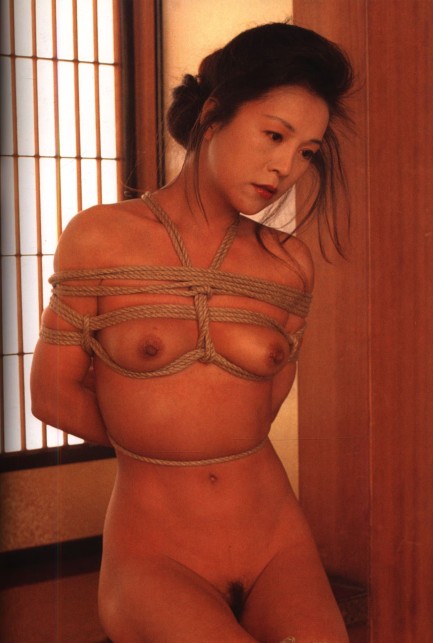
Japanese actress and eternal beauty Hitomi Kozue has finally gotten her tan perfect. She's been at it since last June, when we shared the first shot in a series she made for Heibon Punch. We checked in again a few months later and she still hadn't reached her ideal level of sun-baked luminescence. But now the star of such films as the 1974 Dirty Harry reinterpretation Sukeban Deka: daati Marii and the 1975 women-in-prison flick True Story of a Woman Condemned: Sex Hell is perfectly golden and her beach sojourn has come to a close. These two attention getting shots are the last from this particular session, but they're by no means the last photos of Kozue we have for you. She was prolific, and shall return.
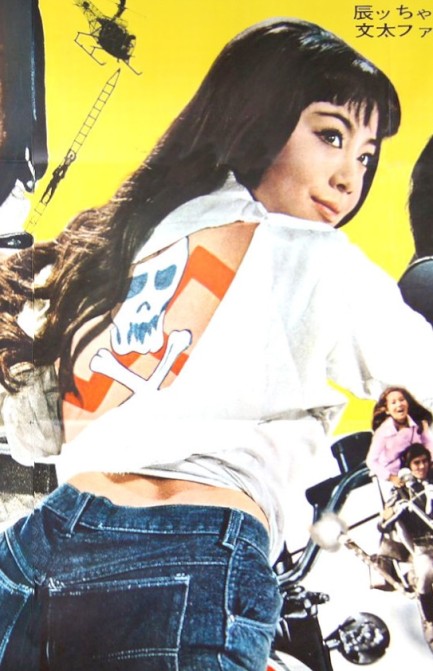
 Oshida makes her mark and it looks like a swastika. 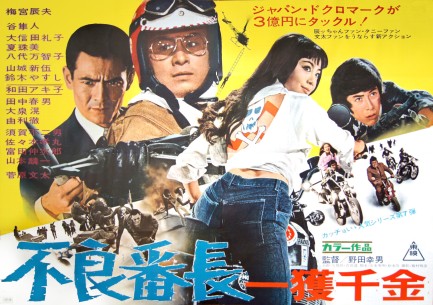
Above is a bo-ekibari style poster for the pinky violence actioner Furyô banchô: Ikkaku senkin, aka Wolves of the City: Fast Money. This piece is cousin to the standard sheet for the film we shared a couple of years ago. Just as when we showed you that one we haven't located the movie yet, but we'll keep working on it, if only to find out why star Reiko Oshida has a swastika on her back. We're guessing she's in a motorcycle gang, and it's their emblem. Furyô banchô: Ikkaku senkin premiered today in 1970. You can see the other poster here, and that entry also discusses briefly the swastika symbol in Japanese culture.
 The lone stranger rides again. 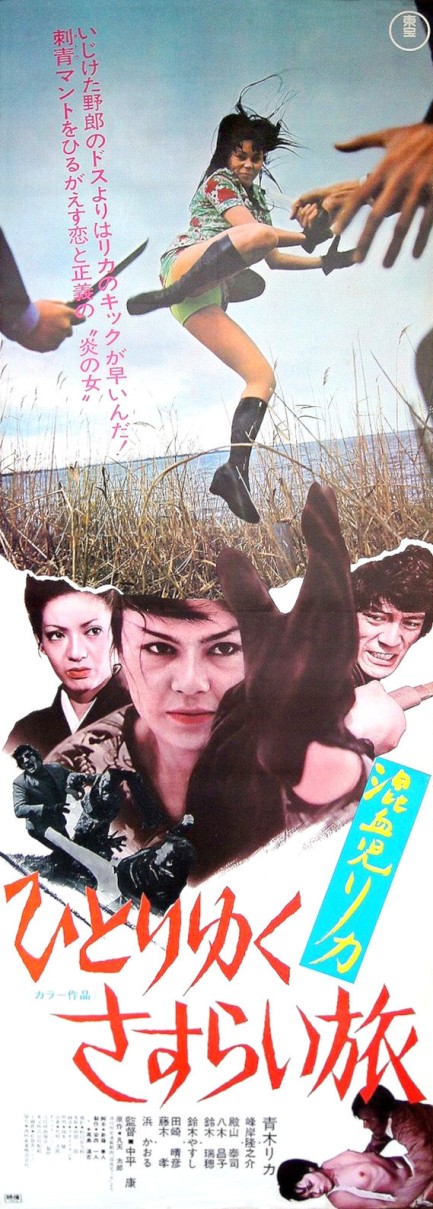 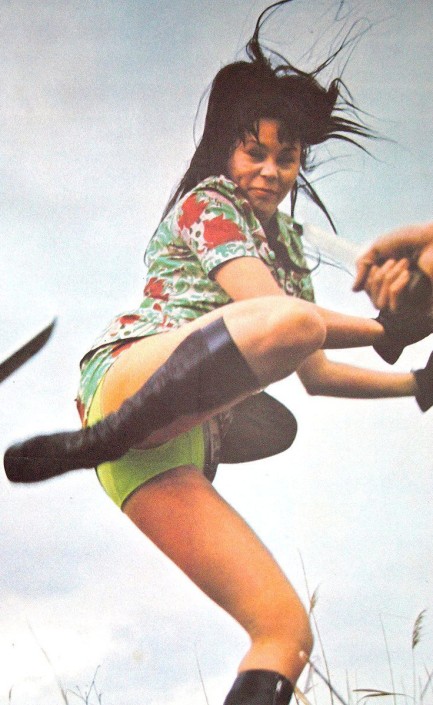
We usually watch movies in the order we're able to acquire them, so as a matter of availability we ended up watching parts one and three in the Rika the Mixed Blood Girl trilogy without having seen the middle entry. Last night we remedied that and screened part two, Konketsuji Rika: Hitoriyuku sasuraitabi, known in English as Rica 2: Lonely Wanderer. You see a rare tateken style poster for the film above—along with a nice zoom—that you won't find anywhere but on Pulp Intl. We already expounded upon the change in spelling of Rika's name in the English title a while back. Shorter version: we don't know why Rica makes more sense than Rika. Probably it doesn't. Take it up with the honchos at Kindai Eiga Kyokai.
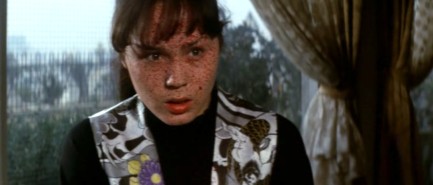
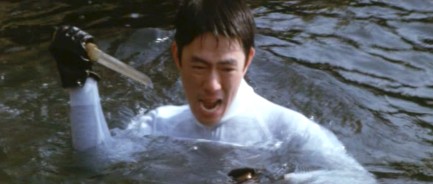
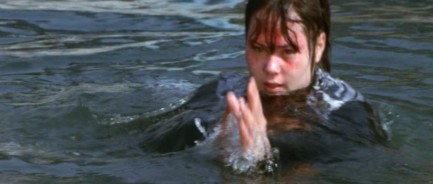
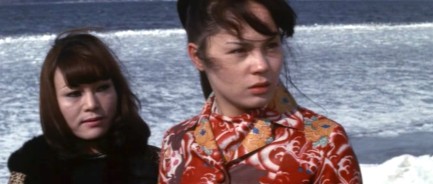
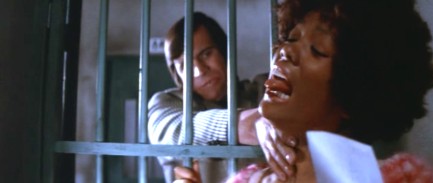
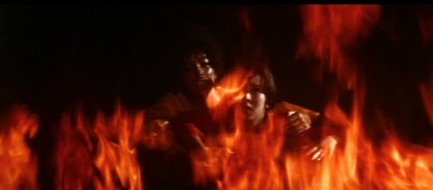
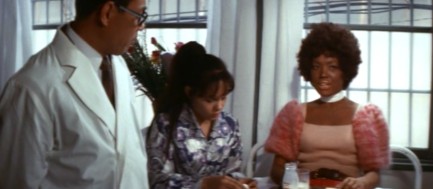
Rika 2/Rica 2 stars Rika Aoki and she's once again required to right wrongs, as she escapes from the frying pan of reform school and lands in the fire of urban crime and other hazards endemic to pinku cinema. The main plot involves a ship that exploded and sank in Misawa harbor, and a survivor—Rika's friend Hanako—who's in a mental hospital as a result. But Hanako is mentally fine. She's actually hiding in the one place hired killers can't reach her. Turns out the ship was yakuza owned, and everyone who survived is being hunted down. Rika goes to the police and demands an investigation, but the cops are yakuza owned too. Why must everyone who survived the ship disaster be killed? How high does the conspiracy go?
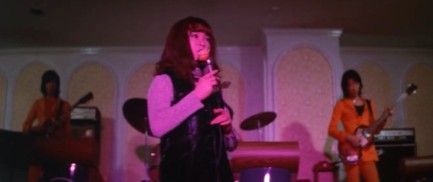
Rika handles her business with moral outrage and violence, but she also has time for a musical number or two. She's the Dylan of the Misawa nightclub district. Check out her lyrical stylings: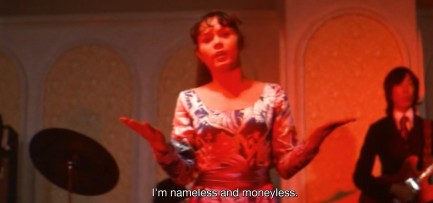  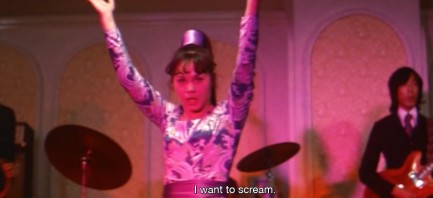
As with the other films, some of the action in Rika 2/Rica 2 veers into slapstick. Also like the other films, there are racial and political digressions, and they aren't subtle. For instance, when Rika and a friend are accosted by Americans at one point, the group consists of one cowboy, one hippie, one guy dressed in a suit, etc. Later Rika is told point blank that it's lucky she's half white, because being half black like her friend Hanako would make her even more inferior to anyone fully Japanese. These are villains talking to her. The movie's default setting is anti-racist, which of course is correct and moral, but it's funny how what's considered racist evolves over time. Hanako is played by Japanese actress Masami Souda in shoe polish and an afro wig. Oops! For pinku cinema, it's just another day. But all-in-all, a reasonably fun one. Konketsuji Rika: Hitoriyuku sasuraitabi premiered in Japan today in 1973.
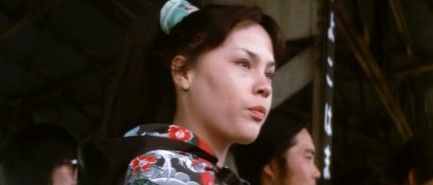     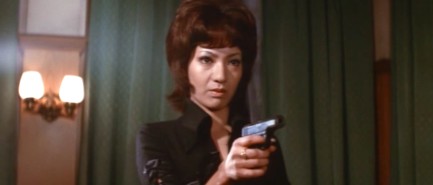   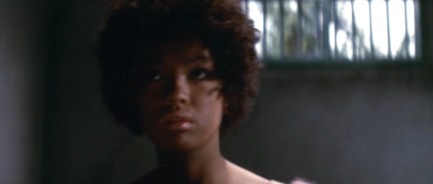       
 All you need is one part Reiko and you'll be completely intoxicated. 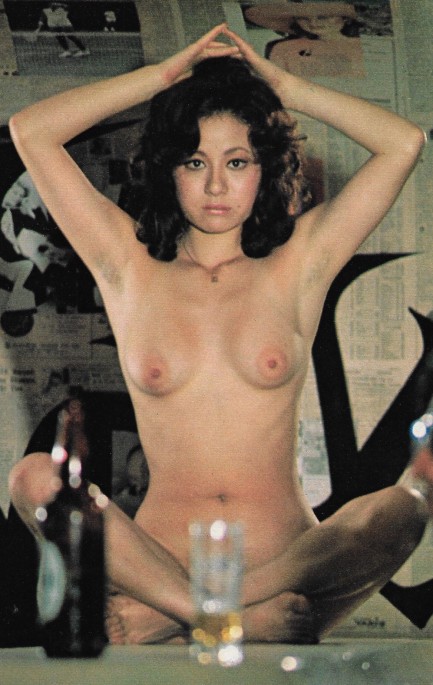
Above is another look at Reiko Ike perched on a Kyoto bartop from a 1972 promo series that appeared in the Japanese magazine Heibon Punch. As we mentioned, the location was used in her action movie Sukeban gerira. We'll try to get around to posting more shots from the series at some point. In the meantime, you can see the previous photo here.
 In Japan business is war—complete with innocent bystanders. 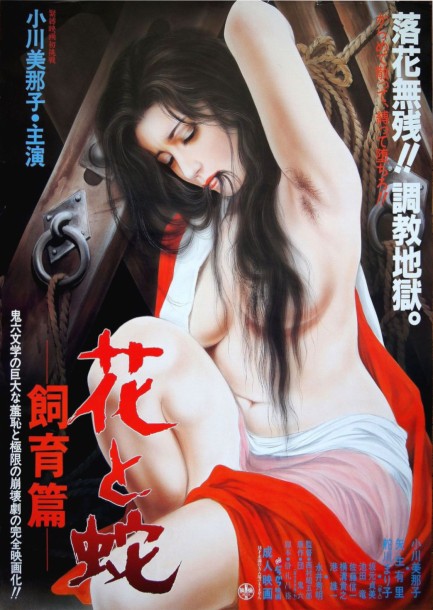
This brilliant promo was painted for Hana to hebi: Shiiku-hen, known in English as Flower and Snake 3: Punishment. It starred Minako Ogawa of Dan Oniroku ikenie shimai, aka Sisters To Be Sacrificed, and in fact the same painter must have produced both posters. Have a look. The central figure is almost identical, no? Right down to her hairy armpits. Since there's no official info on who the artist is we'll throw in our two cents. It was bondage painter Kaname Ozuma. He painted at least one other poster for the Flower and Snake series, which you can see here. In the meantime this piece is literally nowhere else to be found in the quality you see here. At least, as far as we can tell.
We watched the film and it's a typically perverse roman porno tale about a powerful businessman married to Minako Ogawa, who he stole from a subordinate who was helpless to prevent it. When he later declines to help a business associate out of a jam that person has Ogawa kidnapped—literally thrown into a giant bag—taken to an isolated house, sexually assaulted, and coercively trained using bondage, a kielbasa, and other esoterica in order to turn her into a performer for live sex shows. That's a hell of a twisted retaliation for being refused financial help, but twisted is what roman porno is all about.
Of technical note is the fact that, though it was illegal to show pubic hair in Japanese movies, the ever clever roman porno filmmakers found a loophole. They have Ogawa's captors, as part of her torment, cut off her pubic hair with scissors. Though it couldn't be shown attached to her body without bringing down the wrath of censors, they got away with showing it falling into bathwater. You gotta give the pervs credit. They were always thinking outside the—er—box. Hana to hebi: Shiiku-hen premiered in Japan today in 1986.
After a long day on the set filming sex and bondage... I'm very happy to spend the evening doing this.

 She's a woman completely without restraint. 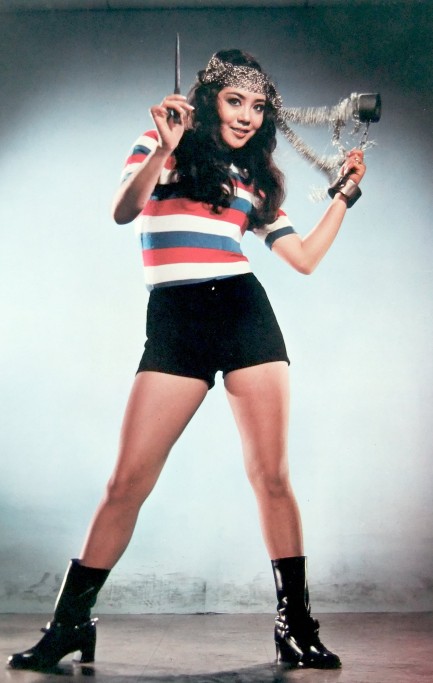
We bet you didn't notice that Japanese actress Reiko Oshida is swinging handcuffs in a circle. We understand. You'd tend to notice other elements of the photo first, like the knife, the boots, the shorts, or the stripes. This promo image was made for her 1971 pinky violence actioner Delinquent Girl Boss: Worthless To Confess, which was originally titled Zubekô banchô: zange no neuchi mo nai. A similar pose was used on the movie's poster, which you can see here. And if you're very interested, you can see alternate posters here and here, and Oshida with her crew of sword maniacs here. She shall return.
 Three times the danger, three times the fun. 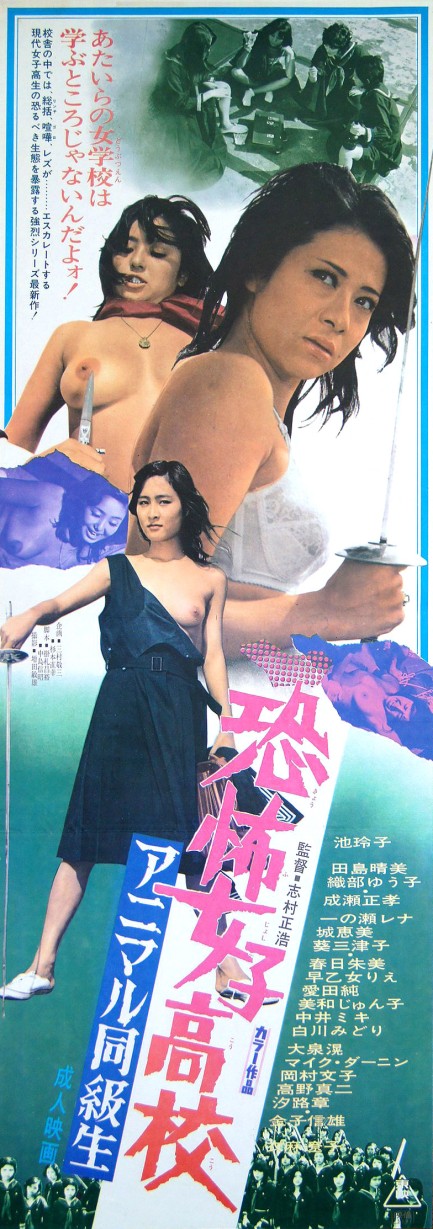
We talked about Reiko Ike's 1974 pinky violence flick Kyôfu joshi kôkô: Animal dôkyôsei—known in English as Terrifying Girls High School: Animal Courage—a long while ago, but we wanted to highlight this rare promo in tateken format. You can see the original poster and learn a bit about the film here.
 1001 nights is not nearly enough time with Ayako Meki, Erina Miyai, and Izumi Shima. 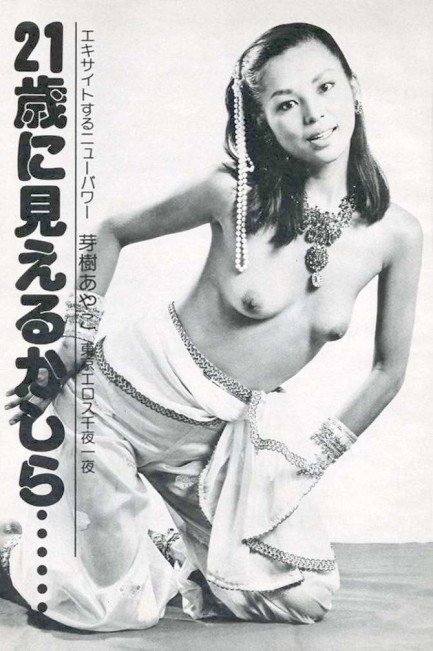
A few years ago we shared an ultra rare tateken promo for the 1001 Nights inspired roman porno flick Tokyo eros senya ichiya. That poster was a follow-up to a standard poster we'd shared back in 2017. In both cases the movie was unavailable for us to watch. Well, above you see a magazine page featuring the movie's co-star Ayako Meki. This isn't directly a promo for the film, but she's dressed in character. The text says “because you look 21,” which is weird, and goes on to describe her as “an exciting new power.” We're showing this to you because the movie premiered today in 1979, and this time we did have a copy to watch.
Known in English as Eros Nights in Tokyo, the story here involves lonely young Kiyoyasu Adachi and three women in his life—Izumi Shima, Ayako Meki, and Erina Miyai. We can't fault the guy's taste, but we do take exception to his methods. He succumbs to creepy urges such as spying on Shima (who's his stepmother), attempting to force a kiss upon Meki (which devolves into a full-scale perv attack), and looking up the skirt of Miyai (who's mentally disabled). Later he grows a bit more subtle in his attempts to indulge his urges, such as when he convinces Shima to accept a personalized wash, full body massage, and more. After that nipply nuru session, his stepmom is fully on board with further advances.
By now it's clear to the viewer that fantasy has overtaken reality for Adachi. We've seen this line crossed in numerous films, and it's usually a subtle trip across the border. When did it happen here? It's hard to be sure, but probably sometime after Adachi was chased by a policeman that somehow multiplied into an entire Keystone Kops style squad, and sometime before he was showered with a fortune in gold coins from a fountain.
All this stuff is mostly played for laughs, and indeed there are some legitimately funny moments, though not nearly as many as the filmmakers intended. We're talking about a Nikkatsu Studios roman porno production, which means that even as comedy it has the usual trappings of that genre, and those trappings just aren't humorous. For example, there's an attempted gang rape, which Adachi foils in full gangster mode, as the entire situation morphs into a set piece right out of American grindhouse cinema. Funny? No. Creative. For sure.
As we've mentioned before, by 1979 Nikkatsu was trying new ideas for its roman porno line, and Tokyo eros senya ichiya certainly qualifies. It's hard to judge such an outrageous flick objectively, so we won't try except to say that it's well made, as these films always are. We will mention, though, that we were disappointed none of the stars wore a harem costume. It turns out that 1001 Nights was a more oblique inspiration than we assumed. Have a look at the other posters here and here and you'll see what we expected. Do we recommend the film? Yes, of course. It has Izumi Shima. Full stop. 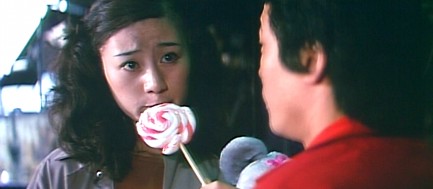 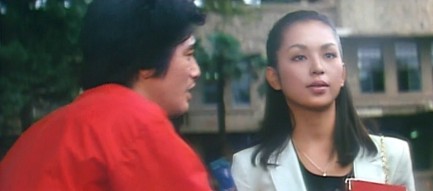 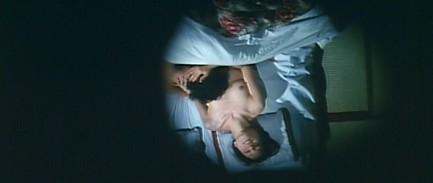 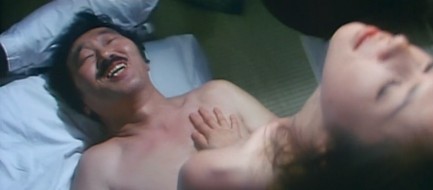 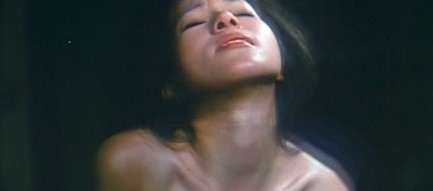 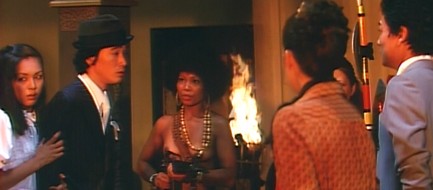    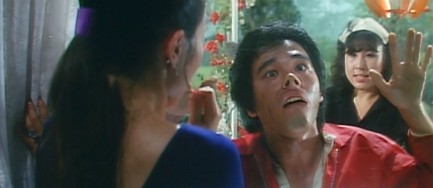 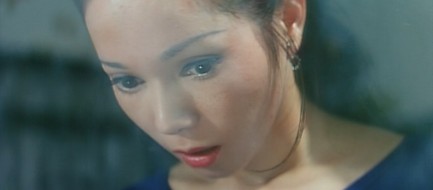 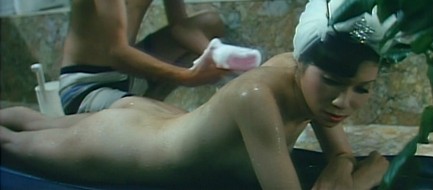 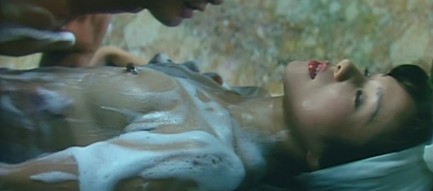 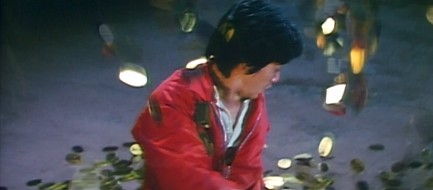
 She shot an arrow into the air, it fell to Earth— Well, nobody knows where because they weren't watching the arrow. 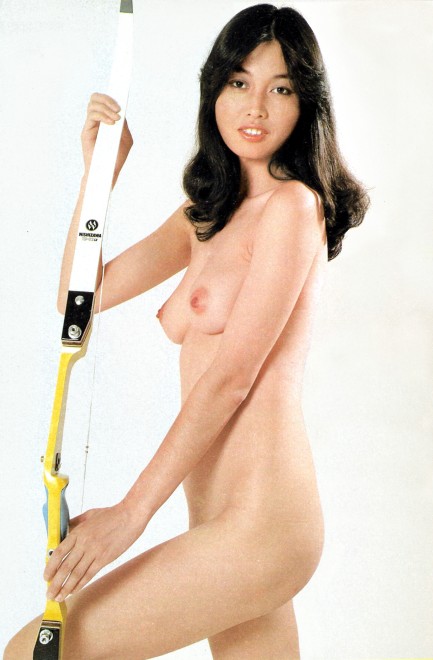
Japanese actress Maria Mari poses with a fancy Nishizawa recurved archery bow, which like the arrow she shot nobody is bothering to pay an iota of attention to. It's understandable. Mari looks quite beautiful and slender here in this photo from 1980. The image is part of a series of seven published in Weekly Playboy featuring different actresses posed with sports and recreation gear. You'll be seeing the other shots as the months roll onward. In the meantime you can see a bit more Mari here and here.
 What's a girl have to do to get service in this joint? 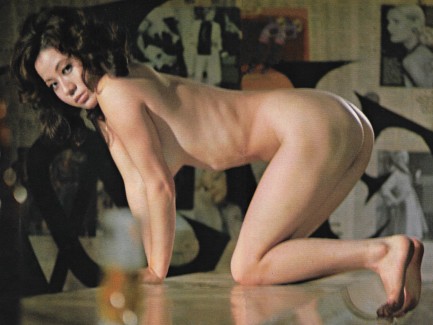
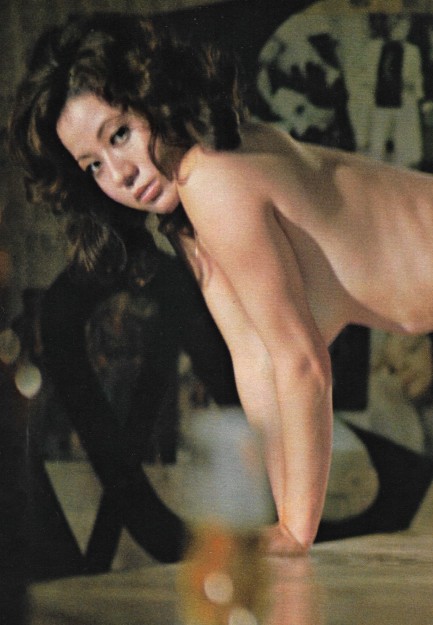
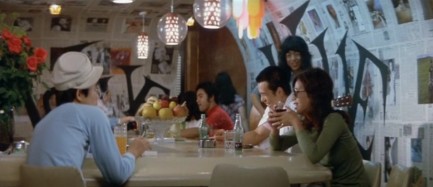
In this photo from a 1972 issue of Heibon Punch we see cinema star Reiko Ike, who decided to hit the Kyoto nightlife scene, but after terribly slow service was forced to take matters into her own hands and hop across the bar in an effort to get a mai-tai. In the bartender's defense, he didn't ignore Reiko intentionally. He fainted when she came in the door. This is (or was) a real world Kyoto bar that appeared in the pinky violence flick Sukeban gerira, aka Girl Boss Guerrilla, which Reiko had a major role in. The photo isn't an official promo from the film. At least, the magazine text doesn't mention it. But we recognized the place. In any case, Reiko got her mai-tai. Until the bartender regains consciousness drinks are on the house, and she's the toast of the town.

|
 |
The headlines that mattered yesteryear.
1945—Mussolini Is Arrested
Italian dictator Benito Mussolini, his mistress Clara Petacci, and fifteen supporters are arrested by Italian partisans in Dongo, Italy while attempting to escape the region in the wake of the collapse of Mussolini's fascist government. The next day, Mussolini and his mistress are both executed, along with most of the members of their group. Their bodies are then trucked to Milan where they are hung upside down on meathooks from the roof of a gas station, then spat upon and stoned until they are unrecognizable. 1933—The Gestapo Is Formed
The Geheime Staatspolizei, aka Gestapo, the official secret police force of Nazi Germany, is established. It begins under the administration of SS leader Heinrich Himmler in his position as Chief of German Police, but by 1939 is administered by the Reichssicherheitshauptamt, or Reich Main Security Office, and is a feared entity in every corner of Germany and beyond. 1937—Guernica Is Bombed
In Spain during the Spanish Civil War, the Basque town of Guernica is bombed by the German Luftwaffe, resulting in widespread destruction and casualties. The Basque government reports 1,654 people killed, while later research suggests far fewer deaths, but regardless, Guernica is viewed as an example of terror bombing and other countries learn that Nazi Germany is committed to that tactic. The bombing also becomes inspiration for Pablo Picasso, resulting in a protest painting that is not only his most famous work, but one the most important pieces of art ever produced. 1939—Batman Debuts
In Detective Comics #27, DC Comics publishes its second major superhero, Batman, who becomes one of the most popular comic book characters of all time, and then a popular camp television series starring Adam West, and lastly a multi-million dollar movie franchise starring Michael Keaton, then George Clooney, and finally Christian Bale. 1953—Crick and Watson Publish DNA Results
British scientists James D Watson and Francis Crick publish an article detailing their discovery of the existence and structure of deoxyribonucleic acid, or DNA, in Nature magazine. Their findings answer one of the oldest and most fundamental questions of biology, that of how living things reproduce themselves.
|

|
|
It's easy. We have an uploader that makes it a snap. Use it to submit your art, text, header, and subhead. Your post can be funny, serious, or anything in between, as long as it's vintage pulp. You'll get a byline and experience the fleeting pride of free authorship. We'll edit your post for typos, but the rest is up to you. Click here to give us your best shot.
|
|