| Vintage Pulp | Apr 11 2023 |



| The Naked City | Jan 20 2015 |

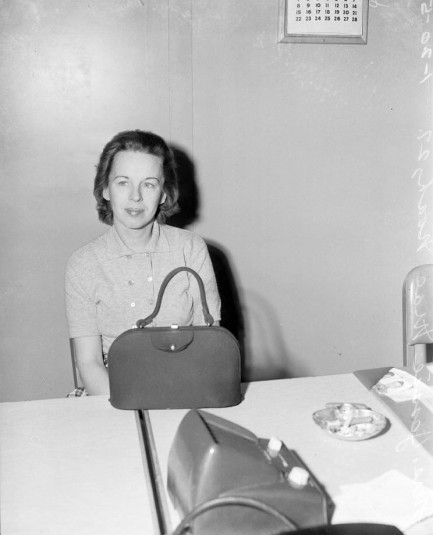
This photo made today in 1959 shows a woman named Jessie Mae Noah, who Los Angeles police had arrested and were questioning in connection to a crime that had occurred seven weeks earlier. On that December night a Samuel Goldwyn Studios suit named Kenneth Savoy walked into the In Between Café on Melrose Avenue during the time two men—one holding a sawed-off shotgun—were in the process of robbing it. Having collected the money and valuables of eight patrons and the contents of the cash register, they demanded Savoy’s wallet, and perhaps having watched too many of his own movies, he replied that if they wanted it they’d have to shoot him. That hard-boiled response earned him a load of buckshot in the stomach. The robbers scampered to their getaway car—where Jessie Mae Noah was waiting in the rear seat—and fled the scene.
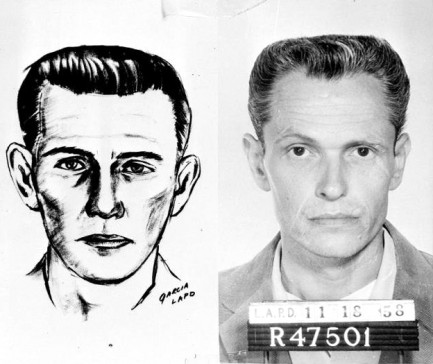
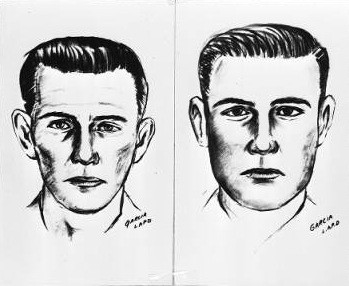 After police published composite sketches of the robbers in the newspapers, Noah contacted police, resulting in the photo op at top. The robbers—George Scott and Curtis Lichtenwalter—were arrested later (for those who wonder whether composite sketches are ever accurate, check the comparison between Scott and his likeness at bottom).
Scott had fled all the way to Texarkana, Arkansas, and gave up only after a shoot-out with police at a motel. Jessie Mae Noah claimed she’d had no idea her two acquaintances were planning a robbery, and that she had simply gone for a ride with them for kicks. She avoided a murder charge, but Scott and Lichenwalter were both found guilty of robbery and first degree homicide. Scott—the triggerman—was gassed to death by the state of California in September 1960. And as for the victim Kenneth Savoy, you have to wonder what he thought in that instant when the shotgun went off. We suspect he thought that maybe calling bluffs was something best left to the stars of action films.

| Femmes Fatales | Musiquarium | Sep 27 2014 |


| The Naked City | Feb 17 2011 |

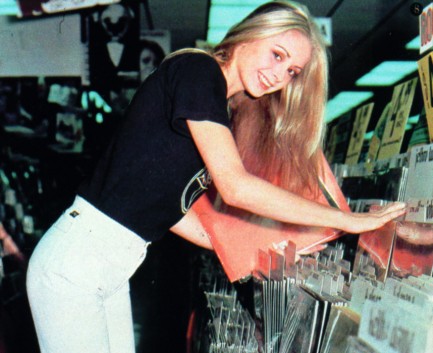
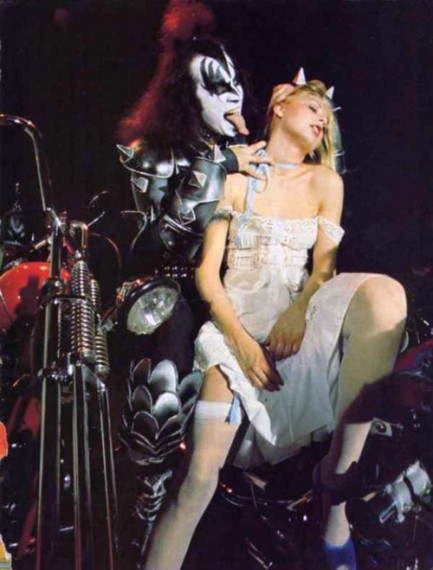
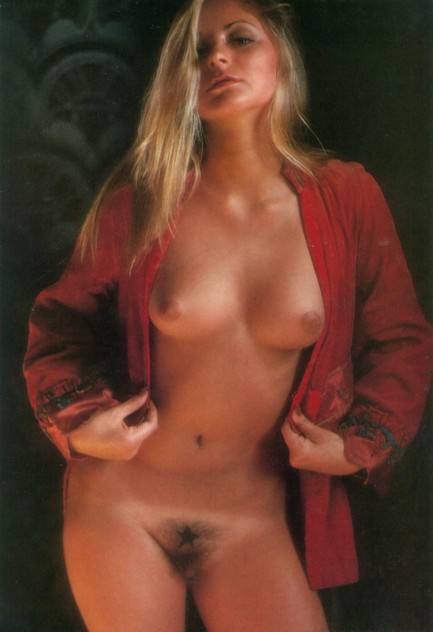
She was born Ellen Louise Stowe in Little Rock, Arkansas, but she called herself Star because of her fascination with the sky. She even got a big blue star tattooed below her bikini line. She moved to Los Angeles with ambitions to become a dancer and caught the eye of a Playboy scout while performing at a strip bar. From that point forward she met lots of celebrities and made connections. She was acquainted with Kiss bassist Gene Simmons, dated him, and posed for a Kiss picture disc. Offered an opportunity to be a Playmate of the Month, she accepted and was featured in the magazine’s February 1977 issue.
On March 16, 1997 she was found strangled and dumped behind an Eckerd pharmacy. Another area prostitute named Sandra Kay Walters had been strangled in the same manner weeks earlier, leading police
 to believe both women had been victims of the same assailant. But leads were scarce. Later in 1997 another woman named Tammy Strunk was found dead in a shopping center trash bin in the city of Plantation, Florida. Before the year ended a woman named Theresa Kettner was found dead in Coral Springs. By then police had to admit they probably had a serial killer on their hands.
| Intl. Notebook | Feb 5 2010 |

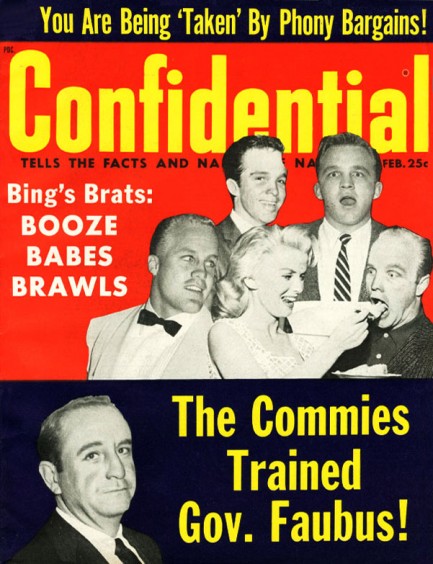
The above issue of Confidential is less visually chaotic than usual on the cover, but packs a wallop inside. The communist tag they’ve slapped on Arkansas Governor Orval Faubus stems from his having attended a leftist school. His political opponent in a 1954 election run-off tried to use it against him, but Faubus won anyway. In 1957, Faubus, at the time facing a serious primary challenge from an unapologetic segregationist, called in the National Guard to close high schools in Little Rock in an effort to prevent black students from attending them. The event made him, for a time, the face of the conservative South, as photos of Faubus speaking to crowds from the front stairs of Central High School circulated around the world. Two years afterward, in 1959, Confidential published this issue. So Faubus was branded a leftist, then a rightist. then a leftist again.
Some historians argue that Faubus, who had been elected student body president at that leftist school (Commonwealth College in Mena, Arkansas), harbored few if any racist beliefs, but by closing Little Rock high schools was merely trying to win an election by proving to the sizable racist electorate in Arkansas that, yes, he too could deny equal rights to African Americans. There’s also the question 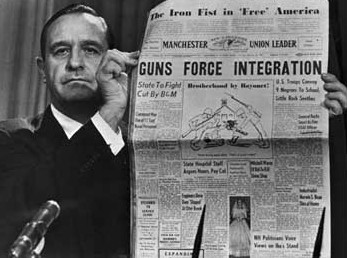 of whether he did it to prevent white mobs from taking violent action against black kids, since he had allegedly been convinced violence was imminent. And it could be argued that if his ultra rightwing rival had defeated him Arkansas would have been far worse off.
The first reading paints Faubus as an opportunist, while the second casts him as more of a good-intentioned pragmatist. Both speak to the reality of politics, where sticking to your principles becomes a dodgy proposition when doing it might cost your job. Viewed from the perspective of a black highschooler, any man who enforces the prevailing system of apartheid is a bad man—political realities nothwithstanding. There's no doubt that bowing to racists and fanatics is cowardly by any measure. So what was Faubus—the man—in the end? We may never know.
Needless to say, quite a furor erupted over the revelations. Even today, you can find apologist websites explaining that Bing’s childrearing techniques were not so harsh for the times, and attack websites that paint him as a murderous tyrant. Phillip Crosby disputed many of the claims in
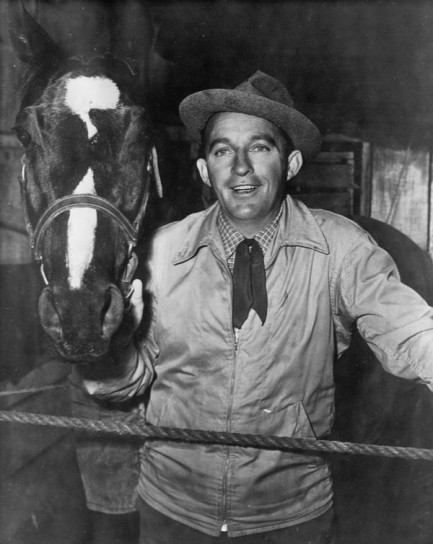 his brother’s book, but Lindsey and Dennis backed Gary’s account. Their suicides by gunshot, six and eight years later, respectively, serve as the debate’s curious exclamation points. But Bing Crosby—whether monstrous abuser or victim of slander—remains an American icon to this day, and books written by other family members portray him as a loving father. As with Governor Faubus, in the end, we may never know what he really was. Both stories prove the old adage true: History depends on who’s doing the telling.
| Hollywoodland | Dec 2 2008 |

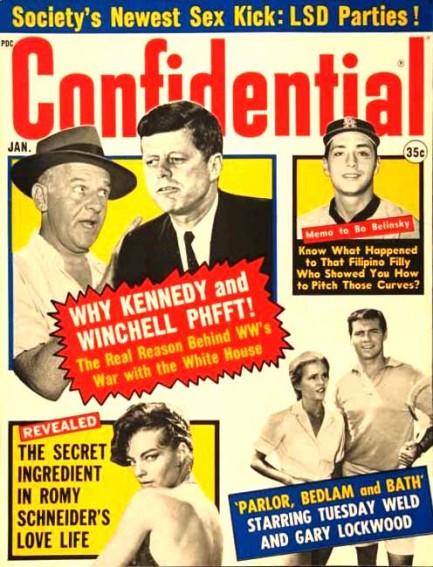
This month in 1952, right wing scandal rag Confidential hit newsstands for the first time. It was owned by Robert Harrison, who got his start in publishing at the New York Graphic, one of the earliest celebrity scandal sheets. Confidential was based in New York City, but its focus was Hollywood and its environs. To gather information Harrison cultivated a vast network of west coast informants—everyone from hotel concierges to taxicab dispatchers. The magazine was lurid, filled with doctored photos, and shamelessly exploitative of hot-button social fears. A typical issue might accuse Hollywood glitterati of using illegal drugs, sympathizing with communists, associating with other races, or working for the mob.
The formula worked. Within two years Confidential grew into a bestselling magazine. It screamed from American newsstands about interracial affairs, LSD parties, and backalley abortions, always in a glaring red-yellow motif that would become its visual trademark. Humphrey Bogart once famously called Robert Harrison “The King of Leer,” sentiments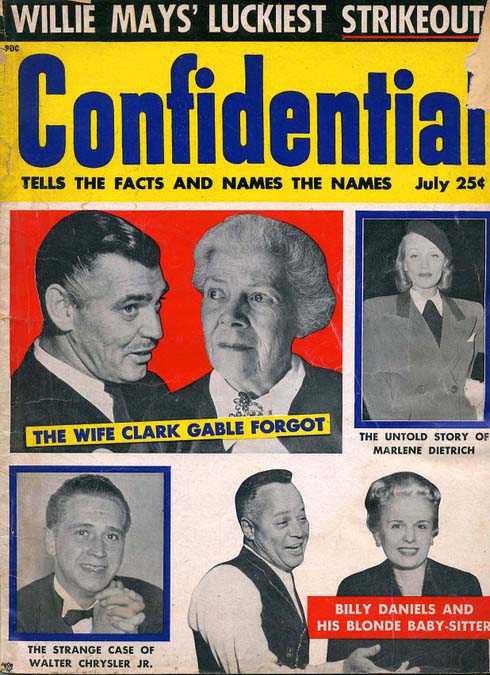 which were echoed throughout Hollywood. Stars were galled not just by the magazine’s constant attacks, but the fact that they originated from three-thousand miles away. It meant Confidential either fabricated its stories, or gathered info by means of spies. Neither possibility was pleasing to consider.
Hollywood began fighting back. Ronald Reagan, who at the time was a snitch for Tinseltown’s hated blacklisters, chaired a committee that smeared Confidential staff. Postmaster General Arthur Summerfield 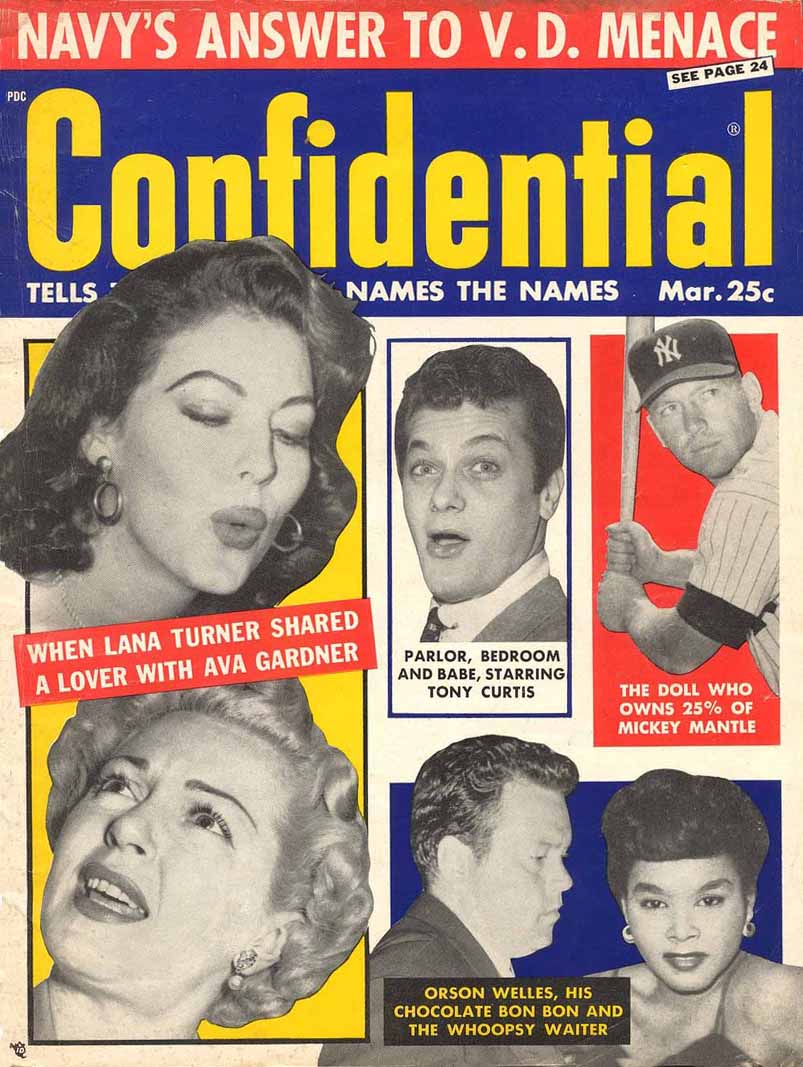
at one point banned mail delivery of the magazine. In 1957 the Kraft Commission put Robert Harrison on trial for conspiracy to publish criminal libel. The trial ended in a plea deal, but not before Hollywood stars realized their greatest ally was the legal system. Lawsuits kept Confidential in litigation from that point forward, and Harrison finally sold out in 1958.
The new owners managed to keep Confidential going, but mindful of lawsuits the magazine had lost under Harrison in 1956 and 1957, operated more cautiously. Soon, readers began to suspect the tabloid was no longer living up to its stated credo: “Telling the facts and naming the names”. Confidential stopped flying off newsstands. Sales dipped to a third what they had been at their zenith. A 1970s shift in editorial focus toward hippie counterculture did little to reverse fortunes, and Confidential finally folded in 1978.
Though defunct, its twenty-two year run was a success by almost any standard. Confidential outlasted a dozen competitors, and its influence extends into today’s newsstand tabloids, Hollywood-oriented television shows, celeb blogs, and even popular fiction. Author James Ellroy’s 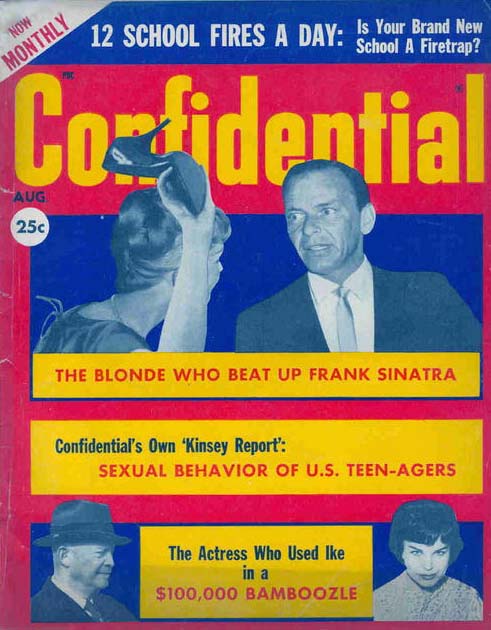
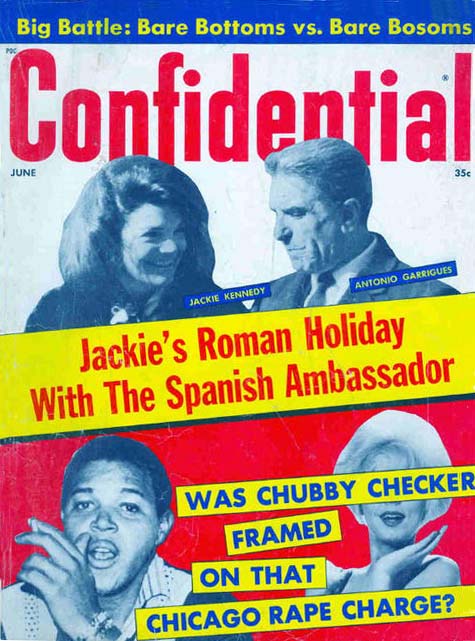 award-winning pulp thrillers frequently reference Hush Hush, a Confidential copycat. And Pultizer Prize winning columnist Stephen Hunter wrote a bestselling thriller about the Mafia’s presence in Hot Springs, Arkansas during the 1950s, a subject Confidential covered in its very first issue.