 So long, suckers! There'll never be a star like me again. 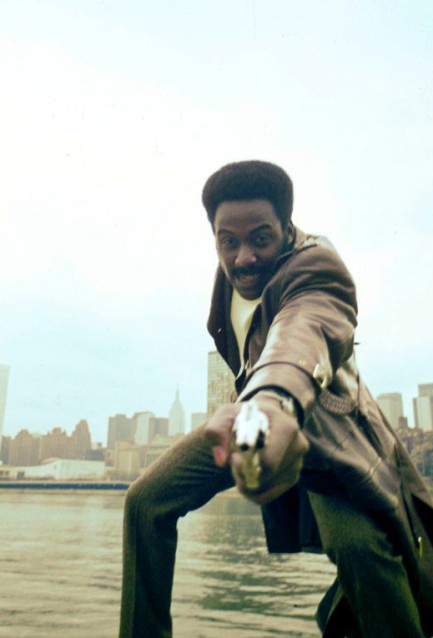
Richard Roundtree, during his long show business career, appeared in scores of movies and television shows, but his first film role was in Shaft and he'll always be known for what can only be described as a cultural awakening, a watershed moment that moved black-centered cinema into the mainstream. It precipitated a flood of capital brought to bear on the genre by investors seeking easy returns, which undermined blaxploitation cinema much same way capital brings a flood of condos to a thriving ethnic neighborhood. Even so Shaft has stood the test of time, is one of the better action movies of the 1970s, generated the sequels Shaft's Big Score and Shaft in Africa, as well as a series of novels, and has remained within the American consciousness thanks to its popular soundtrack, its many lyrical references in hip-hop, and its one-of-a-kind star. Roundtree died today at age eighty-one.
 She had nothing left to hang onto. 
Arabella Árbenz, née Arabella Árbenz Vilanova, was born and raised in our former (and still beloved) home Guatemala, moved to Canada for college, and became a fashion model in France. She also tried acting and had one credited role, playing the lead in the 1965 drama Un alma pura, which was made in Mexico. We've seen it, and she's decent in it, enough so that we suspect she'd have had a future on the screen. But nothing having to do with Guatemala is ever simple, therefore Arabella's life had many twists and turns. She was the daughter of Jacobo Árbenz, who was elected president of Guatemala in 1951, but was overthrown in a CIA sponsored coup lobbied for by the United Fruit Company. Under the collaborationist dictator Jorge Ubico Castañeda, United Fruit had been given 99-year leases on millions of acres of land amounting to 42% of the country's total area, and was exempted from taxes. Arabella didn't weather her family's subsequent exile well, and after problems in romance and with drugs, in 1965 shot herself dead in front of her paramour, Mexican bullfighter Jaime Bravo Arciga, in Colombia, at age twenty-five.
 Raquel Welch's popularity was unmatched by any other sex symbol of her time. 
Raquel Welch died a few days ago, but as we've mentioned several times, we don't want Pulp Intl. to become a death roll, so we rarely write about celebrities passing. But because Welch is unique we decided to do something on her that day, then realized her iconic sci-fi movie One Million Years B.C. premiered in the U.S. today in 1967, so we decided to wait to share some of photos of Welch in her famous fur bikini. These represent a fraction of the shots made of her in this costume, because Welch was one of the most photographed people in Hollywood at the time, and there was—shall we say—plenty of public interest in her fuzzy two-piece. One Million Years B.C. proved that quality was no barrier to a film becoming a global hit and cultural phenomenon, and Welch was so revered and desired that she emerged an even bigger star even after headlining such puerile, anti-scientific dreck. We're just being honest. She made some pretty good films, but One Million Years B.C. wasn't one of them. Yet it's the one everyone will remember. You can see other fur bikini photos here, here, here, and here.               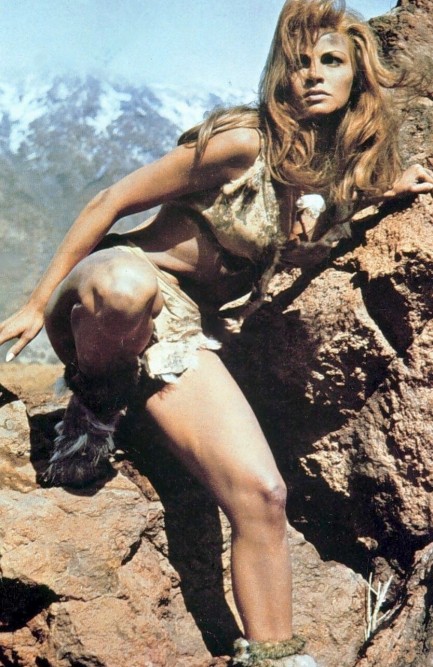    
 Poitier heads to parts unknown after a long and unique career. 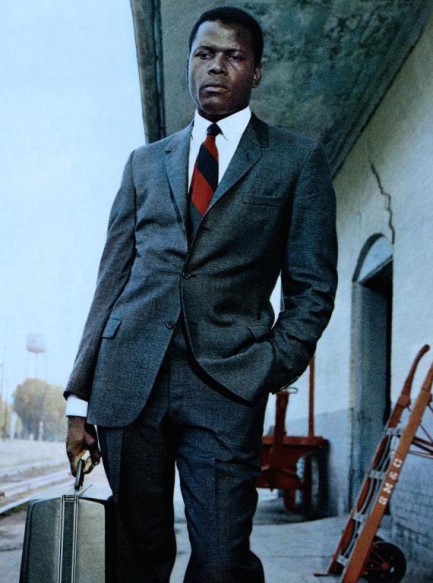
Above is a photo of one-of-a-kind actor and cultural icon Sidney Poitier, who died yesterday aged ninety-four in the Bahamas, where he was born and lived much of his life. He starred in a couple of our favorite lightweight movies, including 1961's Paris Blues and 1992's Sneakers, but this shot is from 1967's unforgettable and topical drama In the Heat of the Night, one of many landmark movies in which he starred. He changed the game. That's really all you can say. See another cool shot of him here.
 Sheena embarks a day late on a long journey. 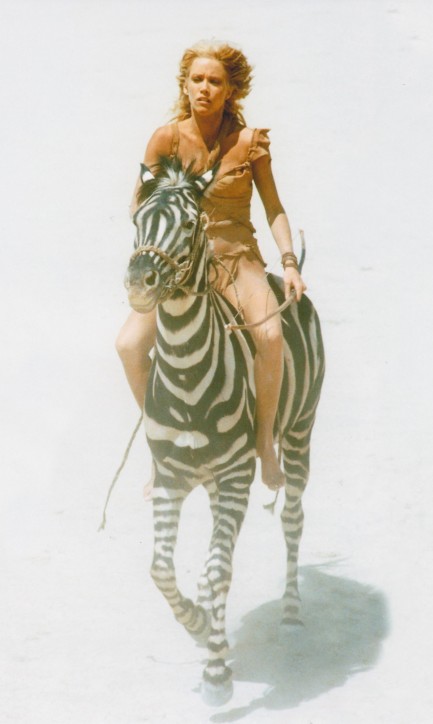
This photo shows U.S. actress Tanya Roberts in character as Sheena in her 1984 lost world flick Sheena, riding what we suspect is a white horse dyed to look like a zebra, and we were going to make an excuse to share it eventually because it's an amazing image. Unfortunately, it became relevant because Roberts died last week. Bizarrely, it happened a day after her announced death. Somehow her publicist told the world she had died, then learned in the middle of an interview that her employer was still alive. Then Roberts died the next day. That's a new one as far as we know. In any case, she looks goddesslike in this photo, and will be remembered for her roles in the James Bond film A View to a Kill and the television series Charlie's Angels (third iteration). Fare thee well, Sheena.
 There's been a pink diamond Barbie, a fashion queen Barbie, and a Sunset Malibu Barbie, so why not a bottomless Barbi? 
You need to look twice but, yes, in this circa-1972 pin-up poster Barbi Benton is missing pants. Or a skirt. Or tights. Or whatever. Benton may be best known as the consort of a world famous pornographer (Hefner, again), but she also acted, guesting on many of the cheesiest television shows of the ’70s and ’80s. Think CHiPs, Vega$, Sugar Time!, The Love Boat—six times—and Fantasy Island—eight times! For our money her zenith was 1983's notably skin-filled sword and sorcery flick Deathstalker. Come to think of it, we may watch that tonight. Meanwhile this image is amazing. Our scan is about 1900 pixels wide, which would be worth framing if we were inclined, but which we'd never do because we aren't seventeen anymore, so our walls have to be home to serious art. Not our rule, but we abide by it.
 Look what the cat dragged in. 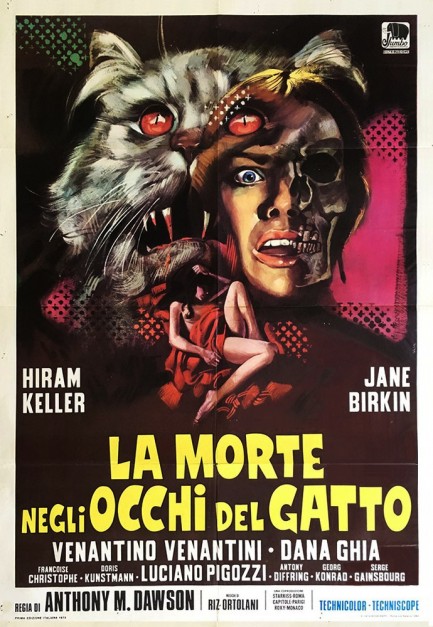
Cats get a bad rap in ’70s horror films. They're always shown lurking, staring, yowling, hissing, flying into frame from some elevated position off-camera, and standing sentinel over murdered bodies. Felines come to the fore once again in the Italian giallo-horror flick La morte negli occhi del gatto, aka Seven Deaths in the Cat's Eye, as beautiful young Jane Birkin ventures into the Scottish countryside for a stay at creepy old Castle Dragonstone, which seems cursed or haunted by a feline or felines. Shortly after her arrival bodies start appearing. Who's doing the killing? Is there really a curse? Why does that darn cat keep turning up? All of the answers and more are revealed, as is the reason behind the carnage, and guess what? It isn't the cat's doing at all. The problem is entirely human and has to do with coveting the castle. Seems everyone wants their own pile of rocks in windblown bumfuck Scotland. Yes, the plot is as blah as we made it sound, but at least the poster art is excellent. There's a another poster, an even better one, with Birkin on it. We digitally restored it to hi-rez perfection, then Photoshop corrupted the file right when we were putting the final touches on it. We aren't going to repeat all that work, so you'll never see what we did. Maybe there's a curse after all. La morte negli occhi del gatto premiered in Italy today in 1973. 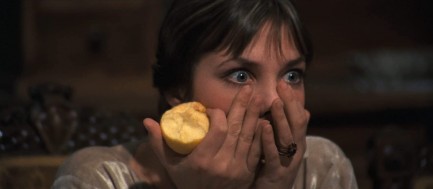    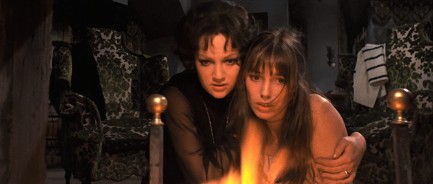
 If heaven were like this it would get crowded mighty fast. 
We don't believe in angels, but if we did this is pretty much what we'd want them to look like. This photo shows heavenly adult film actress Shauna Grant, who, like several other ’70s and ’80s adult film actresses, we've featured before. One reason we do it is because we see a line that extends from pulp all the way into porn via the former's focus on sex. Though authors were not generally able to write explicitly about it at the time, sexual gratification was the prime motivator for many pulp characters. You also see it where pulp intersects film noir, but serious legal risk prevented filmmakers of the ’40s and ’50s from exploring the themes deeply. The pulp influenced literature of the ’50s, and the films of the ’60s pushed the envelope more, but were still constrained by censors.
Around the time Grant was making her debut in porn in 1982, directors en masse were beginning to rework pulp and film classics into thrillers with sex centrally placed. 1981's Body Heat and The Postman Always Rings Twice, 1982's I, the Jury and Cat People, 1984's Against All Odds, and 1987's No Way Out, are just a few examples. The trend continued through 1990's The Grifters, 1994's The Getaway, and beyond, with all these films making clear what was only hinted in source material dating back to the 1930s, ’40s and ’50s—guys will go to almost any length for sex. For real world proof of that, scroll down to yesterday's Barcelona orgy story.
But usually it isn't just sex that gets fictional males in trouble—it's amazing sex. If it were just vanilla sex they wouldn't lie, cheat, steal, and murder. No, it's sex that blew their fuses. So that thread weaves neatly into porn, because porn was designed to implant concepts of sex that average people had never experienced—even if the experiences shown were not reality, but something more like performance art. Grant was one of the art's most popular practitioners. And she fits with our ideas about pulp for another reason too—she's freighted with pulp-like tragedy due to dying early via suicide today in 1984, two days after shooting herself in the head. We have a couple of other Grant items that might interest you, here and here.
 Master of all he surveys. 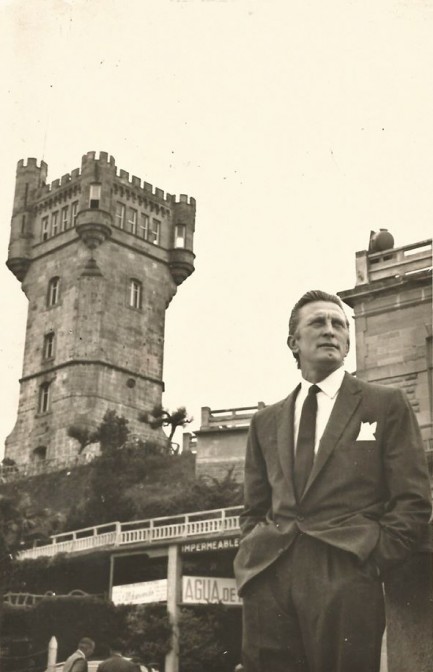
We wanted to do a small post on Kirk Douglas, who died yesterday at the astonishing age of 103, but we took time to look around for a unique photo. This shot shows him in one of our favorite cities, Donostia-San Sebastian, standing atop Igeldo (or Igueldo), one of the seaside town's several large hills. He's looking toward the Bahia de la Concha with the Torreón de Monte Igueldo at his back. It's a majestic shot, fitting for such an icon, far better than showing him greased up as Spartacus, in our opinion. It was made in 1958 when he was attending the sixth Zinemaldia, aka the San Sebastián Film Festival, which was showing his film The Vikings. We don't generally do posts on Hollywood deaths. Why? Because there are so many. Anyone who loves vintage film knows that significant performers, writers, and directors are dying regularly, and we don't want Pulp Intl. to become an obituary roll. But for Kirk Douglas, one of film's all time greats, a consummate actor, an indispensable film noir bad guy, all the rules must be broken. See another max cool image here.
 Albert Camus' fatal 1960 auto accident may have been a KGB assassination. 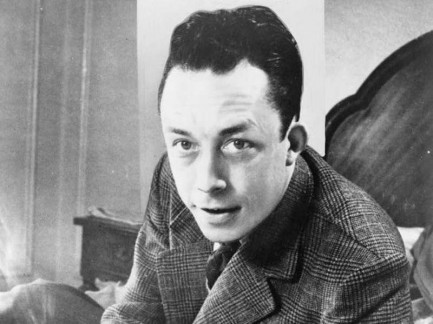
Italian author Giovanni Catelli has just published a book that claims French writer Albert Camus was assassinated by the KGB, rather than dying in an auto accident, as largely believed. When you say the words “Cold War intrigue,” we're all in, so the story caught our eye. Catelli's theory, which he first began airing in 2011, is that the KGB silenced Camus because he was a globally famous figure who made a habit of criticizing the Soviet Union. The order was allegedly given by Dmitri Shepilov, the USSR’s minister of internal affairs, after Camus slammed him in the French newspaper Franc-Tireur in March 1957. Camus died in 1960, so the killing took three years to come to fruition, according to Catelli.
His book length argument, La mort de Camus, is getting white hot press right now, however it's very interesting to look back at contemporary articles about the crash. Camus was riding as a passenger in a car driven by his publisher Michel Gallimard, with Gallimard's wife Janine and their daughter Anne in the rear seat. Michel Gallimard died, but his wife and daughter survived to 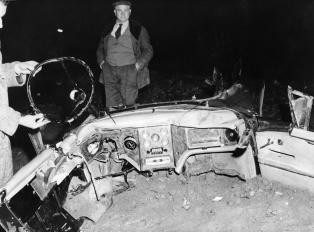 describe the crash. Michel was driving fast and had been told to slow down, and had drunk wine at dinner. describe the crash. Michel was driving fast and had been told to slow down, and had drunk wine at dinner. A gander at the wreckage of the heavy Farcel Vega HK500 attests to its speed. We checked the various articles popping up online and found none that mentioned either the velocity of the car or the drinking of the driver, but that's how the internet works—a fantastic claim circles the world five times faster than anything resembling balance or a fact check.
Catelli, though, has an answer for the reckless driving theory—the Soviets had attached a device to the car that would puncture a tire only in the event of sufficient speed. If the Soviets came up with the device described, it would not kick in without the added ingredient of driver haste, which often happens in conjunction with alcohol consumption, which in turn is a near certainty when talking about French people, all of which means the chances of a crash with muddied circumstances were pretty high. The device, if it ever existed, was certainly clever. It would be like a device that tied your shoelaces together, but only if you went downstairs in a rush, and you happened to live in a fourth floor flat with a balky elevator.
Catelli's belief that Camus was disposed of via assassination is bolstered by the fact that the car he was riding in somehow careened off a stretch of straight road thirty feet wide. Nobody described Michel Gallimard trying to dodge a hedgehog or pothole, so despite speed and possible drunkenness, some unforeseen factor seems required to send the vehicle into the weeds. On the other hand, three years is a long time to enact a death plot. We've seen Yankees and Red Sox fans patch their shit up in less time. But let's move this death from the settled bin into the mysterious bin, which is where we like everything to be anyway. Camus, the famed absurdist, once wrote that, “There can be nothing more absurd than to die in a car accident.” And if Catelli is correct, nothing can be more convenient either. 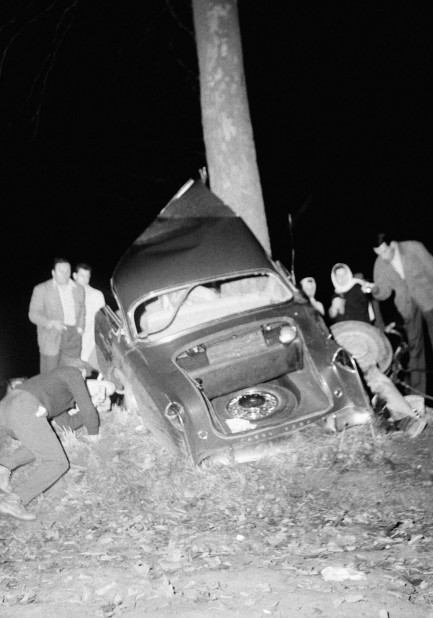 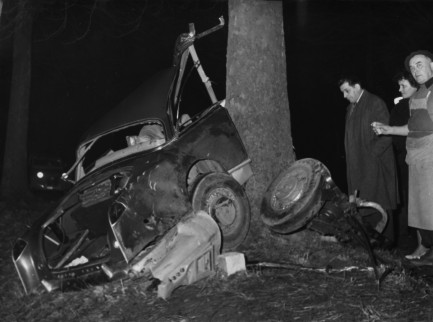

|
 |
The headlines that mattered yesteryear.
1945—Mussolini Is Arrested
Italian dictator Benito Mussolini, his mistress Clara Petacci, and fifteen supporters are arrested by Italian partisans in Dongo, Italy while attempting to escape the region in the wake of the collapse of Mussolini's fascist government. The next day, Mussolini and his mistress are both executed, along with most of the members of their group. Their bodies are then trucked to Milan where they are hung upside down on meathooks from the roof of a gas station, then spat upon and stoned until they are unrecognizable. 1933—The Gestapo Is Formed
The Geheime Staatspolizei, aka Gestapo, the official secret police force of Nazi Germany, is established. It begins under the administration of SS leader Heinrich Himmler in his position as Chief of German Police, but by 1939 is administered by the Reichssicherheitshauptamt, or Reich Main Security Office, and is a feared entity in every corner of Germany and beyond. 1937—Guernica Is Bombed
In Spain during the Spanish Civil War, the Basque town of Guernica is bombed by the German Luftwaffe, resulting in widespread destruction and casualties. The Basque government reports 1,654 people killed, while later research suggests far fewer deaths, but regardless, Guernica is viewed as an example of terror bombing and other countries learn that Nazi Germany is committed to that tactic. The bombing also becomes inspiration for Pablo Picasso, resulting in a protest painting that is not only his most famous work, but one the most important pieces of art ever produced. 1939—Batman Debuts
In Detective Comics #27, DC Comics publishes its second major superhero, Batman, who becomes one of the most popular comic book characters of all time, and then a popular camp television series starring Adam West, and lastly a multi-million dollar movie franchise starring Michael Keaton, then George Clooney, and finally Christian Bale. 1953—Crick and Watson Publish DNA Results
British scientists James D Watson and Francis Crick publish an article detailing their discovery of the existence and structure of deoxyribonucleic acid, or DNA, in Nature magazine. Their findings answer one of the oldest and most fundamental questions of biology, that of how living things reproduce themselves.
|

|
|
It's easy. We have an uploader that makes it a snap. Use it to submit your art, text, header, and subhead. Your post can be funny, serious, or anything in between, as long as it's vintage pulp. You'll get a byline and experience the fleeting pride of free authorship. We'll edit your post for typos, but the rest is up to you. Click here to give us your best shot.

|
|