 She's a rare example of prey that's more dangerous than her predators. 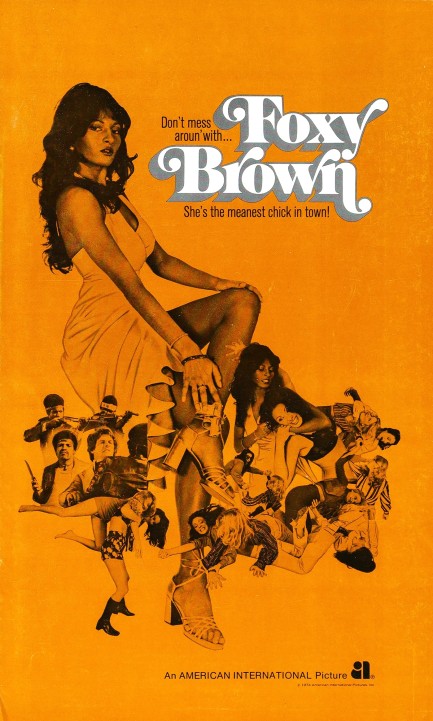 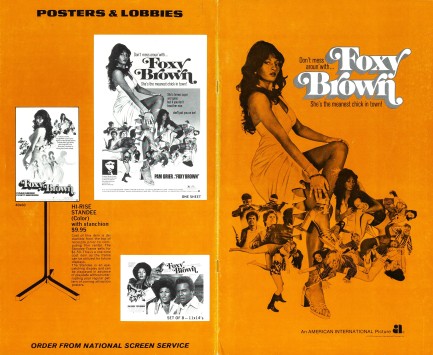
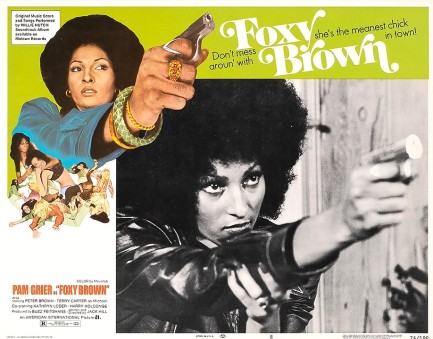
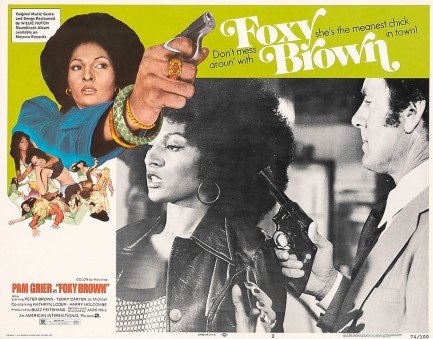
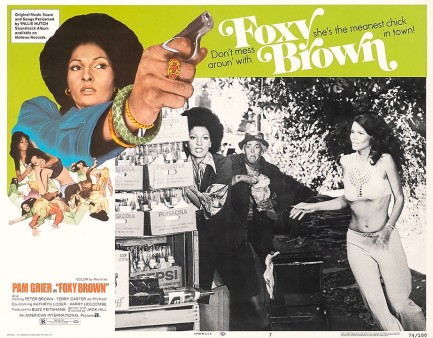
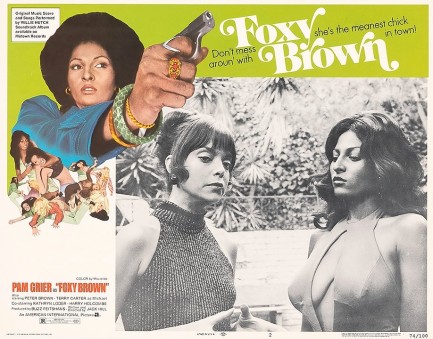
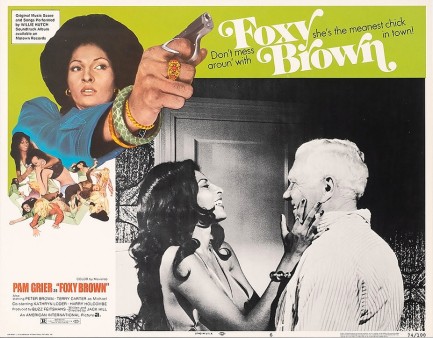
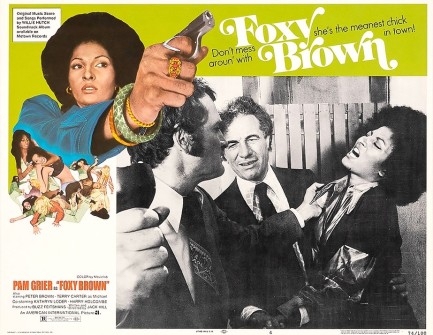
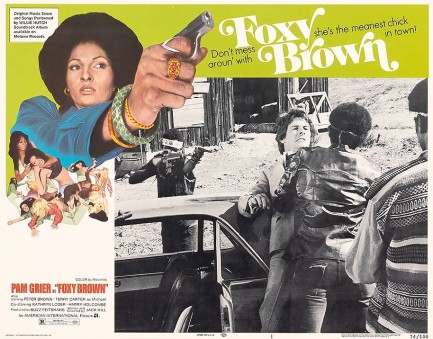
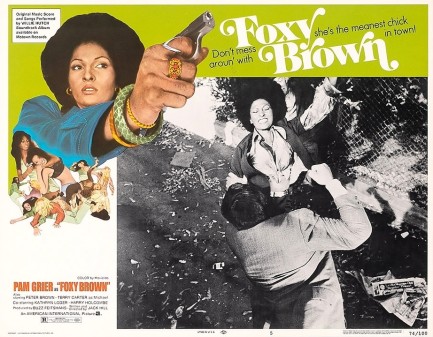
Above is a fun pressbook cover for the legendary Pam Grier's classic action movie Foxy Brown, a tangled tale of drug dealers, crooked cops, loan sharks, and narcs, which premiered in the U.S. today in 1974. When pressed against the wall Grier gets just as vicious as her screen foes. She even sets one guy on fire and runs another over—with a plane. There are no holds barred in blaxploitation cinema.
Below we also have various lobby cards from the film. These are interesting because they're made from production photos that you don't typically see online. It's too bad Grier's blaxploitation/action phase was short, because she was good in the films, even when the films weren't good enough for her. But every artist seeks to hone their craft, so we imagine she got tired of such roles. That's okay—her output, though limited, is always fun to re-watch.
As a side note, the hazards of blogging during the unethical digital age are amply illustrated here. Users on both Alamy and Getty attempt to assert copyright on these items, but movie promos are made for non-copyright holders to publicize the works depicted, and despite claims to the contrary individuals can't hold copyright on them. There are probably hundreds or thousands of these reproductions out there, all individually possessed, so a specific person claiming copyright is nonsensical on the face of it. Only the issuing studio holds copyright.
Even so, we occasionally get threatening e-mails from digital photo resellers. They're AI generated and automatically sent, which means they'll only increase in number as time goes by. We have a form e-mail we send back demanding proof of copyright. We never get a reply to it. Shockingly. We'll say this though—one day corporate greed will kill the blogging culture the same way it's killed most everything else. But that day isn't today. Read what we thought about Foxy Brown here.
 Grier is ready for a battle royal. 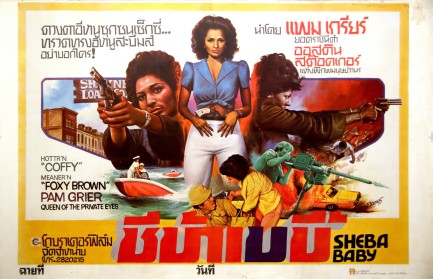
Above you see a rare Thai poster for Pam Grier's 1975 detective thriller Sheba, Baby. The text refers to Grier as the “queen of hearts,” and the “queen of private eyes,” which we think is rather nice. But why stop there? Since the distributors at Go Brother Film were so eager to crown her, let's cover all bases and go with the Queen of Thailand—with respect to Suthida Bajrasudhabimalalakshana. The poster has a date of some sort, but we can't interpret it. Since the movie didn't make it to Europe until late 1976 at the earliest, we're inclined to think the date refers to a Thai premiere in ’77 or ’78. There's also a signature that we can't read. It's a shame not to be able to give the artist credit, but that's the way it goes sometimes. Read more about Sheba, Baby here, and see a cool Egyptian promo poster for it here. 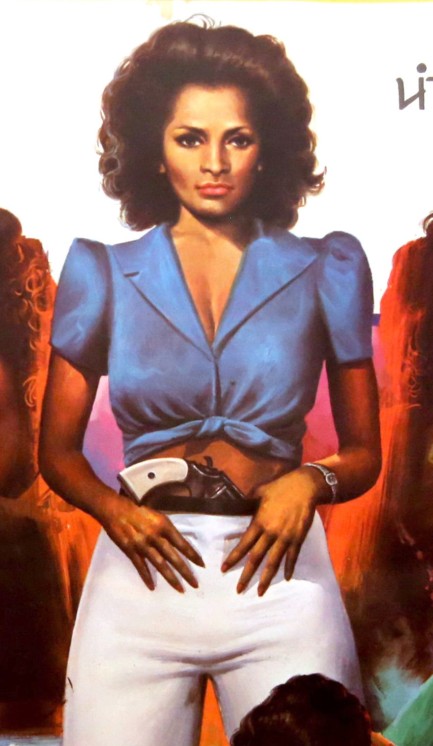
 I give up. Short of developing superpowers I'll never get this hair under control. 
This unusual image of U.S. actress Marlene Clark was made for her 1974 movie The Beast Must Die, which is not to be confused with the 1952 Argentinian thriller released in the U.S. under the same name. The ’74 movie isn't a remake. It's a blaxploitation horror flick. We won't say much about it since we're planning to discuss it in detail. We'll just note that even seeming like she just rolled out of her lair—uh, we mean bed—Clark looks great.
 Jim Brown commits multiple instances of polizia brutality. 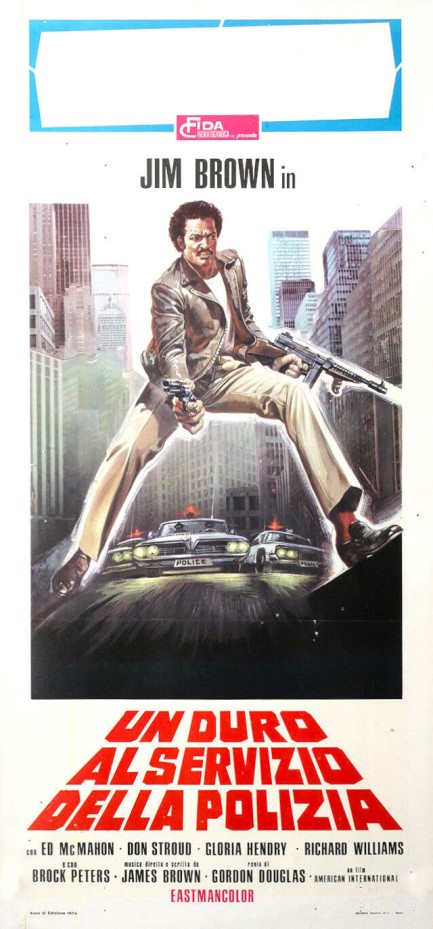
We never like to go very long without highlighting the blaxploitation cycle in cinema, so above you see a nice poster for the 1973 Jim Brown actioner Slaughter's Big Rip-Off, which was retitled Un duro al servizio della polizia for its Italian release. That translates as, “a tough guy in the police service,” which is fitting for Brown, one of the toughest guys around. It should be noted though, that he doesn't play a cop in the film, but a vigilante who partners with the cops. There's no Italian premiere date, but Rip-Off screened in most of Europe in 1974, so it's safe to say the same is true for Italy. We've seen it, but we'll return to the subject later after we have another look. In the meantime you can enjoy two Italian posters for 1972's Slaughter here.
 So long, suckers! There'll never be a star like me again. 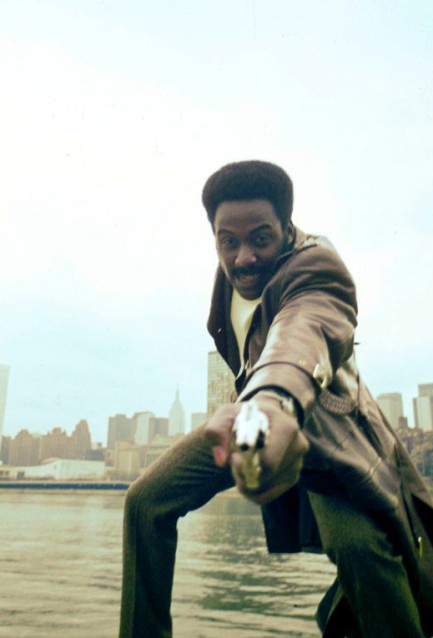
Richard Roundtree, during his long show business career, appeared in scores of movies and television shows, but his first film role was in Shaft and he'll always be known for what can only be described as a cultural awakening, a watershed moment that moved black-centered cinema into the mainstream. It precipitated a flood of capital brought to bear on the genre by investors seeking easy returns, which undermined blaxploitation cinema much same way capital brings a flood of condos to a thriving ethnic neighborhood. Even so Shaft has stood the test of time, is one of the better action movies of the 1970s, generated the sequels Shaft's Big Score and Shaft in Africa, as well as a series of novels, and has remained within the American consciousness thanks to its popular soundtrack, its many lyrical references in hip-hop, and its one-of-a-kind star. Roundtree died today at age eighty-one.
 Let's have phone sex. First I'll send you a photo to inspire you. It should be in your mailbox in three or four days. 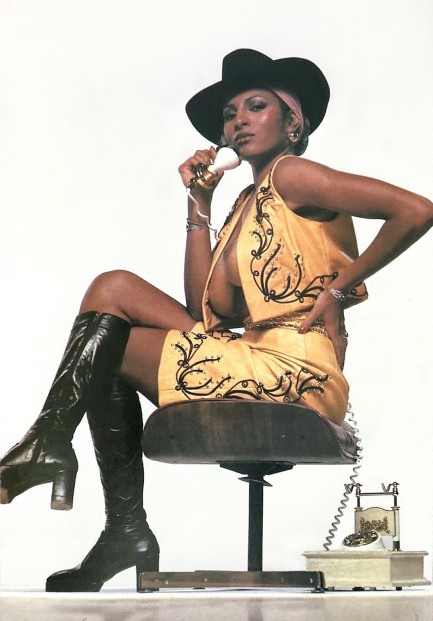
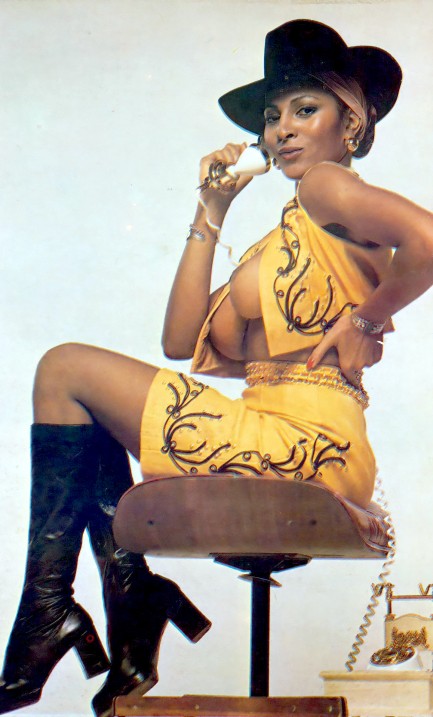 Above you see a rare image from Players magazine circa 1974 of cinema legend Pam Grier using a device known as a rotary telephone. It's a great shot of both her and the museum piece. A couple of other frames from her hang-out session exist that were used in the offshoot publication Players Girls Pictorial in 1976. Above you see a rare image from Players magazine circa 1974 of cinema legend Pam Grier using a device known as a rotary telephone. It's a great shot of both her and the museum piece. A couple of other frames from her hang-out session exist that were used in the offshoot publication Players Girls Pictorial in 1976.
Grier saw nudity as liberating and empowering. In a Rolling Stone interview she said, about the choice to appear unclothed in films, “I wanted to make people start seeing women of color, because we weren’t the epitome of sexual attraction for the male audience, in movies, magazines, anything. I said, How come we don’t see women of color in Hollywood and see them beautifully, like Fellini and Bertolucci and Bergman see women?”
With her boldness Grier helped change the paradigm of onscreen sexuality a bit, and today her images are among the most coveted out there, with magazines in which she appeared nude often auctioning for more than a hundred dollars. Tall, angular, and lovely, she went from actress to cultural icon and maintains that status today. You can see all kinds of Grier in the website. Just click her keywords below.
 Shaft hit America and changed the game. 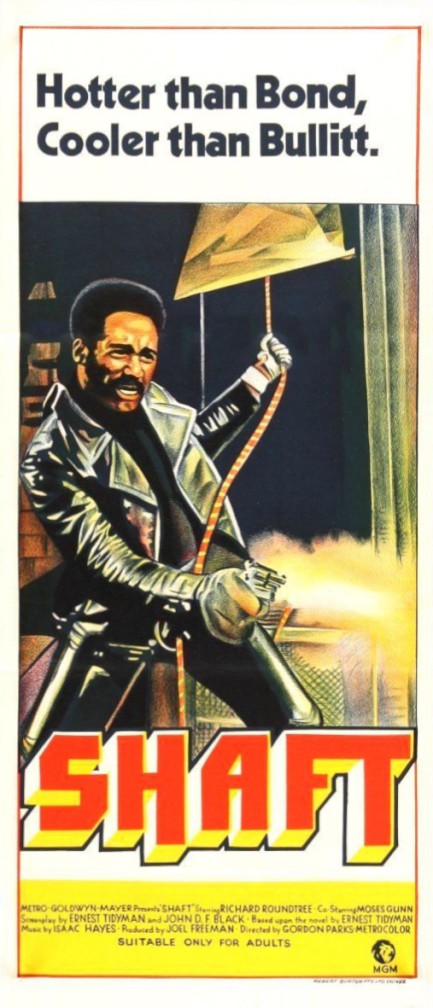
We've discussed quite a few blaxploitation movies, but have neglected the 1971 thriller Shaft. What can you say about the granddaddy of them all, the movie that helped change Hollywood thinking about what viewpoints would sell? Many of the black oriented movies that came afterward were cash grabs, and for that reason most of them weren't good. No such problems exist with Shaft. It's fast, furious, and fun. Our viewing was a reminder that in addition to being a detective movie and a movie that centers black experiences, it's also a neo film noir in both execution and mood. Directed by acclaimed photographer and photo-journalist Gordon Parks, Shaft is gorgeous work, made mostly in actual locations around New York City, and sprinkled with symbology and visual metaphor right from the opening credits.
The character of Shaft is important in film history. Because the theme song is so widely heard most people know Shaft is a bad mother shut-your-mouth, but as the song also says, he's complicated. He lives in Greenwich Village in a bachelor pad decorated with modern art and filled with books. He's kind to children and helps people in need. He has feelings for his girlfriend but will not be tied down and is obliging toward other women who desire him. And he's a friend to any people who treat him with respect. This extends to his local bartender, who's gay and dispenses a familiar pat to Shaft's ass that we can assume isn't the first or last. A bad mother shut-your-mouth? For sure, but he's so much more. And likewise, Shaft is more than a detective movie. It's a cinematic achievement that entertains visually, intellectually, and viscerally. It's a must watch. It was first seen by the public at a special premiere in Detroit, Michigan today in 1971. 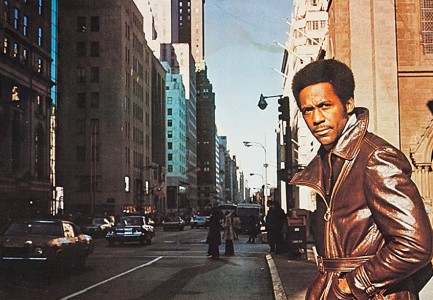 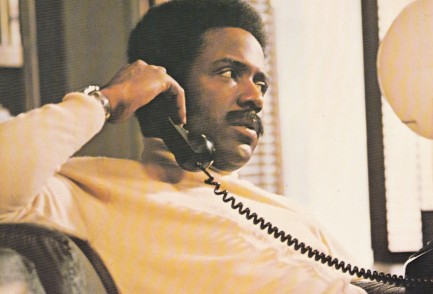 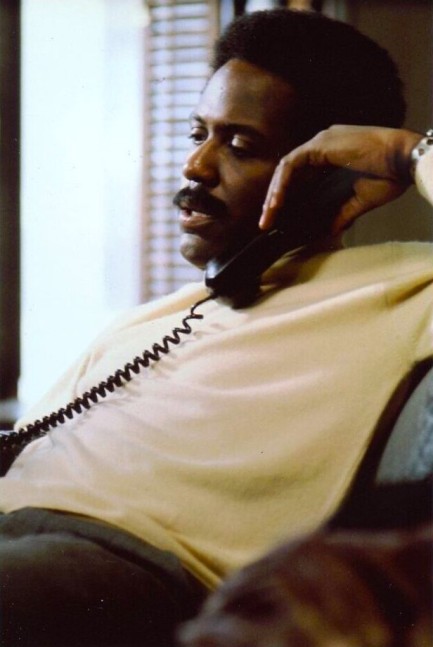 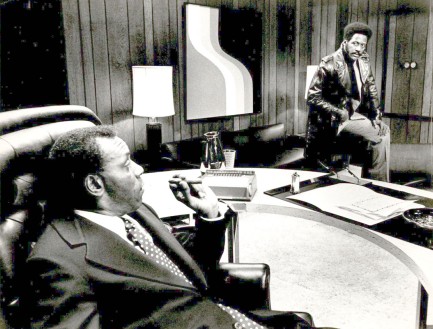 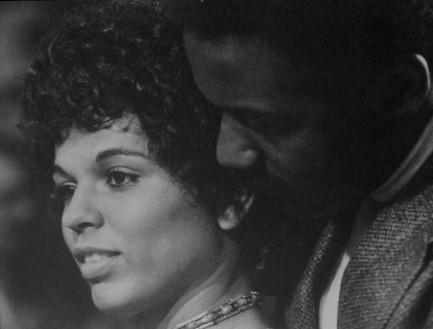 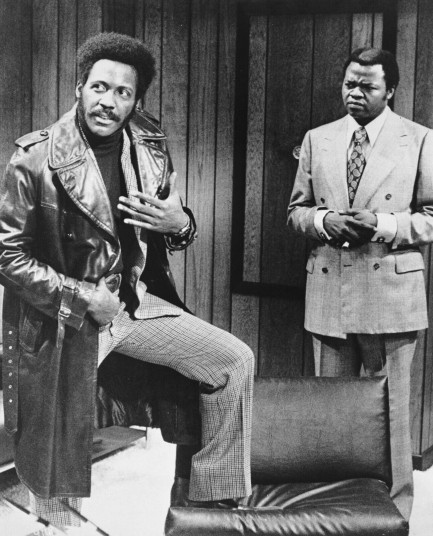 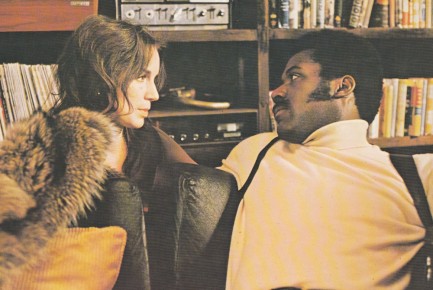 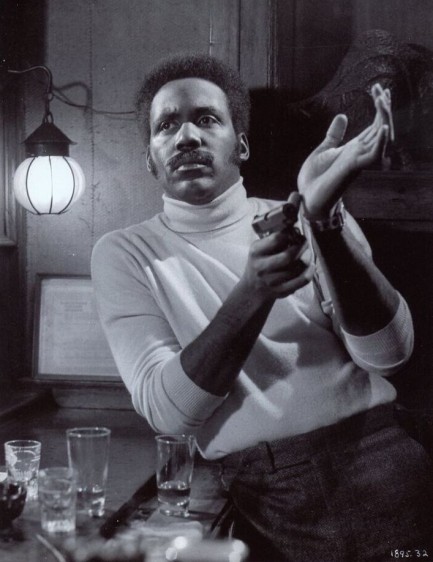 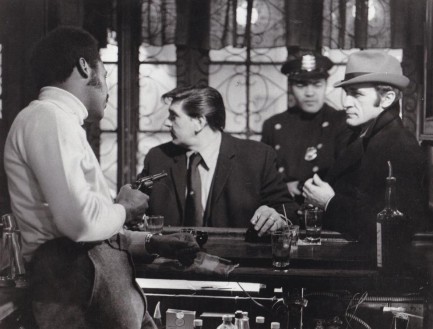 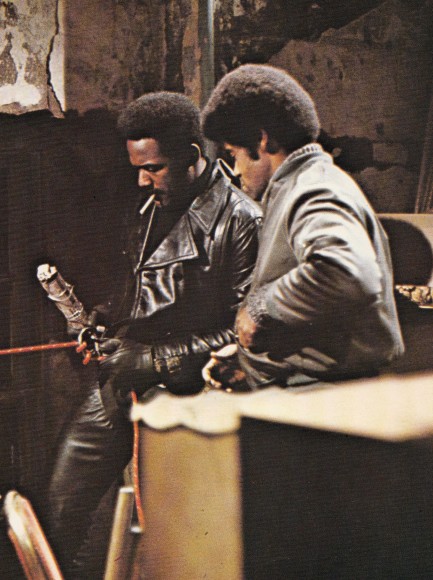 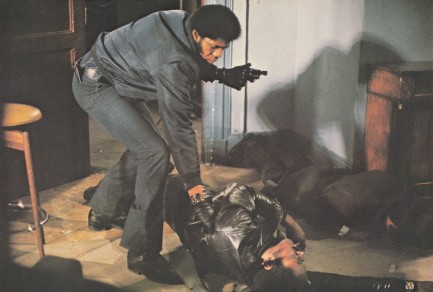 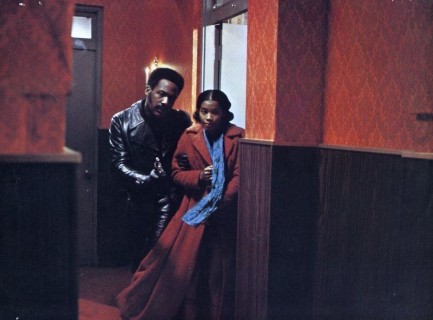 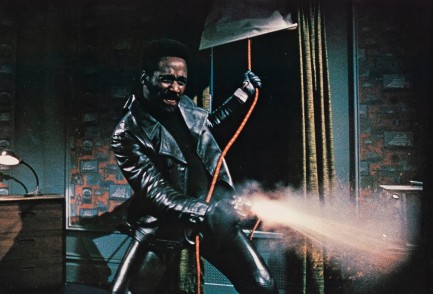 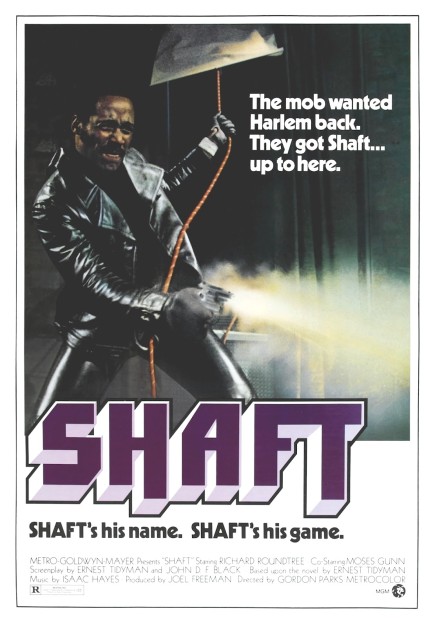
 Ask not for whom the Bell is mistaken. 
If you do an image search on the above photo, every website in which it exists (that would include Getty Images, Yahoo, CNN, et al) says it's Paula Kelly, shot during the making of the 1972 blaxploitation movie Trouble Man. There's just one problem—she isn't Paula Kelly. She's actually—and obviously, we think—Jean Bell, who appeared in such movies as TNT Jackson and Policewomen. Bell and Paula Kelly don't look alike, but just the same they're the victims of an IRE™ (internet replication error) that probably will never be corrected. We're not perfect here, but we also don't have a research department like CNN and Getty Images. Because of the misidentification we don't have a copyright on this shot, but it's probably from around 1974.
 The dress doesn't work as camouflage, but as a fashion statement it's tops. 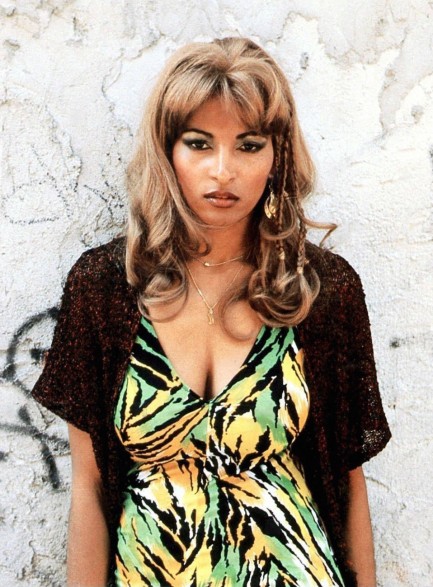
Pam Grier posed for this photo when she was making the a-list crime drama Fort Apache, The Bronx, which was headlined by superstar Paul Newman. Grier was far down the cast list, playing a drug addict prostitute. It was quite a demotion from her starring roles during the blaxploitation era, but the movie was a big hit. She'd finally be toplisted in a mainstream Hollywood movie when Quentin Tarantino cast her in 1997's Jackie Brown, and it was worth the wait. This shot is from 1981.
 Sometimes you can't win no matter what you do. 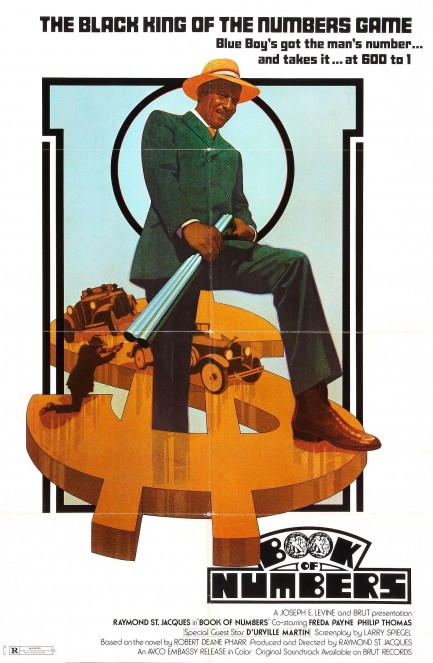
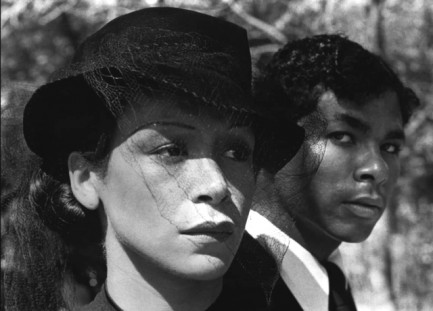
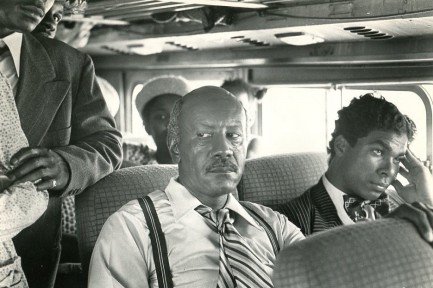
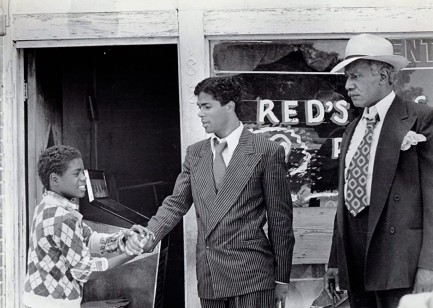
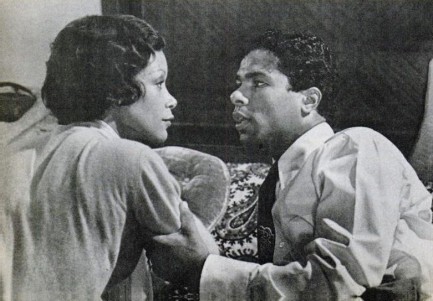
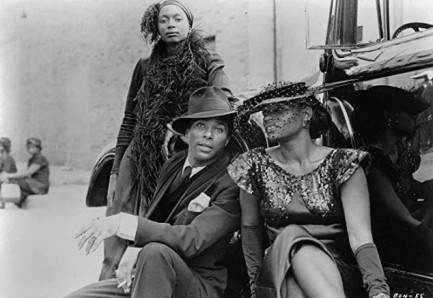
This poster was made for the crime drama Book of Numbers, which premiered in the U.S. today in 1973. The movie falls into the category of blaxploitation, but it's also an ambitious period piece, with a Depression era focus, a deep subtext, and a determination to portray a type of black American life rarely seen onscreen. During the lean years of 1930s a couple of waiters who harbor big dreams ditch food service and hatch a scheme to set up a numbers racket. They roll into El Dorado, Arkansas, get some local help, and soon are making cash faster than they know how to spend it. Their success inevitably attracts the attention of the law, organized crime, and the local Ku Klux Klan. Can the protagonists succeed against all these foes? And what does success look like for black men in the 1930s? No matter how much money they make, they are still not respected, safe, or free.
The movie stars future Miami Vice stud Philip Michael Thomas, along with Raymond St. Jacques, who produced and directed. Their two characters are decades apart in age, and vastly different in how they deal with constant racism. Thomas takes no guff from anyone, even when it costs him; St. Jacques will play any role expected of him by whites in order to survive. This doesn't sit well with the hot-headed Thomas, and leads to growing resentment. In our view, this is the most unique aspect of the film. It implies that because society forces black men to play roles, they can never be truly known by anyone outside their intimate circle. Robert Deane Pharr wrote the source material for this, and it must be an interesting novel, because it spawned a good movie. Book of Numbers is tough, adult, thought-provoking, and historically revealing. We recommend it for 1930s buffs, blaxploitation aficionados, and of course fans of Miami Vice.

|
 |
The headlines that mattered yesteryear.
1945—Mussolini Is Arrested
Italian dictator Benito Mussolini, his mistress Clara Petacci, and fifteen supporters are arrested by Italian partisans in Dongo, Italy while attempting to escape the region in the wake of the collapse of Mussolini's fascist government. The next day, Mussolini and his mistress are both executed, along with most of the members of their group. Their bodies are then trucked to Milan where they are hung upside down on meathooks from the roof of a gas station, then spat upon and stoned until they are unrecognizable. 1933—The Gestapo Is Formed
The Geheime Staatspolizei, aka Gestapo, the official secret police force of Nazi Germany, is established. It begins under the administration of SS leader Heinrich Himmler in his position as Chief of German Police, but by 1939 is administered by the Reichssicherheitshauptamt, or Reich Main Security Office, and is a feared entity in every corner of Germany and beyond. 1937—Guernica Is Bombed
In Spain during the Spanish Civil War, the Basque town of Guernica is bombed by the German Luftwaffe, resulting in widespread destruction and casualties. The Basque government reports 1,654 people killed, while later research suggests far fewer deaths, but regardless, Guernica is viewed as an example of terror bombing and other countries learn that Nazi Germany is committed to that tactic. The bombing also becomes inspiration for Pablo Picasso, resulting in a protest painting that is not only his most famous work, but one the most important pieces of art ever produced. 1939—Batman Debuts
In Detective Comics #27, DC Comics publishes its second major superhero, Batman, who becomes one of the most popular comic book characters of all time, and then a popular camp television series starring Adam West, and lastly a multi-million dollar movie franchise starring Michael Keaton, then George Clooney, and finally Christian Bale. 1953—Crick and Watson Publish DNA Results
British scientists James D Watson and Francis Crick publish an article detailing their discovery of the existence and structure of deoxyribonucleic acid, or DNA, in Nature magazine. Their findings answer one of the oldest and most fundamental questions of biology, that of how living things reproduce themselves.
|

|
|
It's easy. We have an uploader that makes it a snap. Use it to submit your art, text, header, and subhead. Your post can be funny, serious, or anything in between, as long as it's vintage pulp. You'll get a byline and experience the fleeting pride of free authorship. We'll edit your post for typos, but the rest is up to you. Click here to give us your best shot.
|
|