Nygren and friends teach moviegoers all about natural selection. 
We'll return to paperback covers tomorrow, but for the moment we're running with the same sort of material we posted a couple of days ago, because as the weather warms thoughts naturally turn to sensual pleasures. We can't think of a movie more sensual than Emmanuelle IV. Set in our planet's most sensual country, steamy Brazil, it was the entry in the Emmanuelle series that ushered original lead Sylvia Kristel out the studio gate, and brought in the first of several new Emmanuelles, in this case Swedish actress Mia Nygren. This West German poster, on which the film is titled Die orgien der Emmanuelle, or “the orgies of Emmanuelle,” caught our eye because—well, for several reasons—but mainly because Nygren is pushed into the background by Camella Donner, aka Camella Thomas. Why is that so interesting? Because she isn't in the cast. She probably wasn't even on the same continent. We guess the West German distributors wanted to sex up the poster a bit more. Donner would have been a great addition to the film, but even without her it was fun. Ridiculous, stupid, carnivalesque fun. They don't make 'em like that anymore. Emmanuelle IV premiered in West Germany today in 1984.
 They're going to salvage a lost cargo come hell or Haie water. 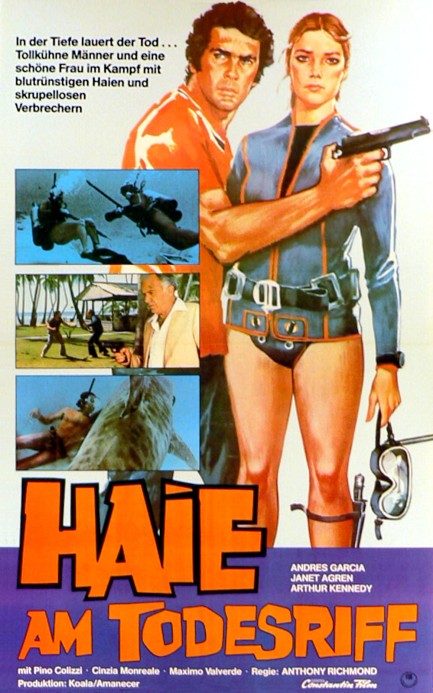
We had a foreign double feature last night, following up La tentación desnuda with Haie am Todesriff, which was originally Italian made as Bermude: la fossa maledetta. Known in English as Cave of Sharks, it premiered in Italy in June 1978 and opened in West Germany today the same year. It is, to be succinct, a Jaws knock-off made with less imagination and less budget. Set on and around the fictive island of San Domingo, which is somewhere near Bermuda, the movie stars Andrés Garcia as a member of an oceanographic expedition who turns up with amnesia six months after his boat goes missing and his colleagues are lost. During those six months that Garcia was presumed dead, his brother tried to move in on his girl Janet Agren—for which he cannot in any be blamed—but with his bro's reappearance there's now a budding love triangle.
Later a plane crashes near San Domingo under strange circumstances with an illegal cargo, sending organized crime figures into to action to recover their loot. Under false pretenses, they hire Garcia, sending him right back into the dread sector of ocean from he'd been fished. He discovers strange, mystical sharks, and thinks they might be the key to getting his memory back. He loses all interest in the crooks' treasure, but they think he's found it and is withholding it. Trouble looms. Does all this sound dumb? You aren't wrong. And the bad plot isn't helped by bad acting, bad action, and incredibly bad miniature work. This one isn't worth your time, even with Janet Agren in the co-starring role. But to make reading this worthwhile, we've added a nice Agren shot to the promos below.
 She's a mean green fighting machine. 
This photo shows German actress Renate von Holt, who appeared in a grand total of four films during her short cinema career, including Heißer Sand auf Sylt, which we wrote about here. The shot came from the West German magazine Caballero, and according to those folks von Holt was in reality Baroness Renate von Holzschuher. We checked it out and the gents at Cabellero are correct. She was minor royalty, a famed presence in society circles, a denizen of the hottest nightspots in Europe, fluent in six languages, and for ten years the companion of Prince Johannes von Thurn und Taxis. Even royalty can become obscure with the passage of time, though. There isn't much on von Holt even on German sites. Well, we're happy to raise her profile. The photo is from 1968.
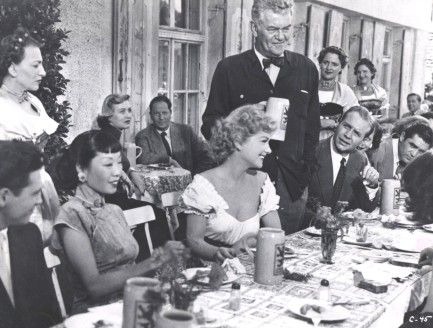
 Bogart may own the café, but Bergman owns the room. 
Since we're checking out European poster art today, above is a nice West German promo for the classic wartime drama Casablanca, with Humphrey Bogart and Ingrid Bergman. We've covered just about all the nice promos for this film: Japanese, Spanish, Italian, and of course the classic U.S. version. Plus we wrote a post about the movie's brilliant set design. But this additional poster is worth sharing because it's the first time we've featured artist Hans Otto Wendt, a well regarded figure who worked during his youth as a draftsman in the newspaper industry, before taking his talents afield and collaborating with Deutsche London Film, Warner Bros., Twentieth Century Fox, and other major studios. He worked until 1969, at which point he retired due to poor health, and finally died in Berlin in 1979. For the above effort, note that he not only made Bergman the star of the poster, but the star of his handpainted lettering too. Casablanca premiered in West Germany today in 1952.
 Round and round she goes. Where she stops nobody knows. 
We like books set in carnivals. They've been among our most interesting reads. So we figured a movie set in a carnival—Carnival Story, with Anne Baxter and Steve Cochran—was a natural. We gave it a look and it's an above average drama about how Baxter becomes a high diver in a Munich carnival and makes a big splash, but has relationship issues that threaten to derail her career and life. Her main problem is Cochran. He lies, he cheats, and he steals, but she just can't quit him, even though her diving partner Lyle Bettger is totally devoted to her. Even after she marries Bettger she can't keep her hands off Cochran. This can only end badly. And by badly we mean violence and death.
Carnival Story is one of those movies with an unspoken sexual subtext. Why would Baxter let Cochran mistreat her again and again? Well, because he gives her something no other man can. Though it couldn't be shown onscreen we can understand that something to be sexual passion. Bettger, and later George Nader, are both devoted to Baxter, and they're nice guys besides, but they're square. Cochran gets Baxter's loins all feverish. Portraying a woman trapped in this dilemma during Hollywood's age of censorship takes acting skill, and Baxter, an Academy Award and Golden Globe winner by this point, has plenty of that. Anything she's in is worth a watch. Carnival Story premiered today in 1954.
 Marie Forså starts an uncontrollable forest Feuer. 
Did you think you'd seen the last of Marie Forså? We can promise you, that won't happen soon. We love all the old sexploitation stars of the ’70s because their breed is extinct now, but Forså is particularly special because of the heat of her performances. Could she act in the thespian sense? Hell, we have no idea. All her dialogue was in Swedish or dubbed. This West German poster was made for her 1975 erotic classic Butterflies, sometimes known as Butterfly, but which was called Feuer der lust in Germany—“Fire of Lust.” And she's about to burst into flames here. We talked about the movie a couple of years ago. The unidentified head belongs to co-star Eric Edwards. Below is another promo of the pair, as happy as two people can be. 
 One great photo. Triple the back pain. 
We recently saw German actress Marlies Draeger stylishly garbed in a green jacket-dress, and here in a beautiful black and white promo image she gives her all, not because she's nude—though that too—but because she's recumbent across three metal tables that look like sheer hell on her sacroiliac. What resulted is a great shot, though we wouldn't be surprised if afterward she sent a stack of chiropractor bills to her agent. Speaking of sending, this was sent to us by Pulp Intl. reader Herman, who's been of great help in the past with model identifications. No date on this, but figure around the same time as the other image—say 1968.
 Not quite a jacket, but not quite a dress. 
We were thinking shirt-dress when we first saw this promo image of German actress Marlies Draeger (or Dräger if you prefer), but it isn't really a shirt. It's more like a jacket. So we looked up shirt-jacket and were surprised to learn they exist, but they're called jacket-dresses, and they prove that there's no niche of women's fashion that hasn't been filled. Draeger/Dräger is wearing hers in a shot made for her 1968 thriller Dynamit in grüner Seide, known in English as Death and Diamonds, and she looks amazing.
 America's worst tabloid pops the bubbly and starts the year strong. 
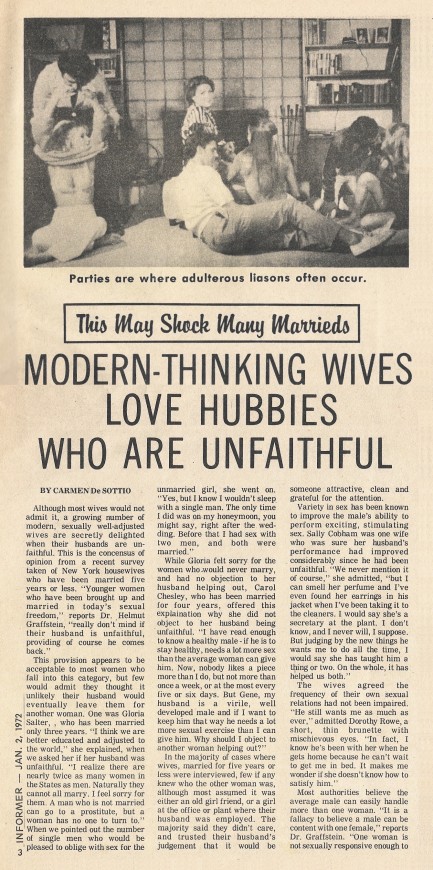
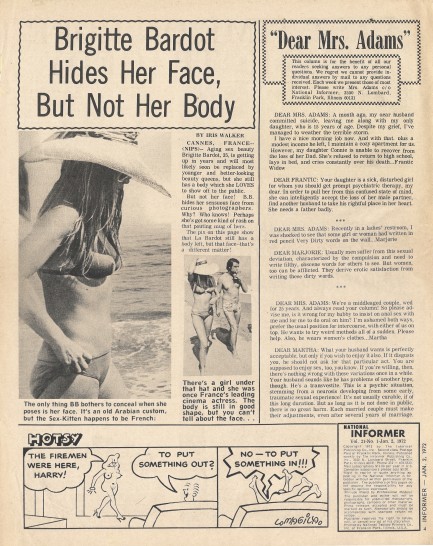
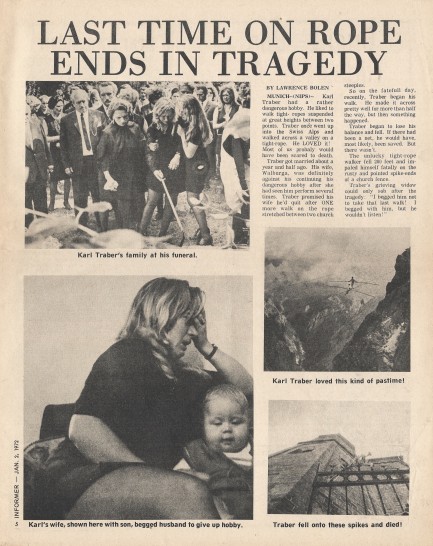
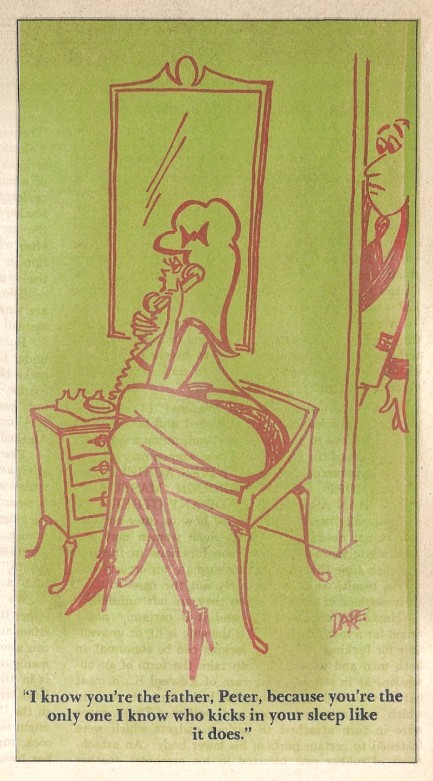
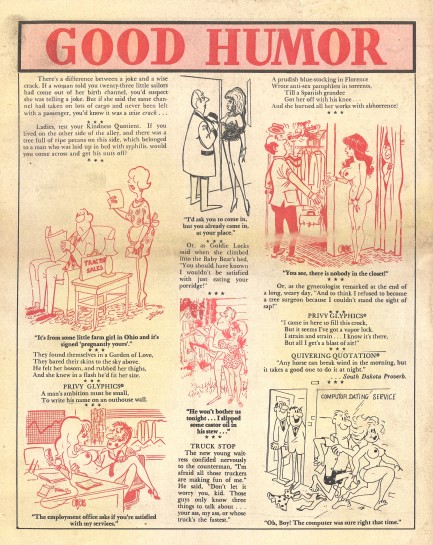
Above is a cover of the tabloid National Informer that hit newsstands today in 1972 featuring an unidentified Champagne toasting model. We love how the editors emphasize the word “truthful” in the second banner, beneath the name of the paper. That's a bold claim from one of the ultimate bottom shelf tabloids of the era, one that traffics in faux news and sensationalism more than actual journalism. But we won't argue the point. Whenever one's reputation is less than stellar don't leave it to chance: tell people what opinion to have of you. National Informer says it's truthful, fine.
There are a couple of stories of note in this issue. According to Informer, German high wire artist Karl Traber died when he lost his balance during a walk between the towers of two Munich churches and fell two-hundred feet onto a spiked fence. We couldn't find a single reference to anyone named Karl Traber online, though we did to a Traber family who remain famous today as aerialists. We did a Boolean search within German websites and still found no Karl Traber who suffered this grisly death. It's no surprise. Cheap tabloids often leave you with more questions than answers. We'll blame it on sloppy journalism (maybe they got a name wrong?) rather than false reporting. But since we don't want to spend our Monday searching the internet, we'll just move on.
Later in the issue Informer's resident seer Mark Travis produces a slate of predictions, and one of them qualifies as his wildest ever: I predict the invention of a serum which is injected into the bloodstream to create more pigmentation of the skin and turn a white person black. It will be very popular among the young college students. This serum [snip] will enable white youngsters from affluent homes to really see what life in the ghetto is like. Since the results will wear off in a few weeks if the injections are discontinued, it will be quite an adventure to “go black” for a short period of time. Only a wig will be necessary to complete the disguise. And since another drug which works in reverse—lightens the skin—will enable any Negro who desires to do so to pass for white, it will soon be impossible to tell who is white, who is black, and who is one in the disguise of the other.
We think we know how that would turn out: the caste-destroying serum would be banned in all fifty states, plus overseas U.S. territories, and bring penalties for usage ranging up to execution. We're only half kidding. Imagining the possible fallout from such a form of recreation makes us want to pitch the idea to some of our Hollywood friends. Can you imagine the television show that could be produced? Travis has made some blah predictions over the years, but we bet this one hit a nerve among Informer's readership. Unfortunately, we don't have the next few issues to check the infuriated responses in reader mail. Maybe it's better that way. As a side note, this is the thirtieth issue of Informer we've shared.
 Go in the water? That's the freaking North Sea you're talking about. 
It's been a few years, so we're returning to subject of German actress Karin Schubert today with this brilliant shot that first appeared as a centerfold in the West German magazine Sexy, a publication that did this sort of thing often. Schubert is a unique figure. She was born in Hamburg during wartime in 1944, debuted in cinema during the late ’60s, then, after establishing herself as a mainstream actress, went into porn. We talked about that in detail here, and we also mused on the relationship between mainstream erotic films and xxx movies, with her as an example, at this post. The latter link contains some of our ponderings concerning nudity on our website, so you may be interested in that, and if so, we go into more detail on that subject here, and talk about the entire purpose behind the site here. The above shot dates from 1971. And by the way, Germany does have some nice beaches—when they aren't covered by snow.

|
 |

The headlines that mattered yesteryear.
1945—Mussolini Is Arrested
Italian dictator Benito Mussolini, his mistress Clara Petacci, and fifteen supporters are arrested by Italian partisans in Dongo, Italy while attempting to escape the region in the wake of the collapse of Mussolini's fascist government. The next day, Mussolini and his mistress are both executed, along with most of the members of their group. Their bodies are then trucked to Milan where they are hung upside down on meathooks from the roof of a gas station, then spat upon and stoned until they are unrecognizable. 1933—The Gestapo Is Formed
The Geheime Staatspolizei, aka Gestapo, the official secret police force of Nazi Germany, is established. It begins under the administration of SS leader Heinrich Himmler in his position as Chief of German Police, but by 1939 is administered by the Reichssicherheitshauptamt, or Reich Main Security Office, and is a feared entity in every corner of Germany and beyond. 1937—Guernica Is Bombed
In Spain during the Spanish Civil War, the Basque town of Guernica is bombed by the German Luftwaffe, resulting in widespread destruction and casualties. The Basque government reports 1,654 people killed, while later research suggests far fewer deaths, but regardless, Guernica is viewed as an example of terror bombing and other countries learn that Nazi Germany is committed to that tactic. The bombing also becomes inspiration for Pablo Picasso, resulting in a protest painting that is not only his most famous work, but one the most important pieces of art ever produced. 1939—Batman Debuts
In Detective Comics #27, DC Comics publishes its second major superhero, Batman, who becomes one of the most popular comic book characters of all time, and then a popular camp television series starring Adam West, and lastly a multi-million dollar movie franchise starring Michael Keaton, then George Clooney, and finally Christian Bale. 1953—Crick and Watson Publish DNA Results
British scientists James D Watson and Francis Crick publish an article detailing their discovery of the existence and structure of deoxyribonucleic acid, or DNA, in Nature magazine. Their findings answer one of the oldest and most fundamental questions of biology, that of how living things reproduce themselves.
|

|
|
It's easy. We have an uploader that makes it a snap. Use it to submit your art, text, header, and subhead. Your post can be funny, serious, or anything in between, as long as it's vintage pulp. You'll get a byline and experience the fleeting pride of free authorship. We'll edit your post for typos, but the rest is up to you. Click here to give us your best shot.

|
|