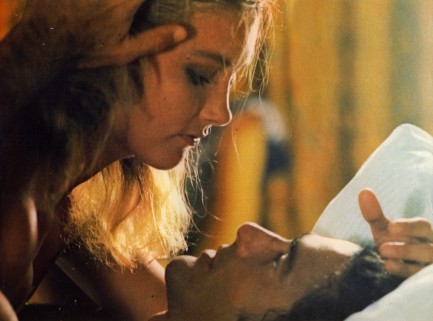
Nygren and friends teach moviegoers all about natural selection. 
We'll return to paperback covers tomorrow, but for the moment we're running with the same sort of material we posted a couple of days ago, because as the weather warms thoughts naturally turn to sensual pleasures. We can't think of a movie more sensual than Emmanuelle IV. Set in our planet's most sensual country, steamy Brazil, it was the entry in the Emmanuelle series that ushered original lead Sylvia Kristel out the studio gate, and brought in the first of several new Emmanuelles, in this case Swedish actress Mia Nygren. This West German poster, on which the film is titled Die orgien der Emmanuelle, or “the orgies of Emmanuelle,” caught our eye because—well, for several reasons—but mainly because Nygren is pushed into the background by Camella Donner, aka Camella Thomas. Why is that so interesting? Because she isn't in the cast. She probably wasn't even on the same continent. We guess the West German distributors wanted to sex up the poster a bit more. Donner would have been a great addition to the film, but even without her it was fun. Ridiculous, stupid, carnivalesque fun. They don't make 'em like that anymore. Emmanuelle IV premiered in West Germany today in 1984.
 It's the same old story. Take a trip to the tropics, lose every bit of self control. 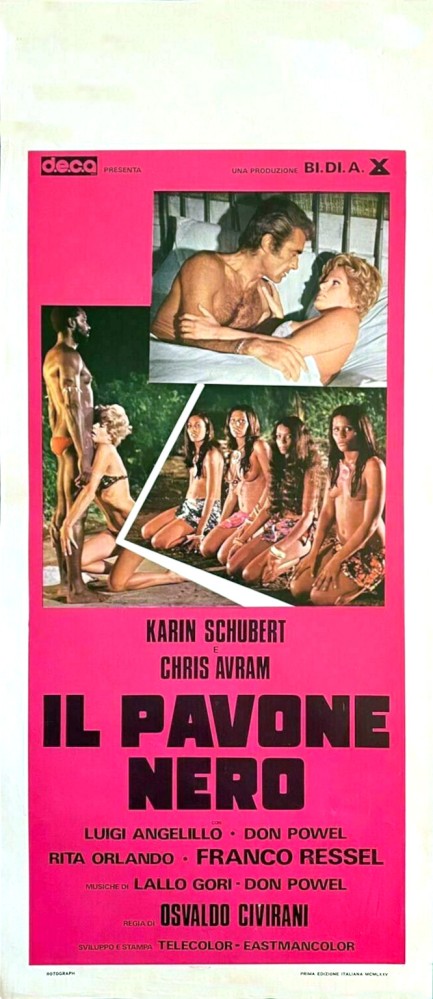
We ran across this Italian locandina for the shot-in-the-Dominican Republic sexploitation flick Il pavone nero, known in English as Voodoo Sexy, and thought it made a nice alternate promo to the one we posted years back. The movie premiered in Italy today in 1975, and with a title like Voodoo Sexy you know what it's about: white skin + tropical heat = a total loss of inhibitions. Flicks of this ilk were an unofficial subgenre of ’70s and ’80s cinema. We love them, and you know why? Because they aren't wildly inaccurate in terms of northerners going crazy down south. The star of this one was German actress Karin Schubert, and that's the other reason we revisited the film—it gave us an excuse to share the photo of her below. Hope it helps you get over hump day. 
 Elke snags seashells by the seashore. 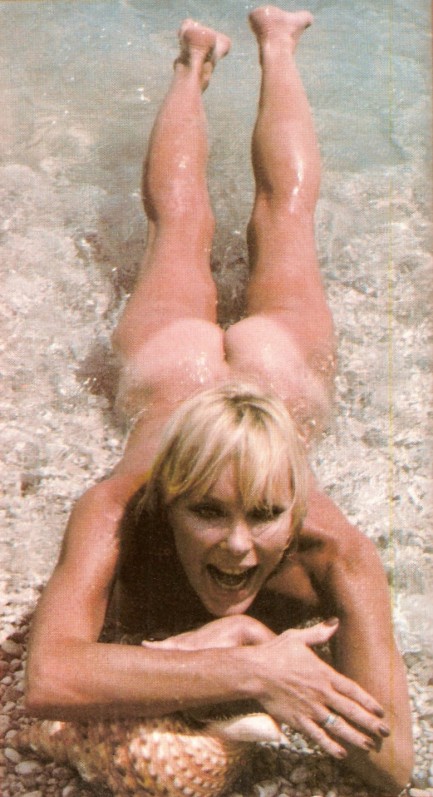
German star Elke Sommer shows her beach bum in this shot made during a photo session in Haiti in 1978, and first published in the the U.S. magazine Eros. Sommer is another of those performers who was huge during her time, but doesn't have what today most film buffs consider many quality efforts among her nearly one hundred movies. A Shot in the Dark and The Prize are probably the best remembered from her mainstream output, while cult fans tend to gravitate toward Lisa and the Devil, The Wrecking Crew, and of course Deadlier Than the Male, which we've seen and written about more than once (feel free to click its keywords just below). We're going to explore a few more of those hundred movies of hers, so maybe we'll uncover a treasure the way Sommer has uncovered the giant conch shell she's hanging onto.
 Palmer demonstrates proper usage of the most important bad girl accessory. 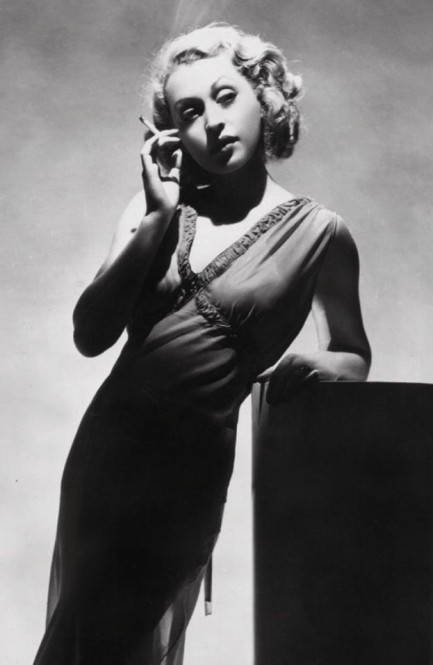
Femmes fatales (that's how the French spell it, and they should know) need a lot of accessories. Among the most important are eyes that smolder, a walk that slinks, dresses that cling, a mouthful of lies, a small pistol, and a strong liver, but is there any accessory more important than the cigarette? We don't think so. German actress Lilli Palmer makes the most of a cigarette in this striking promo image that's undated but probably from the early 1940s. Neither of us have ever smoked, nor seriously dated a woman who did, but there's no denying it looks good on Lilli.
 The fundamental things apply. 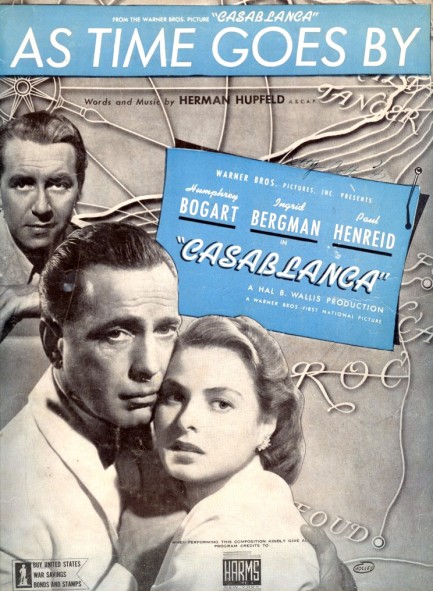
Here’s something nice we ran across on an auction site. It’s a piece of sheet music for “As Time Goes By”, which is a song written by German composer Herman Hupfeld and sung by Dooley Wilson’s character Sam in 1942’s Casablanca. The tune is inextricably identified with the film, but it was actually written for the 1931 Broadway show Everybody’s Welcome, where, in its complete form, it becomes clear the song is just as much about stress as about romance. You wouldn’t know that of course, because you don’t know the lyrics—really, who does? But today’s your lucky Monday—you can brush up on the words here. Just remember these two music fundamentals: if you sing, please do so from the diaphragm; and if you sing badly, blame it on booze.
 They're going to salvage a lost cargo come hell or Haie water. 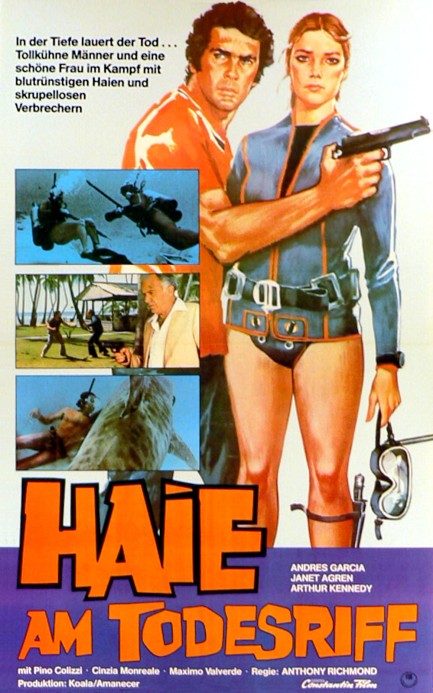
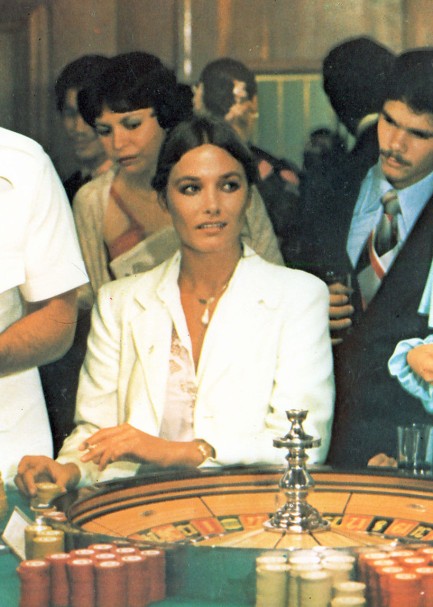
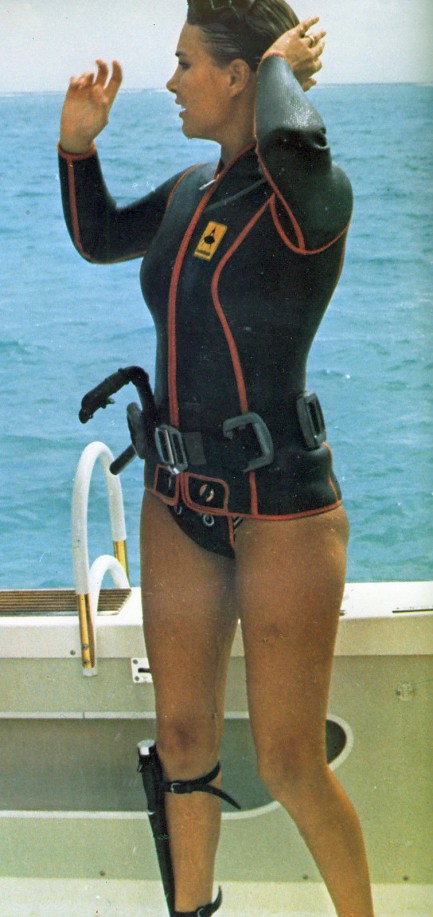
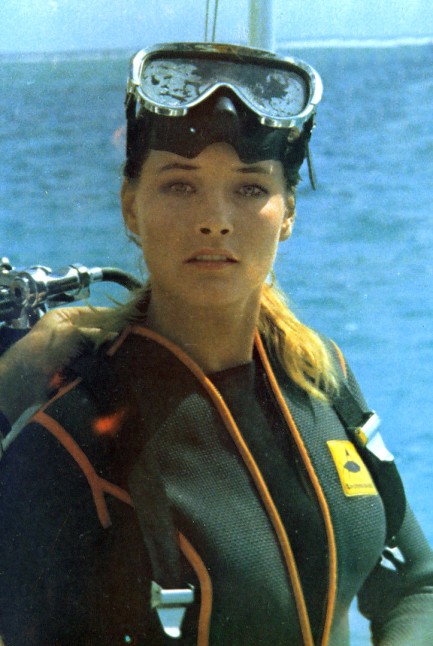
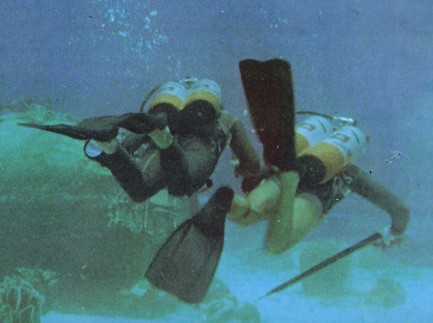
We had a foreign double feature last night, following up La tentación desnuda with Haie am Todesriff, which was originally Italian made as Bermude: la fossa maledetta. Known in English as Cave of Sharks, it premiered in Italy in June 1978 and opened in West Germany today the same year. It is, to be succinct, a Jaws knock-off made with less imagination and less budget. Set on and around the fictive island of San Domingo, which is somewhere near Bermuda, the movie stars Andrés Garcia as a member of an oceanographic expedition who turns up with amnesia six months after his boat goes missing and his colleagues are lost. During those six months that Garcia was presumed dead, his brother tried to move in on his girl Janet Agren—for which he cannot in any be blamed—but with his bro's reappearance there's now a budding love triangle.
Later a plane crashes near San Domingo under strange circumstances with an illegal cargo, sending organized crime figures into to action to recover their loot. Under false pretenses, they hire Garcia, sending him right back into the dread sector of ocean from he'd been fished. He discovers strange, mystical sharks, and thinks they might be the key to getting his memory back. He loses all interest in the crooks' treasure, but they think he's found it and is withholding it. Trouble looms. Does all this sound dumb? You aren't wrong. And the bad plot isn't helped by bad acting, bad action, and incredibly bad miniature work. This one isn't worth your time, even with Janet Agren in the co-starring role. But to make reading this worthwhile, we've added a nice Agren shot to the promos below.
 She's a mean green fighting machine. 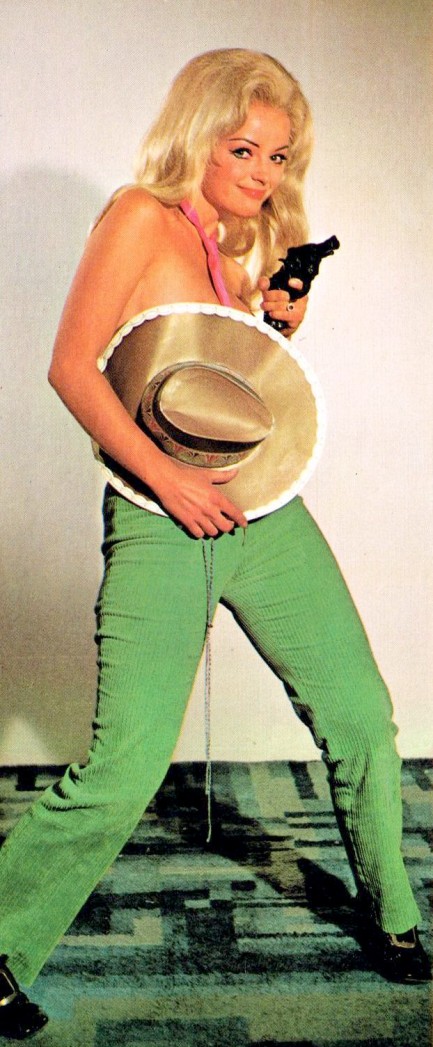
This photo shows German actress Renate von Holt, who appeared in a grand total of four films during her short cinema career, including Heißer Sand auf Sylt, which we wrote about here. The shot came from the West German magazine Caballero, and according to those folks von Holt was in reality Baroness Renate von Holzschuher. We checked it out and the gents at Cabellero are correct. She was minor royalty, a famed presence in society circles, a denizen of the hottest nightspots in Europe, fluent in six languages, and for ten years the companion of Prince Johannes von Thurn und Taxis. Even royalty can become obscure with the passage of time, though. There isn't much on von Holt even on German sites. Well, we're happy to raise her profile. The photo is from 1968.
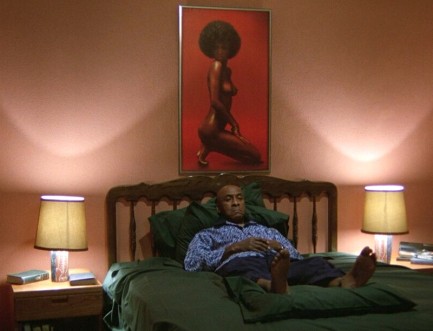
 Dick Halloran and his late night guests. 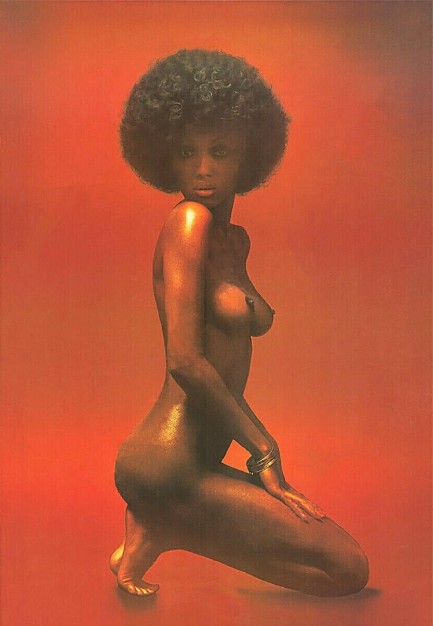
We're revisiting the art of headshop posters with this image of an unidentified afro-topped beauty shot in 1979 by famed German lensman Cheyco Leidmann. This particular piece may look familiar to cinema fans. It's the poster that was over Scatman Crothers' bed in the 1981 scarefest The Shining. His character Dick Halloran was about as single as a man could be in that movie—living alone, hanging in his jammies, watching television late at night, with naked art looking down on him. Getting axed in the sternum was really a case of putting the poor guy out of his misery.
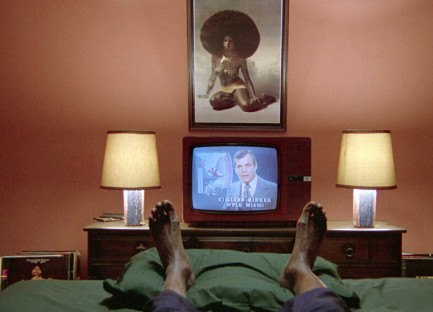
Halloran didn't have just one guardian angel on his walls. The reverse shot from that same sequence shows another poster, located over the television. That model we can identify. She's actress and centerfold Azizi Johari, who's made a few appearances here on the website. We even shared the very same poster a couple of years ago. But we decided to bring her back today so our visit to Halloran's bachelor pad would be complete. See more Johari here and here. She's well worth it.
 People aren't into books like they used to be. I'm just trying to make it enticing again. 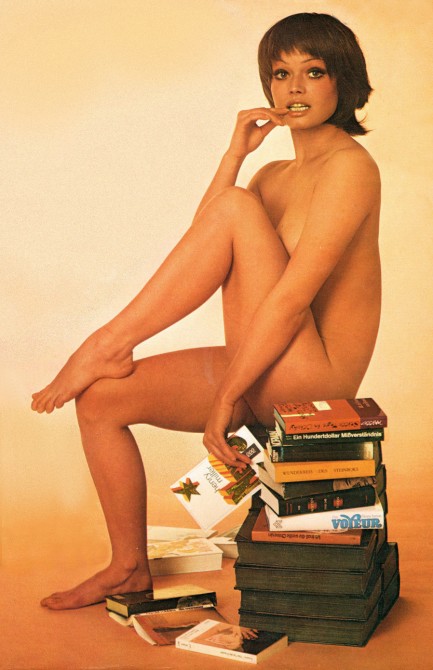
The only movie we've seen with German actress Andrea Rau is the low budget production Robinson und seine wilden Sklavinnen, aka Robinson and His Tempestuous Slaves, and she made that otherwise uninspired effort worthwhile all by herself. She works similar magic, above, on a pile of books, including a Rowohlt Verlag edition of Henry Miller's Sexus. Rau appeared in about twenty films, and after the cinema made the time-honored transition into television, where she acted until 2008. The above photo came from a 1974 cover of the magazine Rex, and we took the liberty of removing the text. For a couple more shots of Rau check here and here.
 Bogart may own the café, but Bergman owns the room. 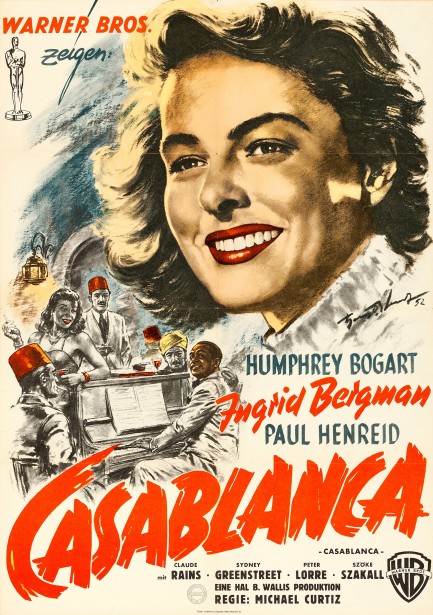
Since we're checking out European poster art today, above is a nice West German promo for the classic wartime drama Casablanca, with Humphrey Bogart and Ingrid Bergman. We've covered just about all the nice promos for this film: Japanese, Spanish, Italian, and of course the classic U.S. version. Plus we wrote a post about the movie's brilliant set design. But this additional poster is worth sharing because it's the first time we've featured artist Hans Otto Wendt, a well regarded figure who worked during his youth as a draftsman in the newspaper industry, before taking his talents afield and collaborating with Deutsche London Film, Warner Bros., Twentieth Century Fox, and other major studios. He worked until 1969, at which point he retired due to poor health, and finally died in Berlin in 1979. For the above effort, note that he not only made Bergman the star of the poster, but the star of his handpainted lettering too. Casablanca premiered in West Germany today in 1952.

|
 |
The headlines that mattered yesteryear.
1945—Mussolini Is Arrested
Italian dictator Benito Mussolini, his mistress Clara Petacci, and fifteen supporters are arrested by Italian partisans in Dongo, Italy while attempting to escape the region in the wake of the collapse of Mussolini's fascist government. The next day, Mussolini and his mistress are both executed, along with most of the members of their group. Their bodies are then trucked to Milan where they are hung upside down on meathooks from the roof of a gas station, then spat upon and stoned until they are unrecognizable. 1933—The Gestapo Is Formed
The Geheime Staatspolizei, aka Gestapo, the official secret police force of Nazi Germany, is established. It begins under the administration of SS leader Heinrich Himmler in his position as Chief of German Police, but by 1939 is administered by the Reichssicherheitshauptamt, or Reich Main Security Office, and is a feared entity in every corner of Germany and beyond. 1937—Guernica Is Bombed
In Spain during the Spanish Civil War, the Basque town of Guernica is bombed by the German Luftwaffe, resulting in widespread destruction and casualties. The Basque government reports 1,654 people killed, while later research suggests far fewer deaths, but regardless, Guernica is viewed as an example of terror bombing and other countries learn that Nazi Germany is committed to that tactic. The bombing also becomes inspiration for Pablo Picasso, resulting in a protest painting that is not only his most famous work, but one the most important pieces of art ever produced. 1939—Batman Debuts
In Detective Comics #27, DC Comics publishes its second major superhero, Batman, who becomes one of the most popular comic book characters of all time, and then a popular camp television series starring Adam West, and lastly a multi-million dollar movie franchise starring Michael Keaton, then George Clooney, and finally Christian Bale. 1953—Crick and Watson Publish DNA Results
British scientists James D Watson and Francis Crick publish an article detailing their discovery of the existence and structure of deoxyribonucleic acid, or DNA, in Nature magazine. Their findings answer one of the oldest and most fundamental questions of biology, that of how living things reproduce themselves.
|

|
|
It's easy. We have an uploader that makes it a snap. Use it to submit your art, text, header, and subhead. Your post can be funny, serious, or anything in between, as long as it's vintage pulp. You'll get a byline and experience the fleeting pride of free authorship. We'll edit your post for typos, but the rest is up to you. Click here to give us your best shot.
|
|