Fear and loathing are the least of his problems. 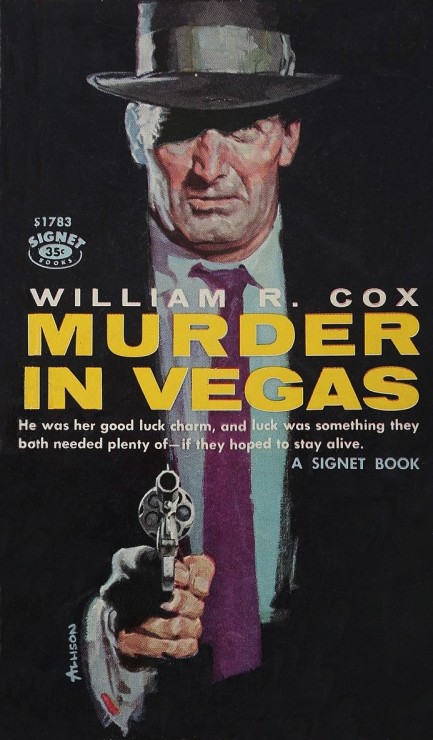
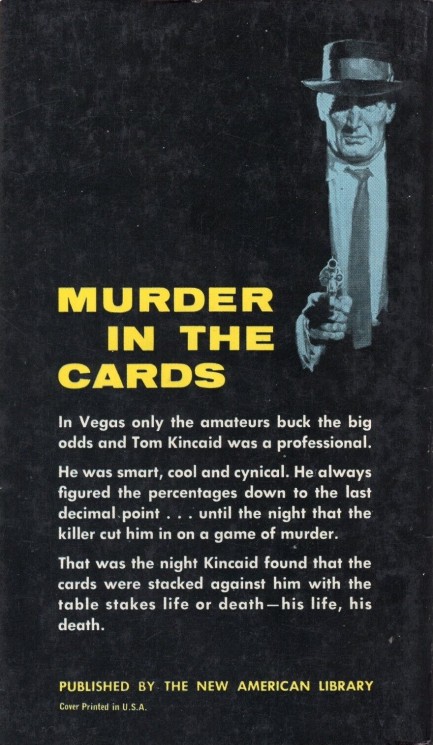
Jerry Allison art strikes a menacing note on the cover of William R. Cox's 1960 novel Murder in Vegas, in which Cox's gambler hero Tom Kincaid from 1958's Hell To Pay, which we recently discussed, returns to the written page to find more trouble. The first murder in the book actually occurs in Los Angeles, but someone is later knocked off in Vegas and as a direct result Kincaid is elevated from silent partner to full owner of a casino called the White Elephant. Simultaneously his girlfriend Jean Harper is in town filming a movie, and the murder and film production seem tied together. Kincaid is as interesting as before, but the fun creation here is down-on-her-luck party girl Carry Cain, who mixes sexiness and vulnerability with a beatnik mentality. She's an aspiring actress and gambling addict who thinks Kincaid might finally bring her the luck she's been seeking. Instead she finds herself in the middle of a Vegas-sized mess. Cox has talent, as we've noted before. It shines bright in Murder in Vegas.
 The journey to becoming her true self. 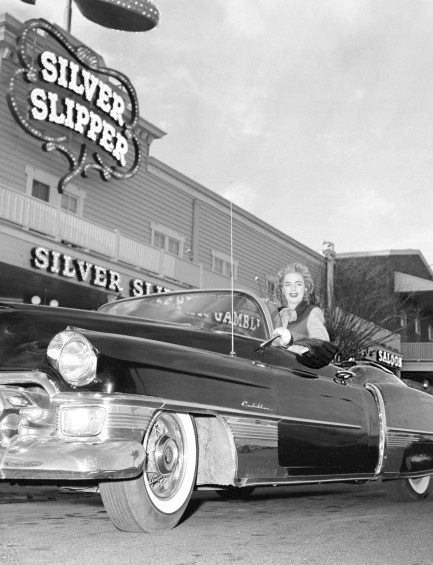 
We found these photos at a very interesting website called Vintage Las Vegas, which could be the number one online repository for historical Sin City photos. What they show is trans star Christine Jorgensen, who sometime this month in 1955 posed for these photos at the Silver Slipper casino. In the first she's seated in a sweet Cadillac Eldorado convertible, the 1954 model, which you can tell by the shape of the chrome fender accents. At the time Jorgensen was globally famous as one of the first men to surgically become a woman, and was performing all around the U.S. as a singer and dancer.
We first shared Jorgensen on our website way back in 2011, and since then people like her have been posited as the enemy of all that is good. Well, as far as we know Jorgensen just wanted to live her best life, as did the many other famous trans personalities of the mid-century era such as Coccinelle, Gayle Sherman, Abby Sinclair, Ajita Wilson, Tula Cossey, April Ashley, and Roxanne Alegria. That many? Yeah. The trans community has been around a long time. It's only the panic that's new—and misdirected.
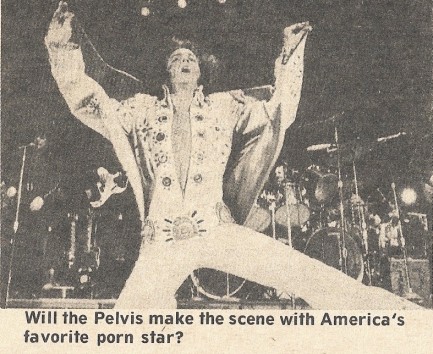
 Notable show business encounters: the Pelvis meets the Throat. 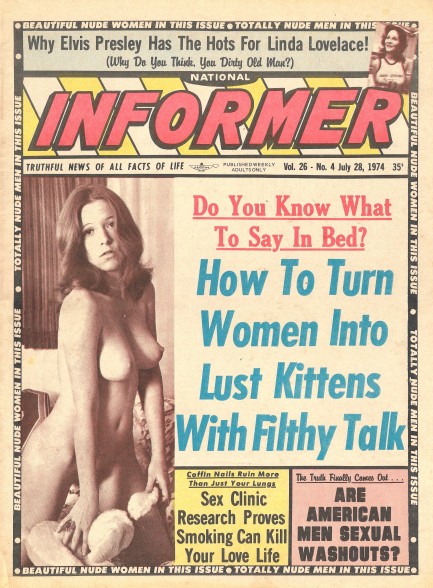
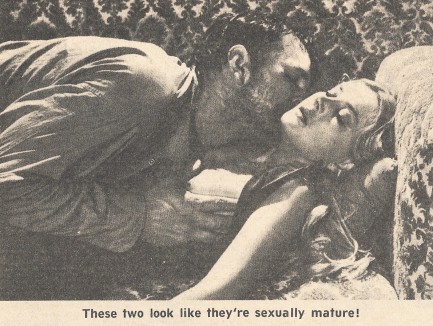
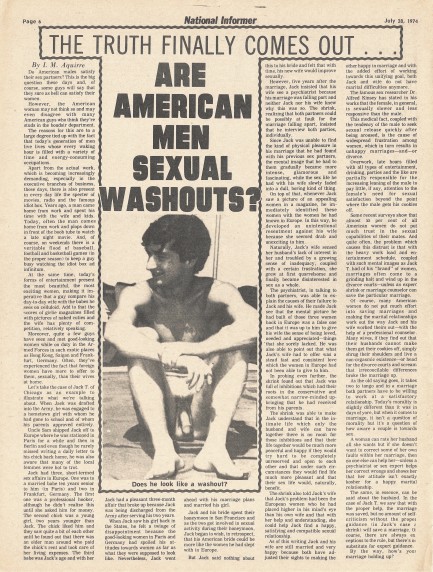
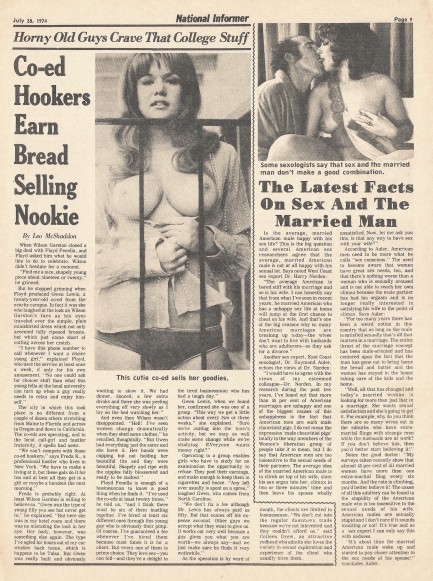
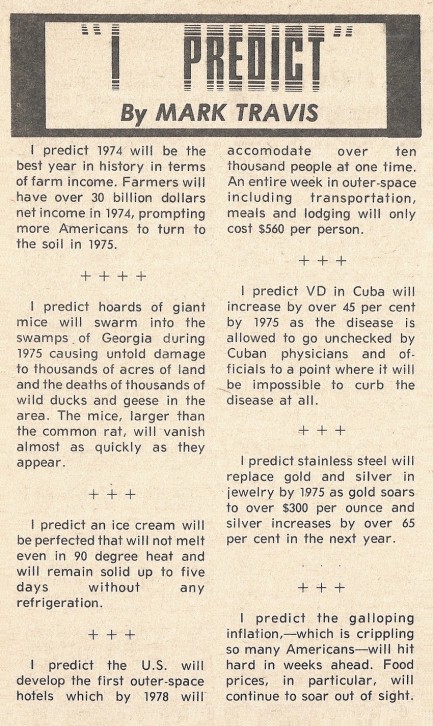
Issues of National Informer on back-to-back days? Sure, why not? The above example, published today in 1974, is five years older than yesterday's, and in the intervening timeframe the editors seem to have stopped woman bashing. They're still treating them as complete sex objects, but that's what Informer was all about. They've also replaced the (not so) Great Criswell with new psychic Mark Travis. We're still curious who actually bought these mags (we do it for scientific purposes, so we don't count), and exactly how seriously they took it. Our guess is not very.
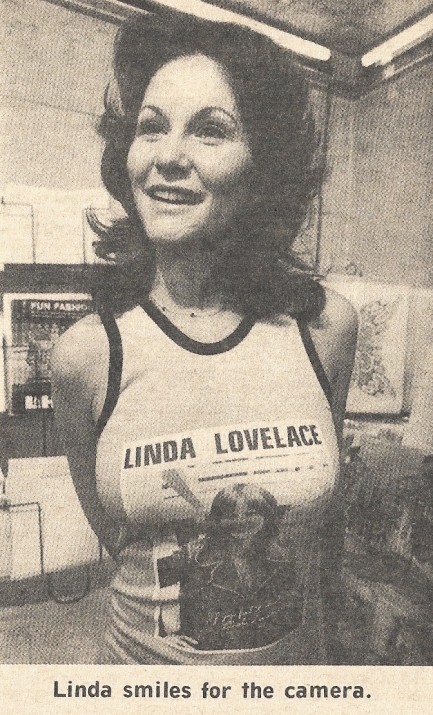
The main attraction in this issue is the story on swivel-hipped musical star Elvis Presley and Linda Lovelace, centerpiece of the xxx smash Deep Throat. Lovelace, who was purportedly involved—at least for a few hours at a time—with such aging stars as Richard Burton, Rex Harrison, Bob Hope, Dean Martin, and (of course) Frank Sinatra, as well as young Hollywood rebels Paul Newman, Marlon Brando, and Dennis Hopper, is alleged to have met up with Presley in Las Vegas. You could be forgiven for assuming that nature took its course, but it didn't. At least, according to reports.
What on Earth could have stopped these two sex elementals from joining forces? Presley allegedly told Lovelace he was temporarily hors de combat because he had hurt himself having sex with Natalie Wood the previous week. Hey, we just relay this stuff. We make no claim that any of it is true. And we thought Natalie was so sweet. Well, you should never judge a book by its cover. Tabloids, on the other hand, you can safely evaluate at a glance. Informer is just as down and dirty as it looks.
 Some people wait for success to come. Some people go out and grab it. 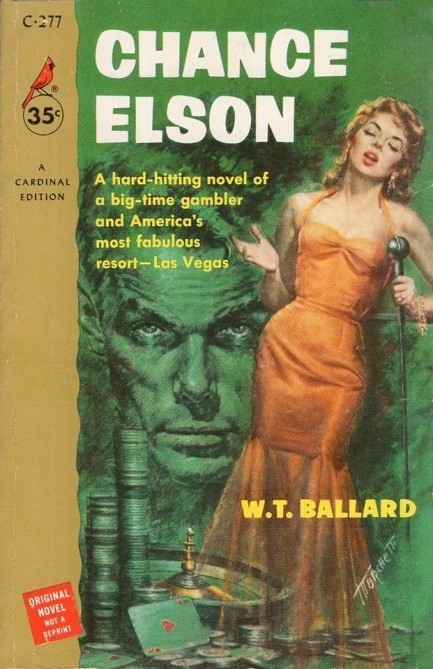
Lou Marchetti painted this cover for Chance Elson by W.T. Ballard, and as always does a good job. This came in 1958, and by then Ballard, who had been publishing since the days of Black Mask magazine, was an extremely experienced author. All that practice shows as he weaves the Depression-era tale of a Cleveland nightclub owner who's driven out of business and town by the mafia and crooked cops, fetches up way out west in a wasteland city called Las Vegas, and tries to build a hotel/casino empire. His rival in this endeavor turns out to be the same mafia thug who precipitated his departure from Cleveland.
There's an interesting subplot here involving Elson taking in an orphaned girl of fourteen named Judy, who grows into a beautiful woman and the main love interest. Because she had escaped from a reform school, he at first passes her off as his younger sister, but as she nears adulthood it's pretty clear to most that Woody and Soon-Yi—oops, we mean Chance and Judy—have something more than guardian/ward feelings for each other. As you might suspect, in the deadly game of dueling casinos that develops between Elson and the mafia, she becomes the pawn.
Chance Elson has a timeline that runs for over a decade, so the book moves beyond the boundaries of most crime thrillers into life story territory, and a major theme concerns whether Elson, who's trying to keep a growing Las Vegas from being overrun by organized crime, can win that battle without becoming as bad as those he seeks to thwart. Or more to the point, his business dealings hinge upon ruthlessness, but his personal dealings and opportunity for true love hinge upon becoming a better human being. Are there flaws in the book? Well, we weren't happy with certain aspects of the woman-in-danger subplot. But like we said, Ballard was experienced. His fictional retelling of the rise of Sin City is expert work.
 Whole lotta Lola going on. 
This photo shows U.S. actress, dancer, and singer Lola Falana ready for a dip in unidentified waters, doing a nice turn to give the photographer an over-the-shoulder look. We figure the distinctive building in the background reveals where this was made, but we can't identify the structure. We can, however, tell you when the photo was shot. It's from 1967, early in Falana's career, when she was working in Italy in such films as Lola Colt. She would later become one of the biggest stars in Las Vegas, eventually pulling in $100,000 a week for a residency at the Aladdin. Yeah. She was rolling in it. Below, in a photo from the same session, she pre-jumps for joy over her impending earnings. 
 Climate change dredges up grim evidence of crimes thought long forgotten. 
Earlier this week in Nevada, someone ambling along the shoreline of Lake Mead found a corroded oil drum that had a nasty surprise inside. Police determined that the contents were human remains, and that the poor individual died of a gunshot wound sometime in the mid-1970s to early 1980s. Whoever killed the person dumped the body deep into the lake—actually a huge reservoir formed by Hoover Dam—but because of an ongoing drought in the western states, the water has in recent years dropped more than a hundred feet below its maximum, revealing tracts of previously submerged land. Authorities believe that as the water level continues dropping they'll find more bodies. And why is that? Well, Las Vegas is nearby.
In a related story, somewhere in Sin City an elderly mobster awoke from an afternoon nap in a sweaty panic, put his hands to his painfully throbbing head, and said: “I felt a great disturbance in the Force. It's as if a voice I thought was silenced decades ago suddenly cried out in terror.” Silence doesn't always last. For sure that'll be the interesting part of this—seeing if modern forensics can identify the body, a good possibility considering the advances of recent decades. And of course identification might lead to suspicions about who dumped it.
The elderly mobster later phoned a slightly less elderly hitman and ranted, “You told me it'd never be found!” To which the hitman said, “Who am I? Nostra-fuckin'-damus? I'm supposed to know the goddamned lake's gonna dry up? You still getting chauffeured around in that old Cadillac? I got a hybrid, so don't blame me!” To the list of problems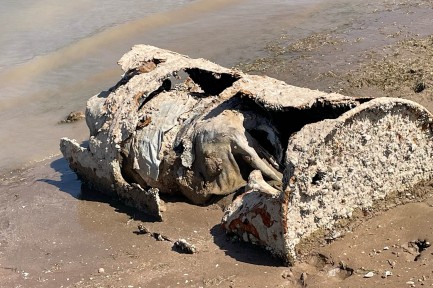 caused by global warming, add grisly corpses reappearing, and former hitmen virtue signaling about their carbon footprints. Which the mobster was too old to understand anyway. “Hybrid? You know I never worked with them! I never liked them, and I never trusted them!” caused by global warming, add grisly corpses reappearing, and former hitmen virtue signaling about their carbon footprints. Which the mobster was too old to understand anyway. “Hybrid? You know I never worked with them! I never liked them, and I never trusted them!”
Plenty of mob-connected people have disappeared from Las Vegas over the decades. As pulp aficionados we have to hope they're all in the lake. Seriously, wouldn't it be fantastic if like seventy bodies turned up? Meanwhile, we bet there's an uptick in local bottled water sales. While it's true the reservoir's output is purified before it gushes through city faucets, and the nuclear testing grounds and chemical plants scattered around Vegas have probably left worse than corpse pathogens in the lake, images of human remains tend to give people a special kind of willies. You can purify the water, but you can't purify people's natural fear of death and decay. Since nothing serious is actually being done about global warming, we at least recommend a more sustainable form of victim disposal. When trouble looms, hide the evidence better. It's time to innovate, Gen Z—older generations have failed. Edit: As of 7 August a total of four bodies have been found. More to come?
 Who can take a casino, walk in sight unseen, eliminate resistance, and collect up all the green? The candyleg. Oh, the candyleg can. 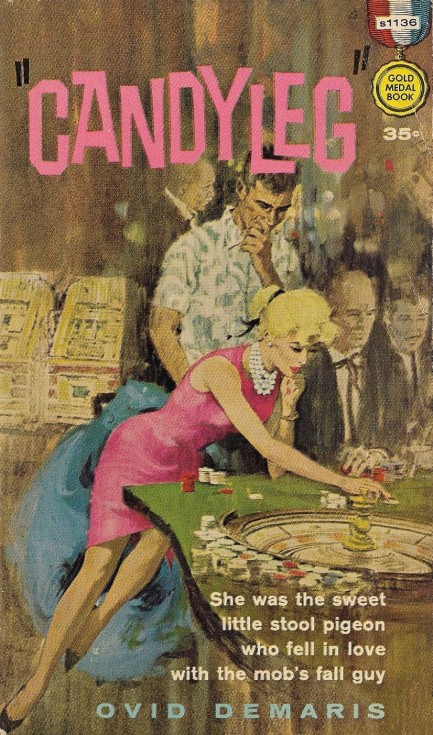
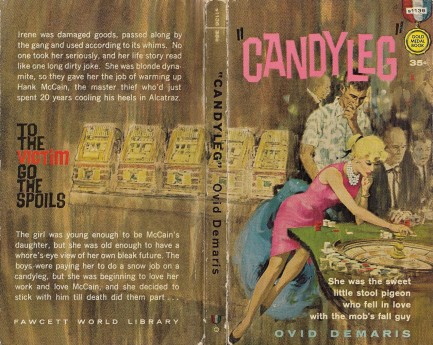
We just finished our second Ovid Demaris novel. The man could write, and his plot set-ups are compelling too. His 1961 mafia thriller Candyleg, also published as Machine Gun McCain, tells the story of McCain, an Alcatraz lifer, who's unexpectedly paroled and told it's so he can mastermind a Las Vegas casino robbery. Jack Falcon, the young and ambitious boss of the western states, wants the casino robbed because it's run by someone he dislikes. McCain is willing, plus he owes a debt for his release, but he soon learns that there are tricky crosscurrents.
Falcon has no doubt McCain can and will rob the casino, but knowing McCain is too independent to share information, Falcon commands his girlfriend Irene to keep McCain close—as in between the sheets—and report back everything going on. McCain, by the way, is Falcon's father. Why do they have different last names? Daddy issues. In any case, he's sending his girlfriend to lay his dad in order to pry info loose about the heist to relay back. It's precarious, family-wise, but high stakes require extraordinary efforts. Falcon needs the best for the heist, and his dad is the best.
Unfortunately, the controlling interests in the casino, who are all headquartered back east, catch vague wind of something related to their valuable and 100% legal investment, and one of their top bosses comes to town to impress upon Falcon that there can be no turbulence of any sort in Vegas—on pain of death. Absolutely, says Falcon, even as he's sweating the fact that McCain, who wants one big score followed by retirement in South America, has gone off-grid and is unreachable. Falcon is counting on Irene to keep in contact, but will she? She doesn't like her boyfriend nearly as much as she likes his dad.
We recommend this thriller. It has interesting characters, a lean but involving plot, good action, good movement, and a lot of moral ambiguity. In the crime fiction genre, Demaris is top notch. At least so far. We'll see if he can keep his streak going. Oh, and what's a candyleg, by the way? It doesn't have anything to do with Irene, though you'd think so reading the front cover blurb. It means a soft touch, and Irene uses it to describe McCain at one point. It's an interesting term, but she's wrong. McCain isn't soft. He's as tough as they come, and so is Demaris's fiction.
 For there were no more worlds to conquer. 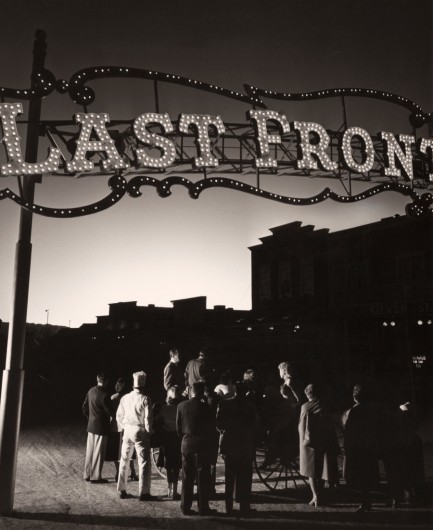
Above: a crowd of spectators standing under the entrance sign of the Last Frontier Village on the Las Vegas strip watch the flash from a nuclear blast emanating from the Nevada desert. In the immediate background are Old West-style buildings that housed shops, restaurants, and the Golden Slipper Casino. The sign is a nice juxtaposition by lensman Volkmar Wentzel, placing his shot at the nexus of visual metaphor and social commentary. The bomb, named Annie, was detonated at Yucca Flat at the Nevada Test Site as part of the test series Operation Upshot-Knothole. It was one of the most photographed of nuclear tests, which is why we've already touched on it here and here, and in fact, because the event was even documented on kinescope, it's one of the few recordings ever made of the sound of a nuclear explosion. Below you see what Annie looked like for people closer to ground zero. It happened early this morning in 1953.
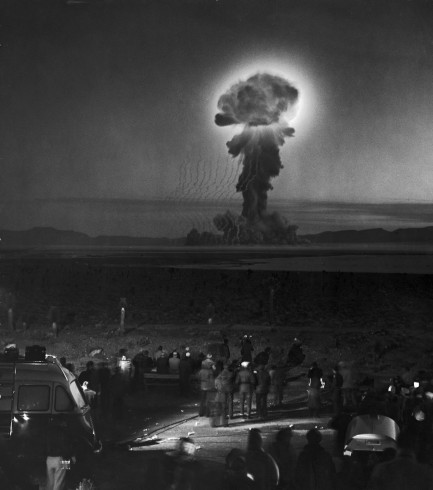
 Heavy is the head that wears the oversized platinum blowout. 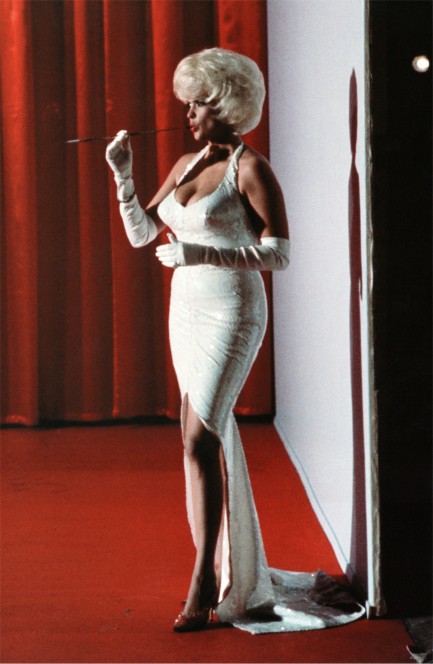
This photo shows Hollywood bombshell Jayne Mansfield sporting an astonishing candyfloss coiffure backstage at the Dunes Hotel in Las Vegas in 1964. The hair—let's just say it—is fucking strange and must have taken at least an hour to sculpt, or maybe it's a wig. Either way, it befits her larger-than-life stature. When you're as big a celebrity as she was you have to set tongues wagging every time you appear in public, because once they stop it's all over. The game remains unchanged today, but few have played it as well as Jayne.
 Just a little something to help pass the time. 
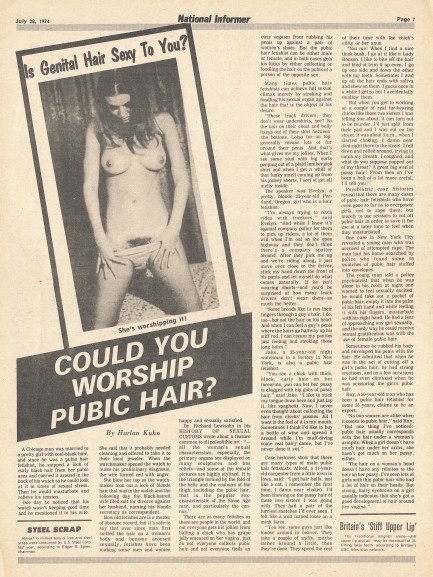
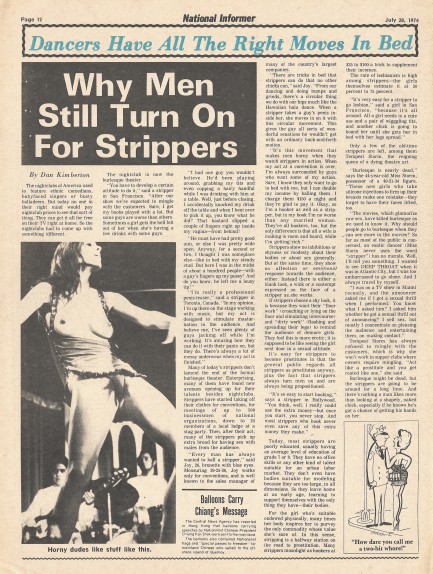
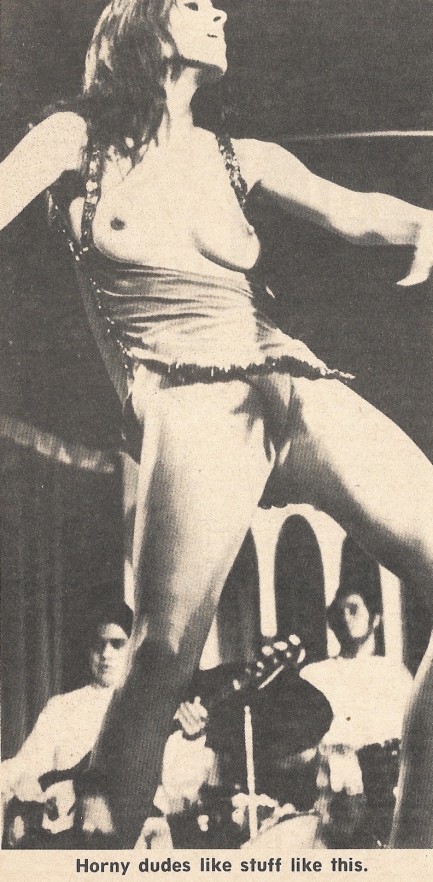
Above is the cover of an issue of National Informer Reader published today in 1974. Some people will tell you that the trans community is a new thing, but it isn't, and we know because vintage tabloids have been obsessed with the subject for more than sixty years. If you don't believe us check here, here, here, here, and here. Reader visits the topic with a story on trans entertainer Jennifer Fox. In cheap tabloids the stories were often made up, but Fox existed. She underwent gender reassignment in 1968 and became a burlesque dancer in Las Vegas. In other stories she's noted that once knowledge of her change became widely known, interest in her exploded and she became a star attraction. The only thing is, we don't think the photo Reader printed is Fox. Her face looks wrong, Fox was usually blonde, and not many burlesque dancers posed frontally nude after becoming famous—it would have devalued the moneymaker. Probably Reader never actually spoke to Fox. The editors simply knew a useful story when they saw it, and used a handout photo that looked good. When it comes to tabloids in this tier almost nothing is 100% accurate. Scans below. 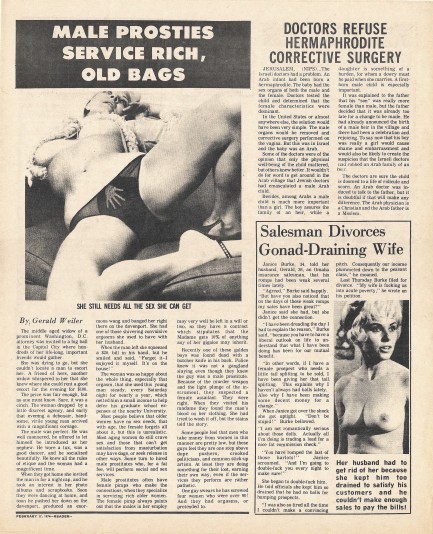  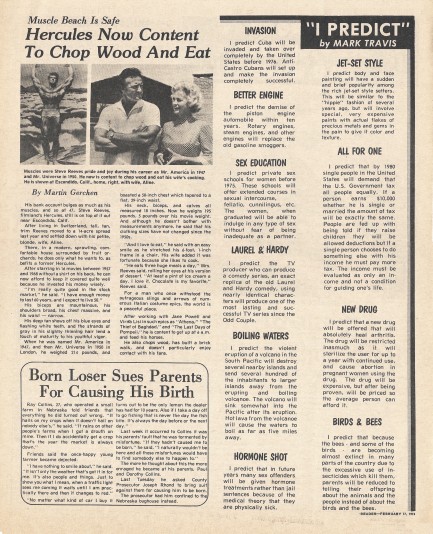 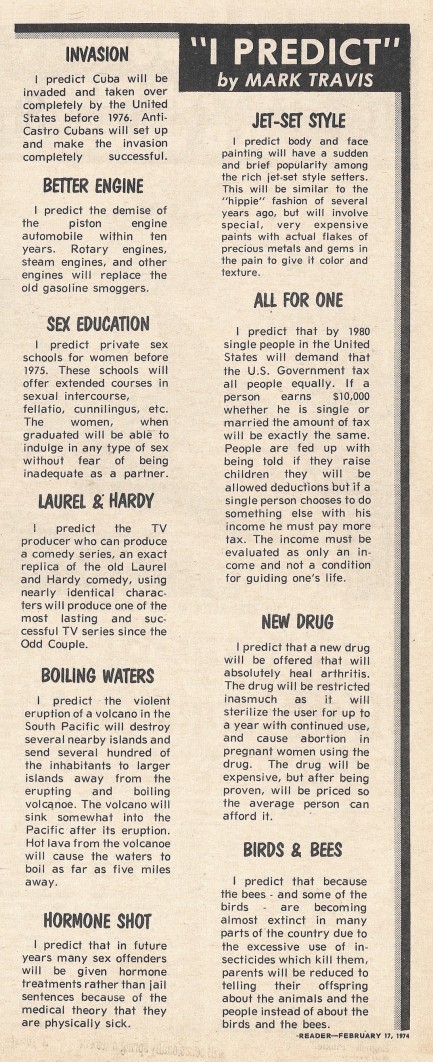   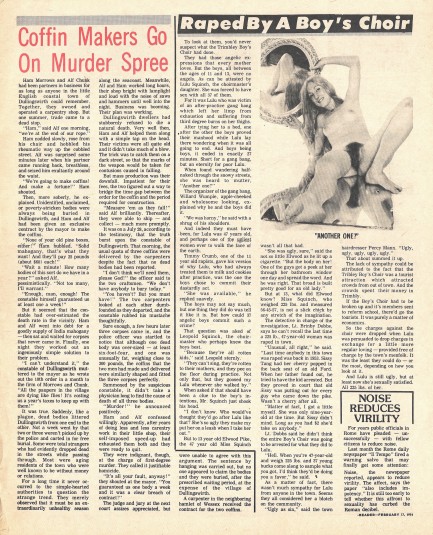   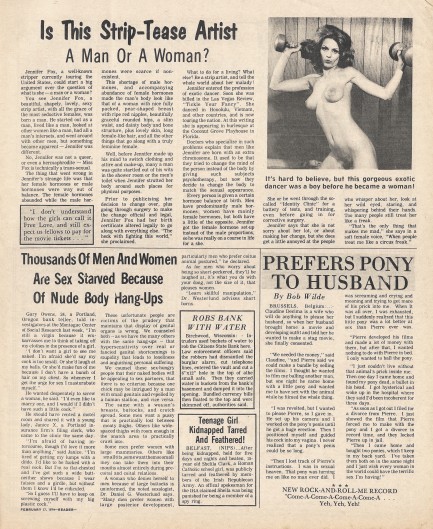  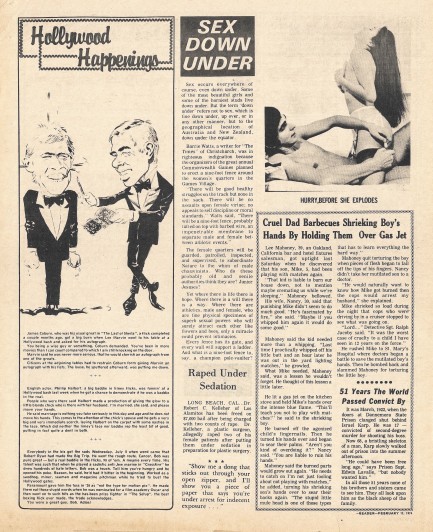 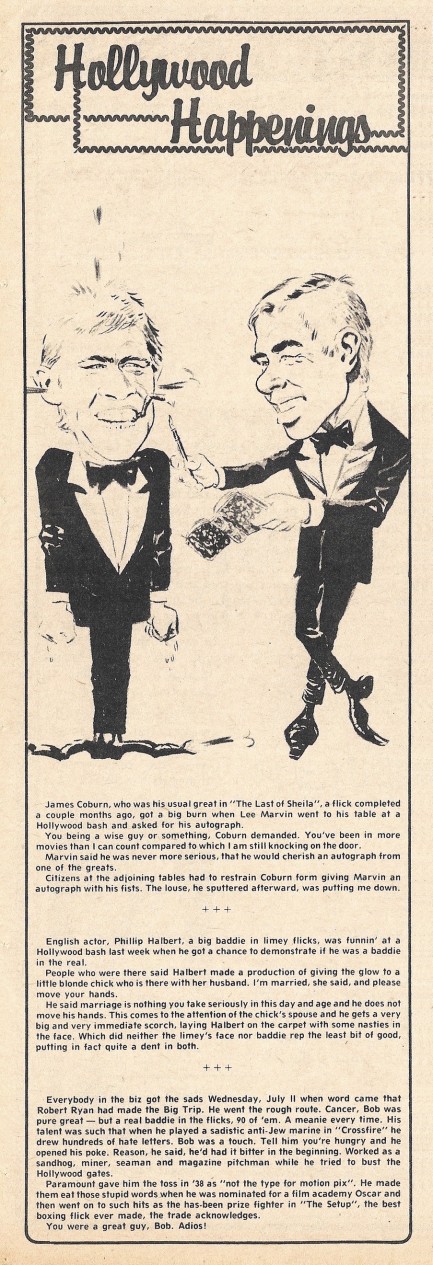

|
 |
The headlines that mattered yesteryear.
1945—Mussolini Is Arrested
Italian dictator Benito Mussolini, his mistress Clara Petacci, and fifteen supporters are arrested by Italian partisans in Dongo, Italy while attempting to escape the region in the wake of the collapse of Mussolini's fascist government. The next day, Mussolini and his mistress are both executed, along with most of the members of their group. Their bodies are then trucked to Milan where they are hung upside down on meathooks from the roof of a gas station, then spat upon and stoned until they are unrecognizable. 1933—The Gestapo Is Formed
The Geheime Staatspolizei, aka Gestapo, the official secret police force of Nazi Germany, is established. It begins under the administration of SS leader Heinrich Himmler in his position as Chief of German Police, but by 1939 is administered by the Reichssicherheitshauptamt, or Reich Main Security Office, and is a feared entity in every corner of Germany and beyond. 1937—Guernica Is Bombed
In Spain during the Spanish Civil War, the Basque town of Guernica is bombed by the German Luftwaffe, resulting in widespread destruction and casualties. The Basque government reports 1,654 people killed, while later research suggests far fewer deaths, but regardless, Guernica is viewed as an example of terror bombing and other countries learn that Nazi Germany is committed to that tactic. The bombing also becomes inspiration for Pablo Picasso, resulting in a protest painting that is not only his most famous work, but one the most important pieces of art ever produced. 1939—Batman Debuts
In Detective Comics #27, DC Comics publishes its second major superhero, Batman, who becomes one of the most popular comic book characters of all time, and then a popular camp television series starring Adam West, and lastly a multi-million dollar movie franchise starring Michael Keaton, then George Clooney, and finally Christian Bale. 1953—Crick and Watson Publish DNA Results
British scientists James D Watson and Francis Crick publish an article detailing their discovery of the existence and structure of deoxyribonucleic acid, or DNA, in Nature magazine. Their findings answer one of the oldest and most fundamental questions of biology, that of how living things reproduce themselves.
|

|
|
It's easy. We have an uploader that makes it a snap. Use it to submit your art, text, header, and subhead. Your post can be funny, serious, or anything in between, as long as it's vintage pulp. You'll get a byline and experience the fleeting pride of free authorship. We'll edit your post for typos, but the rest is up to you. Click here to give us your best shot.
|
|