Vintage Pulp Mar 10 2012
CONSPICUOUS WELCH
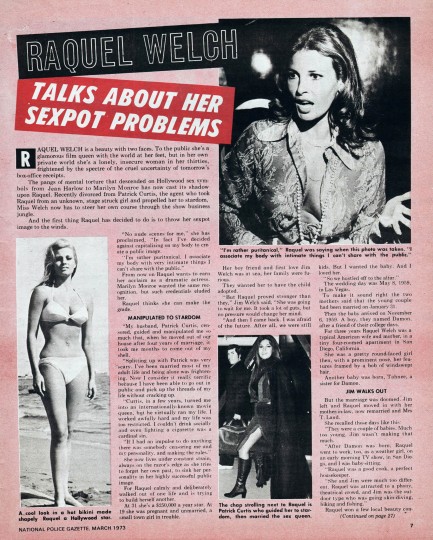
Raquel Welch expresses misgivings about being a global sex symbol.

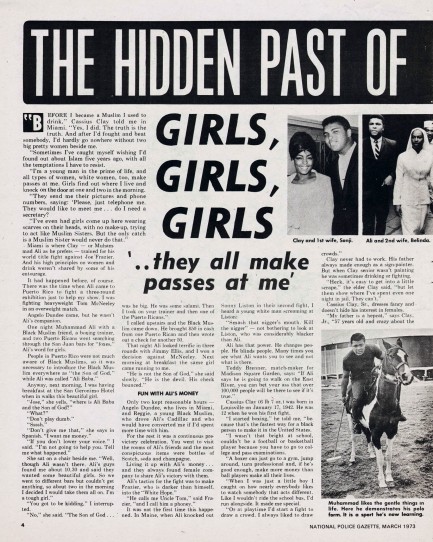
This March 1973 issue of The National Police Gazette sports an eye-catching color scheme cleverly copied from the dress of actress Raquel Welch, who you see at lower left. Welch discusses her early first marriage, which resulted in two children, and laments her restrictive personal/professional relationship with her manager/second husband, who shaped her into an internationally famous cinematic sexpot. As a basically shy person, Welch claims to feel trapped by her image, and says she’s reached the point where she’s fed up with it. Moving forward, she explains, she will be interested only in serious film roles, and will refuse any scripts focusing on her sexuality.

We always find it curious when actors try to make a sharp turn away from what made them famous in the first place. Both men and women do it—among men it’s often comedians and action stars, and among women it’s sex symbols. These career shifts fail far greater than nine times out of ten. In Welch’s case, she was quickly consigned to the purgatory of television movies. Later, she reversed course on whole sexuality thing and posed for Playboy, but scored roles only sporadically for the rest of her career.

But in our opinion, her failure to escape the sex symbol trap wasn't due to a lack of talent. It probably had simply to do with the fact that she had passed the dreaded thirty-year-old barrier and didn’t look like an ingénue anymore. Nowadays actresses last long past thirty, but tellingly, are still not allowed to look their age. Entire websites dedicated to bad cosmetic surgery testify to that fact. In Welch's case, her sudden relegation to second tier status just goes to show what poor taste Hollywood producers have. Because ingénue or not, Raquel is Raquel.
diggfacebookstumbledelicious

Featured Pulp
FEBRUARY 1933 BEAUTE MAGAZINE
JULY 1937 BEAUTES MAGAZINE
JANUARY 1935 PARIS MAGAZINE
JANUARY 1935 POUR LIRE A DEUX
OCTOBER 1929 PARIS PLAISIRS
NOVEMBER 1933 PARIS MAGAZINE
MAY 1935 PARIS MAGAZINE
History Rewind
The headlines that mattered yesteryear.
May 18
1926—Aimee Semple McPherson Disappears
In the U.S., Canadian born evangelist Aimee Semple McPherson disappears from Venice Beach, California in the middle of the afternoon. She is initially thought to have drowned, but on June 23, McPherson stumbles out of the desert in Agua Prieta, a Mexican town across the border from Douglas, Arizona, claiming to have been kidnapped, drugged, tortured and held for ransom in a shack by two people named Steve and Mexicali Rose. However, it soon becomes clear that McPherson's tale is fabricated, though to this day the reasons behind it remain unknown.
1964—Mods and Rockers Jailed After Riots
In Britain, scores of youths are jailed following a weekend of violent clashes between gangs of Mods and Rockers in Brighton and other south coast resorts. Mods listened to ska music and The Who, wore suits and rode Italian scooters, while Rockers listened to Elvis and Gene Vincent, and rode motorcycles. These differences triggered the violence.
May 17
1974—Police Raid SLA Headquarters
In the U.S., Los Angeles police raid the headquarters of the revolutionary group the Symbionese Liberation Army, resulting in the deaths of six members. The SLA had gained international notoriety by kidnapping nineteen-year old media heiress Patty Hearst from her Berkeley, California apartment, an act which precipitated her participation in an armed bank robbery.
1978—Charlie Chaplin's Missing Body Is Found
Eleven weeks after it was disinterred and stolen from a grave in Corsier near Lausanne, Switzerland, Charlie Chaplin's corpse is found by police. Two men—Roman Wardas, a 24-year-old Pole, and Gantscho Ganev, a 38-year-old Bulgarian—are convicted in December of stealing the coffin and trying to extort £400,000 from the Chaplin family.
May 16
1918—U.S. Congress Passes the Sedition Act
In the U.S., Congress passes a set of amendments to the Espionage Act called the Sedition Act, which makes "disloyal, profane, scurrilous, or abusive language" about the United States government, its flag, or its armed forces, as well as language that causes foreigners to view the American government or its institutions with contempt, an imprisonable offense. The Act specifically applies only during times of war, but later is pushed by politicians as a possible peacetime law, specifically to prevent political uprisings in African-American communities. But the Act is never extended and is repealed entirely in 1920.

Advertise Here
Reader Pulp
It's easy. We have an uploader that makes it a snap. Use it to submit your art, text, header, and subhead. Your post can be funny, serious, or anything in between, as long as it's vintage pulp. You'll get a byline and experience the fleeting pride of free authorship. We'll edit your post for typos, but the rest is up to you. Click here to give us your best shot.

Pulp Covers
Pulp art from around the web
muller-fokker.blogspot.com.es/2013/03/la-turlutte-finale.html canadianfly-by-night.blogspot.com.es/2013/04/the-mystery-league-and-harlequin-part-ii.html
jasonnahrung.com/2011/10/11/writerly-round-up-including-the-big-sleep-ive-just-had-and-the-one-im-about-to/big-sleep/ lovethiscover.blogspot.com/2011/01/75.html
giallobookcovers.blogspot.com.es/2013/04/i-gialli-di-margot_14.html cryptofwrestling.tumblr.com/post/6650692441/shut-up-weirdo-title-of-the-year-candidate
Pulp Advertising
Things you'd love to buy but can't anymore
PulpInternational.com Vintage Ads
Humor Blog Directory
About Email Legal RSS RSS Tabloid Femmes Fatales Hollywoodland Intl. Notebook Mondo Bizarro Musiquarium Politique Diabolique Sex Files Sportswire