A legendary boxer faces the winter of his discontent. 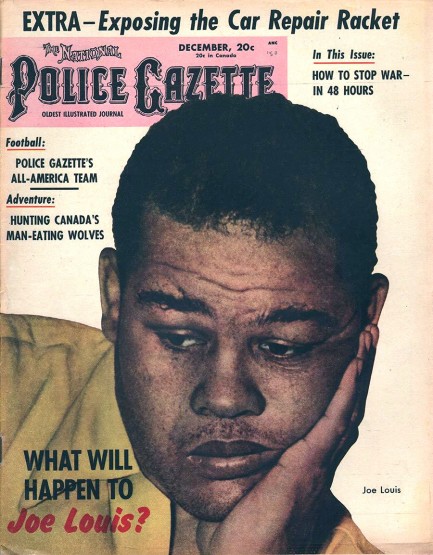
The National Police Gazette asks on a cover from this month in 1950 “What Will Happen to Joe Louis?” It's a poignant question. Louis had earned more than $4 million during his boxing career (about $40 million in 2016 money), but thanks to predatory managers and slimy handlers had received only about $800,000 of it. However, his gross earnings left him with a huge tax bill, forcing him to fight past his prime in an attempt to pay off the debt. In September 1950 he met Ezzard Charles and was thrashed. For his pain he earned just over $100,000—not nearly enough to pay off the government. Left with no choice, he decided to shoot for another big payday. First he notched several wins again club level fighters, then booked a bout against another top boxer. That boxer was twenty-seven year old Rocky Marciano, and the meeting ended with Louis being knocked clean out of the ring. So, getting back to the Gazette's question: "What will happen to Joe Louis?" What happened is he retired and became an exhibition fighter, still carrying that heavy debt, and he never paid it off.
 My father is tougher than your father. 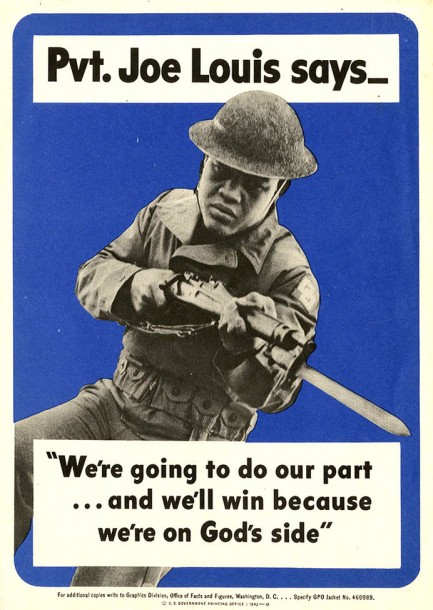
This bit of World War II propaganda, which was created by the Graphics Division of the U.S. government's Office of Facts and Figures in 1942, caught our eye for a couple of reasons. It features champion boxer Joe Louis, which is interesting enough, but it also features a quote he had uttered while taking part in a military charity event: “We’re going to do our part… and we’ll win because we’re on God’s side.” This is an interesting turn of phrase because of its inversion of "our" and "God." The way Louis formulates the idea suggests God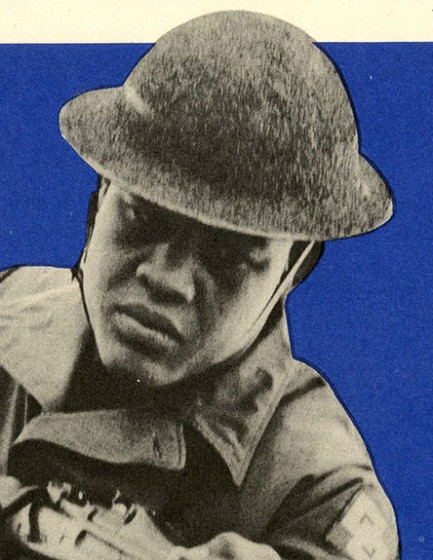 desired the war and the U.S. was just helping out. Usually you hear the sentiment expressed as, “God is on our side,” but Louis's quote has more power loaded into it than the standard iteration. It casts Japan as not just battling an enemy nation that has God's help, but battling the natural order of the cosmos. desired the war and the U.S. was just helping out. Usually you hear the sentiment expressed as, “God is on our side,” but Louis's quote has more power loaded into it than the standard iteration. It casts Japan as not just battling an enemy nation that has God's help, but battling the natural order of the cosmos. Of course, the Japanese also thought they were divinely guided, and over in Europe where Germany was fighting several countries at once, the opportunistic Adolf Hitler, though a skeptic in private, declared himself a Christian in public and busily used religious sentiment in his devoutly Catholic nation to whip up support for his rule. Thus God was presumably rooting for both sides. We have a sizable collection of World War II propaganda inside Pulp Intl., originating from many countries, which we think is worth a look. You can see some of it here, here, here, here, here, and here.
 When worlds collide you want front row seats. 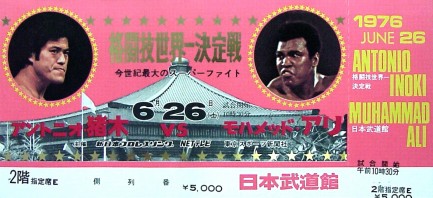
So, everything we write today, pretend we wrote it yesterday. Ready? We talked briefly about Muhammad Ali's proto-MMA experience a few weeks ago. We've been saving this item to share. It's an actual unused ticket stub for the Muhammad Ali-Antonio Inoki exhibition match at the Nippon Budokan arena today yesterday in 1976, exactly forty years forty years and one day ago. Oh yes. This is rare. At least we think it is, because we've never seen another one. We've uploaded it vertically below so you can get a good look at it by dragging it to your desktop and rotating it. 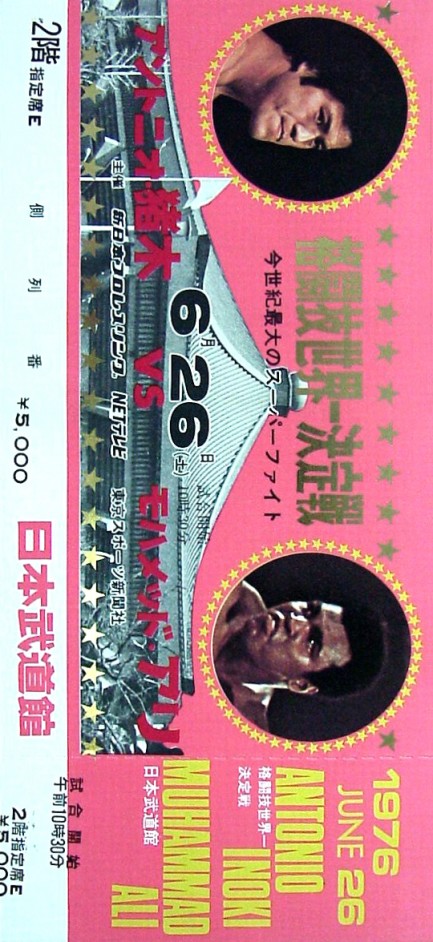
 Ali invades Japan and helps invent MMA. 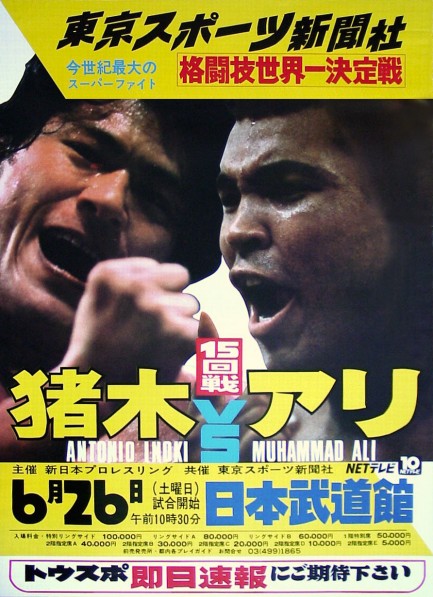
When Muhammad Ali died last week we remembered we had some rarities laying around, but it took a few days to find them. These are the items we were searching for—posters from Ali's June 1976 match at Tokyo's Nippon Budokan arena with Japanese wrestler Antonio Inoki. In what would now be called a mixed martial arts bout, Ali and Inoki fought to a draw, however this was not a freeform battle, but rather a tightly regulated exhibition match. Nevertheless, Ali's leg was so damaged from Inoki's repeated kicks that an infection set in and for a brief time the medical discussion turned to amputation. Today the Budokan match is considered by Ali fans an embarrassment in the boxer's storied career, but it was also an important precursor to MMA, a case study in how boxing and MMA are incompatible sports, and yet another example of Ali's trailblazing nature. He was the king and he will be missed. 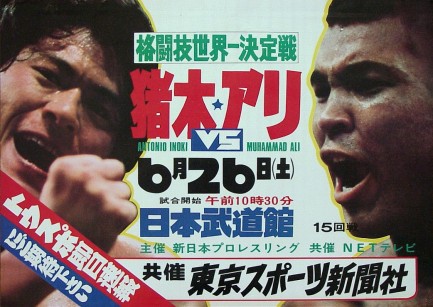
 He gave every last drop of his blood—to the IRS. 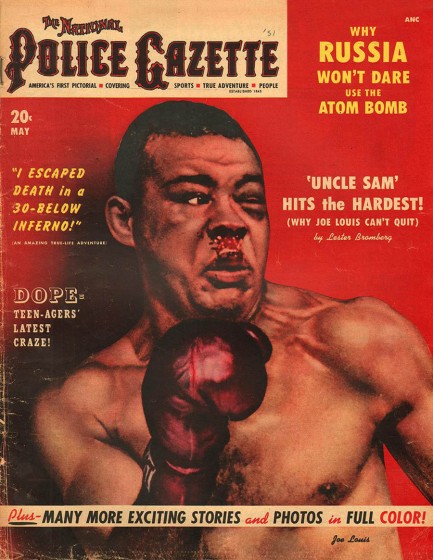
This National Police Gazette cover from this month in 1951 shows a bloodied Joe Louis in the midst of a title bout loss to Ezzard Charles in September 1950. Louis had retired, but when the U.S. government's Internal Revenue Service came after him for $500,000 in back taxes, he fought again—at age thirty-six—with the agreement that the proceeds would clear his debt. Thus Gazette's sub-head: “Why Joe Louis Can't Quit.” He'd hoped to pay off the entire bill with one fight, but the crowd was small and the purse far less than expected. With debt still outstanding, he did the only thing he could—take more fights.
And in the center of the magazine Gazette offers up Hazel Nilsen as its Date of the Month. Gazette featured established personalities on its calendar pages only occasionally, which means the magazine's promo shots today serve as an encyclopedia of aspiring starlets who almost—but never quite—made it. Nilsen was aiming for Broadway because of the excitement of acting before a live audience, but never appeared in a play. Instead she scored small roles in three Hollywood westerns between 1949 and 1952, including as an Indian maiden named White Fawn in Apache Chief, before fading from the scene. Showbiz is a cruel mistress. 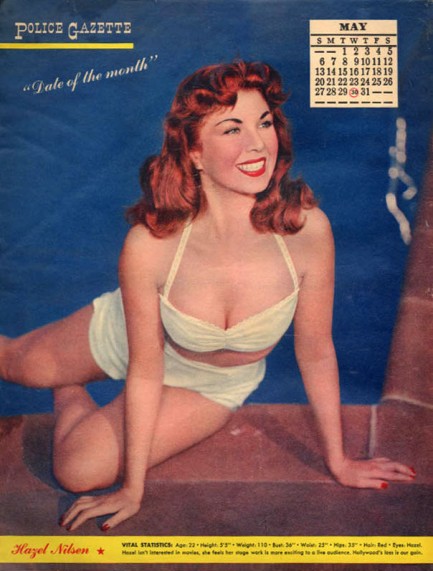
 They didn't call him the Bronx Bull for nothing. 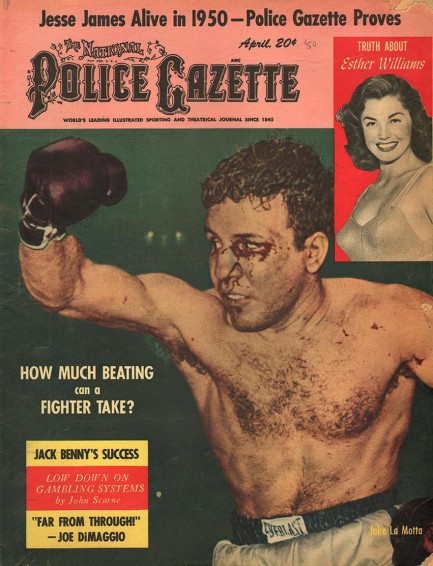
How much beating can a fighter take? National Police Gazette asks that burning question on the front of this issue that hit newsstands this month in 1950. The cover star is Jake LaMotta, the Bronx Bull, who was famous for being able to take a punch—or fifty—and his unseen opponent is French fighter Robert Villemain. The photo was made during their December 1949 bout, a match LaMotta lost by unanimous decision. But his reputation as someone who could take a punch grew even when he lost, and eventually reached legendary proportions. His most serious beating occurred in February 1951 during a bout with Sugar Ray Robinson that was dubbed the Saint Valentine's Day Massacre. By the end the fight had become an epic of human destruction, and almost certainly caused permanent damage to La Motta. But in ninety-five professional matches to that point he had never been knocked to the canvas and he didn't fall that night either, even during a vicious final-round barrage that had LaMotta staggering around the ring. So the answer to Gazette's question—How much beating can a fighter take?—is simple. If you're LaMotta, you can take plenty. 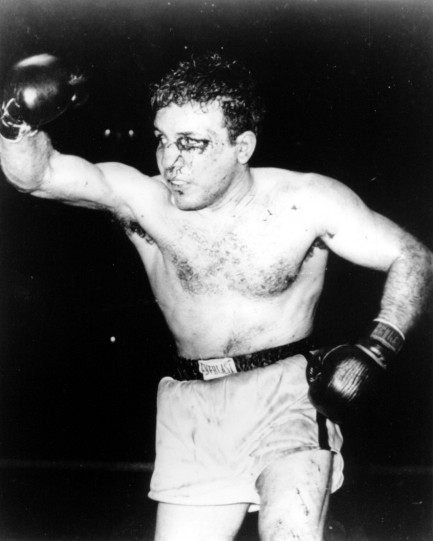
 The boys of summer headline autumn’s biggest event. 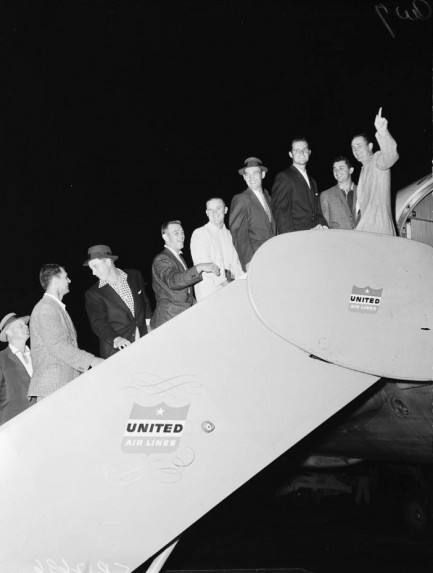
The Los Angeles Dodgers board a United Airlines DC-7 charter plane headed to Chicago, where they would battle the Chicago White Sox in the 1959 World Series. Pictured are Sandy Koufax, Don Zimmer, Pee Wee Reese, and other stars. The Dodgers won the series four games to two. The three games played at the Los Angeles Memorial Coliseum drew huge crowds, with game five’s attendance of 92,706 remaining a World Series record to this day. The photo was made today in 1959.
 It’s time to say goodnight. 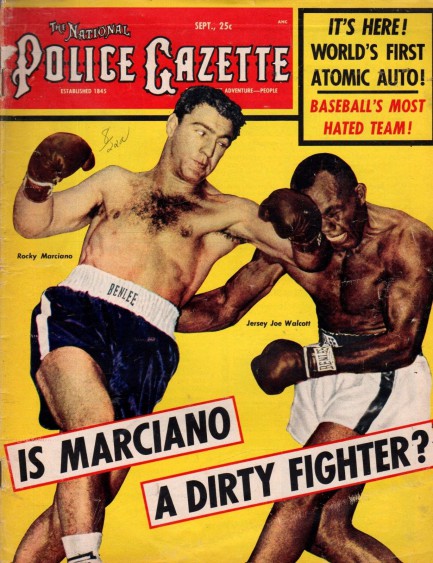 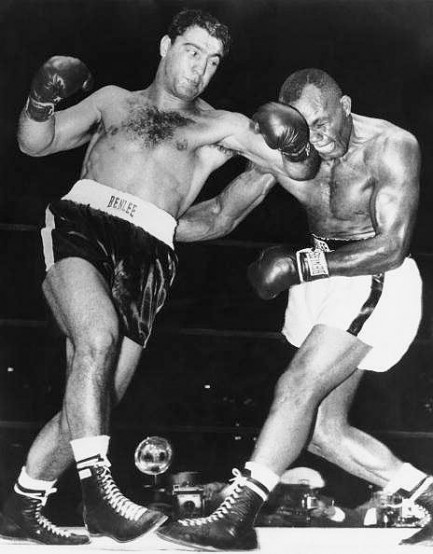
The National Police Gazette loved fighters in general and Rocky Marciano in particular. He appeared on the magazine’s cover at least a dozen times, and above you see another colorful photo-illustration put together from a shot made during his first bout with heavyweight champion Jersey Joe Walcott, which the much younger Marciano won by TKO. The fight was today in 1952, and the photo appeared on the Gazette a year later in September 1953.
 Saddlered, whipped, and sent back to the barn. 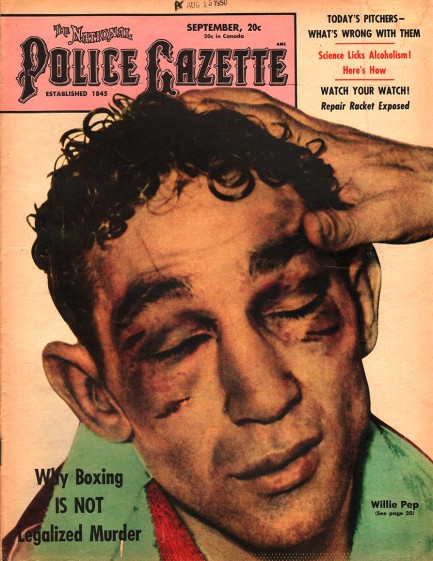 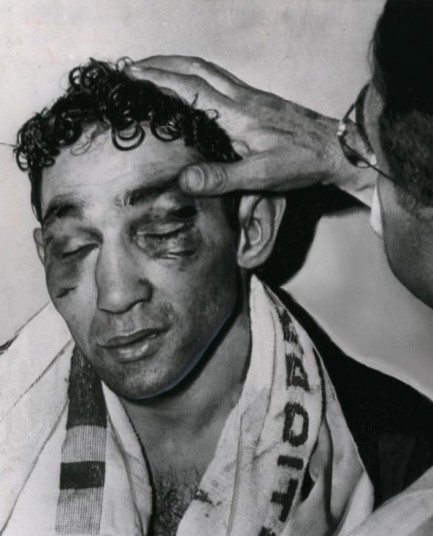
The cover of this National Police Gazette published today in 1950 shows boxer Willie Pep being assessed by Dr. Vincent Nardiello after a February 1949 bout with archnemesis Sandy Saddler. Below the cover is another image from the same sequence. Saddler really put a hurting on Pep, as you can see from the severity of his injuries, but that was normal for the two fighters. They met four times, trading the lightweight championship three times in those battles, with the last fight considered even today one of the dirtiest of all time. You can see more from Police Gazette by clicking its keywords below.
 If I can’t have you, nobody else can. 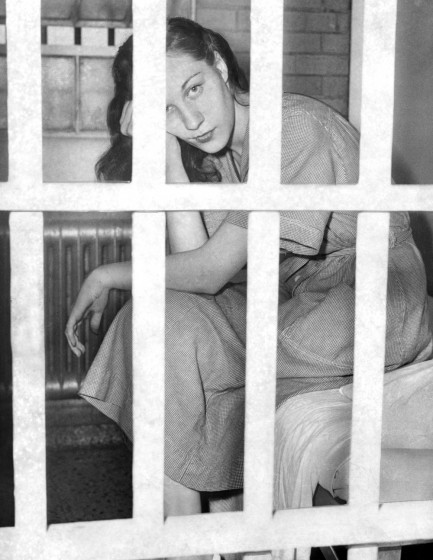
The above photo shows Ruth Ann Steinhagen in Chicago’s Cook County Jail, where she was being held after shooting Chicago Cubs baseball player Eddie Waitkus at the Edgewater Beach Hotel. Steinhagen had invited Waitkus to her hotel room after a Cubs game, first via a note telling him she had an urgent matter to discuss with him, and later by phone. When he finally went to her room she told him (though accounts vary), “If I can’t have you nobody else can,” and shot him in the chest with a .22 rifle she had grabbed from a closet. Steinhagen was an early example of a new breed of psycho—the celebrity stalker. The story of Waitkus’s shooting would later be used by author Bernard Malamud for his 1952 novel The Natural, which was in turn made into a truly excellent 1984 movie with Robert Redford. The jail photo was made today in 1949, and the shooting had happened two days earlier.
 |  |
|
 |
The headlines that mattered yesteryear.
1939—Batman Debuts
In Detective Comics #27, DC Comics publishes its second major superhero, Batman, who becomes one of the most popular comic book characters of all time, and then a popular camp television series starring Adam West, and lastly a multi-million dollar movie franchise starring Michael Keaton, then George Clooney, and finally Christian Bale. 1953—Crick and Watson Publish DNA Results
British scientists James D Watson and Francis Crick publish an article detailing their discovery of the existence and structure of deoxyribonucleic acid, or DNA, in Nature magazine. Their findings answer one of the oldest and most fundamental questions of biology, that of how living things reproduce themselves. 1967—First Space Program Casualty Occurs
Soviet cosmonaut Vladimir Komarov dies in Soyuz 1 when, during re-entry into Earth's atmosphere after more than ten successful orbits, the capsule's main parachute fails to deploy properly, and the backup chute becomes entangled in the first. The capsule's descent is slowed, but it still hits the ground at about 90 mph, at which point it bursts into flames. Komarov is the first human to die during a space mission. 1986—Otto Preminger Dies
Austro–Hungarian film director Otto Preminger, who directed such eternal classics as Laura, Anatomy of a Murder, Carmen Jones, The Man with the Golden Arm, and Stalag 17, and for his efforts earned a star on Hollywood's Walk of Fame, dies in New York City, aged 80, from cancer and Alzheimer's disease. 1998—James Earl Ray Dies
The convicted assassin of American civil rights leader Martin Luther King, Jr., petty criminal James Earl Ray, dies in prison of hepatitis aged 70, protesting his innocence as he had for decades. Members of the King family who supported Ray's fight to clear his name believed the U.S. Government had been involved in Dr. King's killing, but with Ray's death such questions became moot.
|

|
|
It's easy. We have an uploader that makes it a snap. Use it to submit your art, text, header, and subhead. Your post can be funny, serious, or anything in between, as long as it's vintage pulp. You'll get a byline and experience the fleeting pride of free authorship. We'll edit your post for typos, but the rest is up to you. Click here to give us your best shot.
|
|