Vintage Pulp | Sex Files Jul 20 2009
FAROUKING AROUND
It’s good to be the king—just don’t overdo it.

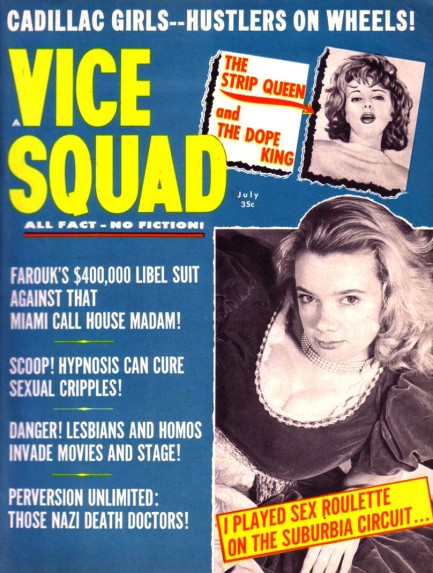
Here’s a July 1962 issue of the tabloid Vice Squad, with several interesting items on the cover. Cadillac girls—self explanatory. Sexual cripples—ditto. Same with sex roulette, perversion unlimited, and the phobic feature on lesbians and homos. But, aha, the story on Farouk’s $400,000 libel suit is worth detailing. In brief, Ruth Barnes, a Miami madame who went by the nom de directeur Sherry, published an autobiography called Pleasure Was My Business. Her book named a raft of celebrity clients, including the ex-king of Egypt, Farouk I. Furthermore, she claimed he was not only a regular client, but that he once snuck into the U.S. via some helpful port authority folks and rented Madame Sherry’s entire house for a night of fun and games. When Farouk learned he'd been outed, he flipped and sued for libel, specifically claiming he was never in the U.S. at the time in question and he was outraged and infuriated and so forth. Long story short—he lost. So not only had he entered the U.S., he’d also entered Madame Sherry’s house, and followed that up by entering a few of her employees. The epilogue on this guy is so fascinating. Always a bit of a gourmand, he started life thin, and remained so through his heyday, but as middle age approached the eating caught up with him and by age forty he was tipping the scales at nearly three-hundred pounds. One night, after gorging himself as usual, he collapsed and died. He was 45. We’ve taken the lesson to heart here at Pulp Intl., and we’re cutting back on the fatty foods and getting more exercise. But we’re never, ever giving up the hookers so don’t even ask.     

diggfacebookstumbledelicious

Vintage Pulp Dec 2 2008
CONFIDENTIALLY YOURS
1950s tabloid aired Tinseltown’s dirty laundry to millions every month.

This month in 1952, right wing scandal rag Confidential hit newsstands for the first time. It was owned by Robert Harrison, who got his start in publishing at the New York Graphic, one of the earliest celebrity scandal sheets. Confidential was based in New York City, but its focus was Hollywood and its environs. To gather information Harrison cultivated a vast network of west coast informants—everyone from hotel concierges to taxicab dispatchers. The magazine was lurid, filled with doctored  photos, and shamelessly exploitative of hot-button social fears. A typical issue might accuse Hollywood glitterati of using illegal drugs, sympathizing with communists, associating with other races, or working for the mob.

The formula worked. Within two years Confidential grew into a bestselling magazine. It screamed from American newsstands about interracial affairs, LSD parties, and backalley abortions, always in a glaring red-yellow motif that would become its visual trademark. Humphrey Bogart once famously called Robert Harrison “The King of Leer,” sentimentswhich were echoed throughout Hollywood. Stars were galled not just by the magazine’s constant attacks, but the fact that they originated from three-thousand  miles away. It meant Confidential either fabricated its stories, or gathered info by means of spies. Neither possibility was pleasing to consider.

Hollywood began fighting back. Ronald Reagan, who at the time was a snitch for Tinseltown’s hated blacklisters, chaired a committee that smeared Confidential staff. Postmaster General Arthur Summerfield at one

point banned mail delivery of the magazine. In 1957 the Kraft Commission put Robert Harrison on trial for conspiracy to publish criminal libel. The trial ended in a plea deal, but not before Hollywood stars realized their greatest ally was the legal system. Lawsuits kept Confidential in litigation from that point forward, and Harrison finally sold out in 1958.

The new owners managed to keep Confidential going, but mindful of lawsuits the magazine had lost under Harrison in 1956 and 1957, operated more cautiously. Soon, readers began to suspect the tabloid was no longer living up to its stated credo: “Telling the facts and naming the names”. Confidential stopped flying off newsstands. Sales dipped to a third what they had been at their zenith. A 1970s shift in editorial focus toward hippie counterculture did little to reverse fortunes, and Confidential finally folded  in 1978.

Though defunct, its twenty-two year run was a success by almost any standard. Confidential outlasted a dozen competitors, and its influence extends into today’s newsstand tabloids, Hollywood-oriented television shows, celeb blogs, and even popular fiction. Author James Ellroy’s award-winning pulp thrillers frequently reference Hush Hush, a Confidential copycat. And Pultizer Prize winning columnist Stephen Hunter wrote a bestselling thriller about the Mafia’s presence in Hot Springs, Arkansas during the 1950s, a subject Confidential covered in its very first issue.

diggfacebookstumbledelicious

Sex Files | Musiquarium Nov 21 2008
SEXY FRONT
The boob that refused to die.

The FCC today appealed its loss in the indecency suit against singer Janet Jackson by asking the U.S. Supreme Court to review the case. During halftime of the 2004 Super Bowl, singer Justin Timberlake deliberately removed part of Jackson’s costume and exposed a pastie-covered breast for approximately one second before a worldwide television audience—including millions of children who we are to believe now suffer from recurring chocolate boob nightmares.

The 3rd U.S. Circuit Court of Appeals threw out the case against Jackson in July (strangely, Timberlake was never sued), but the politically conservative FCC considers the matter of a female breast so weighty that two previous losses leave it undeterred in its desire to impose a six-figure fine on the singer and CBS Television. No word yet on whether the Supreme Court, also politically conservative, will hear the case.

The FCC has appeals pending as well in indecency cases against Cher for uttering “fuck” during the 2002 Billboard Music Awards, and against Nicole Richie, who doubled down the following year at the same awards show by blurting “fuck” and “shit”. U2 lead singer Bono also said “fuck” on American television in 2003, during a Golden Globes Awards broadcast (strangely, he was never sued). As for Pulp Intl., we’re safe for the moment—we think.

diggfacebookstumbledelicious

Swindles & Scams Nov 21 2008
WILLIS INVESTMENT DIES HARD
Plan to make green by investing in green comes to grief in Malaysia.

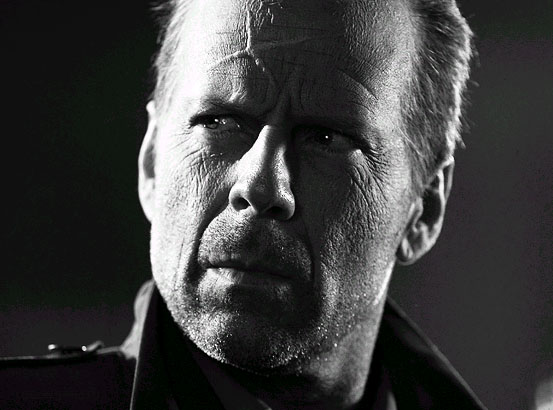
Radar reported today that movie tough guy Bruce Willis filed lawsuit against defendants that include His Royal Highness Prince Imram Ibni Tuanku Ja'afar of Malaysia, alleging that the prince fleeced him out of two million dollars. Willis claims he invested in a company owned by the prince called Petra Group, which was involved in developing a non-toxic and recyclable “green” rubber. According to court papers, the deal Willis entered allowed him to request his investment back at any time. Allegedly he did exactly that and the Prince failed to fork over the cash. Willis is now requesting more than seven million dollars in damages.

diggfacebookstumbledelicious

Featured Pulp
Lesbo Posters
Lili St. Cyr—Star to Recluse
Assorted Phallic Tex Covers
Gene Tierney's Tragedy
Swift’s Space Travel Guide
Rare Marilyn Monroe Images
PARIS-HOLLYWOOD FRENCH MAGAZINE
History Rewind
The headlines that mattered yesteryear.
March 15
1937—H.P. Lovecraft Dies
American sci-fi/horror author Howard Phillips Lovecraft dies of intestinal cancer in Providence, Rhode Island at age 46. Lovecraft died nearly destitute, but would become the most influential horror writer ever. His imaginary universe of malign gods and degenerate cults was influenced by his explicitly racist views, but his detailed and procedural style of writing, which usually pitted men of science or academia against indescribable monsters, remains as effective today as it was eighty years ago.
March 14
1964—Ruby Found Guilty of Murder
In the U.S. a Dallas jury finds nightclub owner and organized crime fringe-dweller Jack Ruby guilty of the murder of Lee Harvey Oswald. Ruby had shot Oswald with a handgun at Dallas Police Headquarters in full view of multiple witnesses and photographers. Allegations that he committed the crime to prevent Oswald from exposing a conspiracy in the assassination of President John F. Kennedy have never been proven.


March 13
1925—Scopes Monkey Trial Ends
In Tennessee, the case of Scopes vs. the State of Tennessee, involving the prosecution of a school teacher for instructing his students in evolution, ends with a conviction of the teacher and establishment of a new law definitively prohibiting the teaching of evolution. The opposing lawyers in the case, Clarence Darrow and William Jennings Bryan, both earn lasting fame for their participation in what was a contentious and sensational trial.

Advertise Hereblog advertising is good for you
Reader Pulp
It's easy. We have an uploader that makes it a snap. Use it to submit your art, text, header, and subhead. Your post can be funny, serious, or anything in between, as long as it's vintage pulp. You'll get a byline and experience the fleeting pride of free authorship. We'll edit your post for typos, but the rest is up to you. Click here to give us your best shot.

Pulp Covers
Pulp art from around the web
killercoversoftheweek.blogspot.com/2010/01/murder-is-dangerous-by-saul-levinson.html breakfastintheruins.blogspot.com/2009/11/knife-by-hal-ellson-lancer-books-1961.html
mutantfamilyvalues.blogspot.com/2010/02/ace-sci-fi-doubles.html www.vintagepbks.com/ember/el313.html
spanishbookcovers.blogspot.com/2009/07/roland-daniel.html pzrservices.typepad.com/vintageadvertising/2009/02/pulp-book-cover-from9155.html
Pulp Advertising
Things you'd love to buy but can't anymore
PulpInternational.com Vintage Ads
Humor Blog Directory
About Email Legal RSS RSS Tabloid Femmes Fatales