 Boxing Illustrated chronicled the sweet science for thirty-eight years. 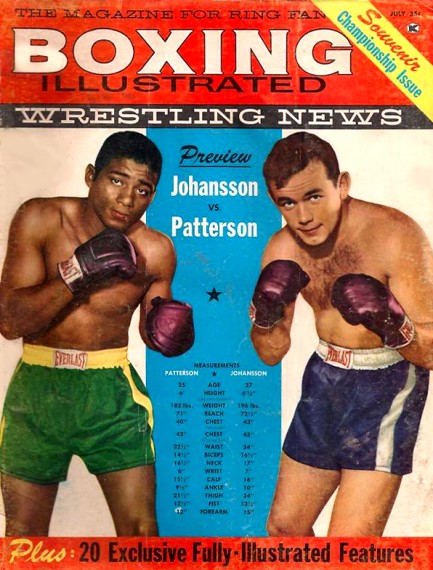
We found this weathered but legible Boxing Illustrated/Wrestling News, a magazine founded by Stanley Weston in 1958, and decided to post it because the cover features Floyd Patterson and Ingo Johansson, two interesting guys we profiled back in December. This issue is from July 1960, and in 1967, Boxing Illustrated/Wrestling News jettisoned its wrestling coverage and went on to become one of the important sports publications of its time. Boxing had been known as the sweet science for nearly two centuries, but during the 1970s larger than life personalities like Muhammad Ali, Howard Cosell, Norman Mailer and George Plimpton gave weight to that nickname, imbuing the sport with both emotional impact and intellectual veneer. Ali and Cosell were nothing less than the yin and yang of the sport, two men who seemed to orbit each other like binary stars. Meanwhile, guys like Mailer and Plimpton were the scribes, using their pens to describe unbridled savagery in terms more suited for the Bolshoi ballet. Boxing Illustrated finally folded in 1995, which is more or less when boxing itself began to lose relevance with the world public as the dynamism inside the ring and the intellectualism outside it both withered. The sport still hasn’t recovered, and with the rise of mixed martial arts, many think it never will. More Boxing Illustrated covers and info here.
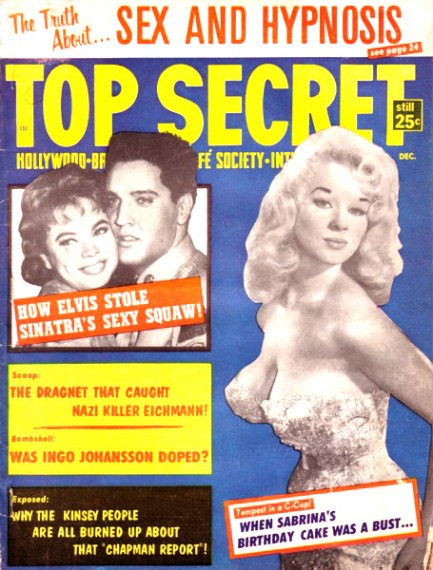
 The two guys Top Secret tried to portray as enemies actually kinda liked each other. As usual, there is an array of interesting teasers on the cover of Top Secret. The squaw in question at left is Jeanne Carmen, who was a famous blonde pin-up, but who was naturally brunette, and had played the role of a Native American girl named Yellow Moon in the cheesy western War Drums. So that’s the source of the squaw reference. Whether Elvis actually stole her from Sinatra, we can’t say. It’s possible any woman in Hollywood would have to be stolen from Sinatra, the guy got around so much. And as if to prove the point, he would later have a fling with the cover star here, Sabrina, aka Norma Sykes. We talked about their tryst in this post from earlier this year. 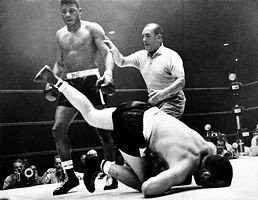 Anyway, the bit that really caught our attention was not the alleged Elvis-Carmen-Sinatra triangle, but the story about Ingo Johansson being doped. Ingemar “Ingo” Johansson was a world champion boxer who had won the heavyweight crown from Floyd Patterson a year earlier. In the March 1960 rematch, Patterson put Johansson’s lights out with a blow so vicious that Johansson was left twitching on the canvas. It was a definitive victory, just as Johansson’s earlier win over Patterson had been, but in 1960 white-black boxing matches were overtly racially divisive, and so Top Secret took advantage by suggesting that perhaps Patterson’s camp managed to slip the Swede a mickey. That question was answered in the March 1961 third match between the two, when Patterson again knocked Johansson out. Anyway, the bit that really caught our attention was not the alleged Elvis-Carmen-Sinatra triangle, but the story about Ingo Johansson being doped. Ingemar “Ingo” Johansson was a world champion boxer who had won the heavyweight crown from Floyd Patterson a year earlier. In the March 1960 rematch, Patterson put Johansson’s lights out with a blow so vicious that Johansson was left twitching on the canvas. It was a definitive victory, just as Johansson’s earlier win over Patterson had been, but in 1960 white-black boxing matches were overtly racially divisive, and so Top Secret took advantage by suggesting that perhaps Patterson’s camp managed to slip the Swede a mickey. That question was answered in the March 1961 third match between the two, when Patterson again knocked Johansson out.
After their careers were over, Johansson and Patterson became good friends and even flew to visit each other in their native countries every year. Top Secret could well have done a story on that, but of course harmony doesn’t sell magazines. So while in the U.S. civil rights strife raged through the rest of the sixties and into the seventies, two guys who once made a living beating the living shit out of each other quietly proved that, given a chance to see each other’s similarities rather than differences, people tend to get along just fine.
|
 |
The headlines that mattered yesteryear.
1986—Otto Preminger Dies
Austro–Hungarian film director Otto Preminger, who directed such eternal classics as Laura, Anatomy of a Murder, Carmen Jones, The Man with the Golden Arm, and Stalag 17, and for his efforts earned a star on Hollywood's Walk of Fame, dies in New York City, aged 80, from cancer and Alzheimer's disease. 1998—James Earl Ray Dies
The convicted assassin of American civil rights leader Martin Luther King, Jr., petty criminal James Earl Ray, dies in prison of hepatitis aged 70, protesting his innocence as he had for decades. Members of the King family who supported Ray's fight to clear his name believed the U.S. Government had been involved in Dr. King's killing, but with Ray's death such questions became moot. 1912—Pravda Is Founded
The newspaper Pravda, or Truth, known as the voice of the Communist Party of the Soviet Union, begins publication in Saint Petersburg. It is one of the country's leading newspapers until 1991, when it is closed down by decree of then-President Boris Yeltsin. A number of other Pravdas appear afterward, including an internet site and a tabloid. 1983—Hitler's Diaries Found
The German magazine Der Stern claims that Adolf Hitler's diaries had been found in wreckage in East Germany. The magazine had paid 10 million German marks for the sixty small books, plus a volume about Rudolf Hess's flight to the United Kingdom, covering the period from 1932 to 1945. But the diaries are subsequently revealed to be fakes written by Konrad Kujau, a notorious Stuttgart forger. Both he and Stern journalist Gerd Heidemann go to trial in 1985 and are each sentenced to 42 months in prison. 1918—The Red Baron Is Shot Down
German WWI fighter ace Manfred von Richthofen, better known as The Red Baron, sustains a fatal wound while flying over Vaux sur Somme in France. Von Richthofen, shot through the heart, manages a hasty emergency landing before dying in the cockpit of his plane. His last word, according to one witness, is "Kaputt." The Red Baron was the most successful flying ace during the war, having shot down at least 80 enemy airplanes. 1964—Satellite Spreads Radioactivity
An American-made Transit satellite, which had been designed to track submarines, fails to reach orbit after launch and disperses its highly radioactive two pound plutonium power source over a wide area as it breaks up re-entering the atmosphere.
|

|
|
It's easy. We have an uploader that makes it a snap. Use it to submit your art, text, header, and subhead. Your post can be funny, serious, or anything in between, as long as it's vintage pulp. You'll get a byline and experience the fleeting pride of free authorship. We'll edit your post for typos, but the rest is up to you. Click here to give us your best shot.
|
|