 You're evil. I'm a little lazy. I think our relationship works because we accept each other's flaws. 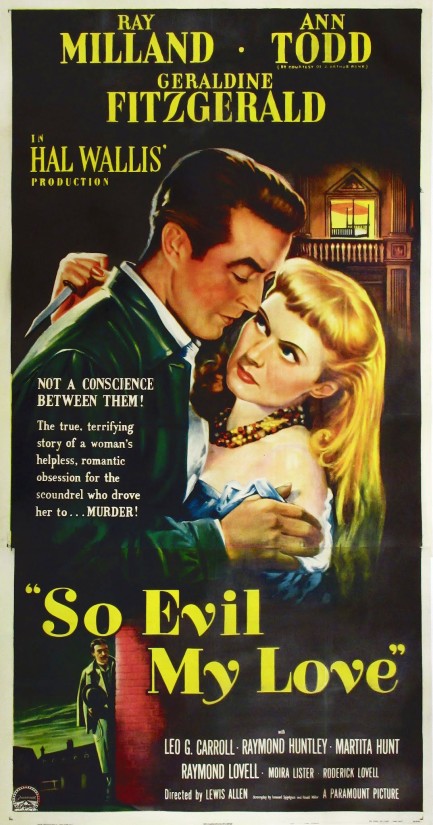
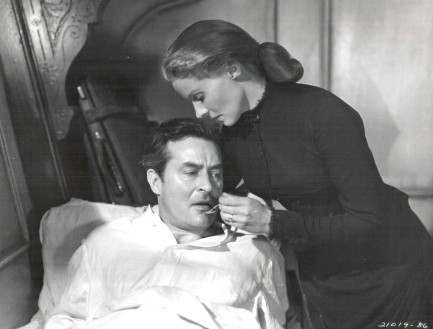
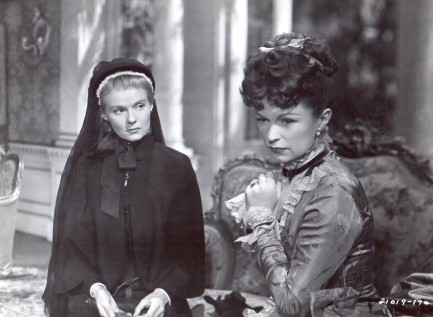
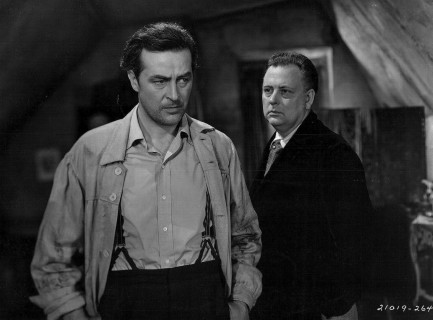
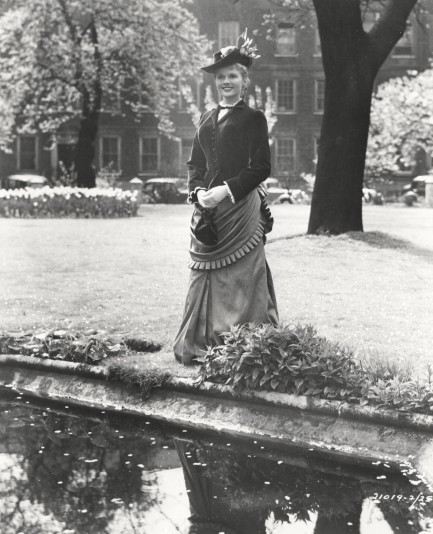
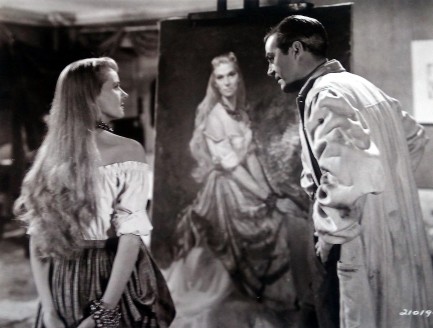
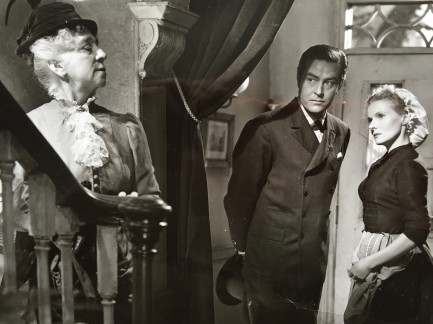
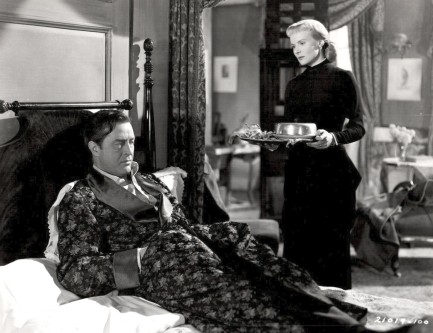
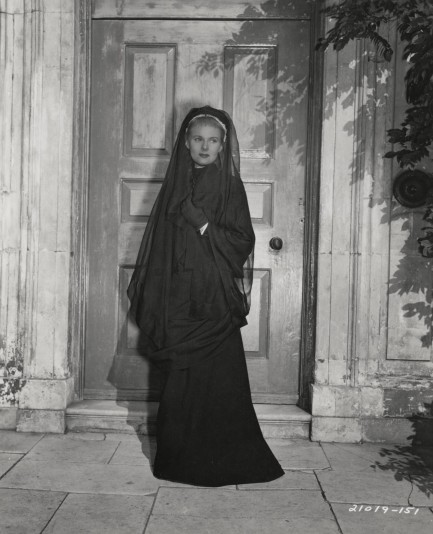
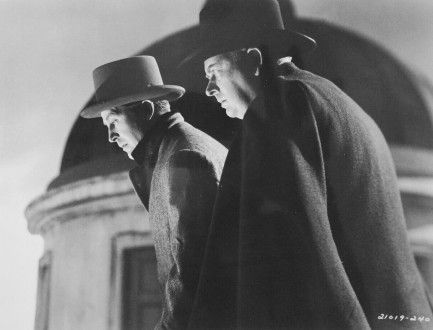
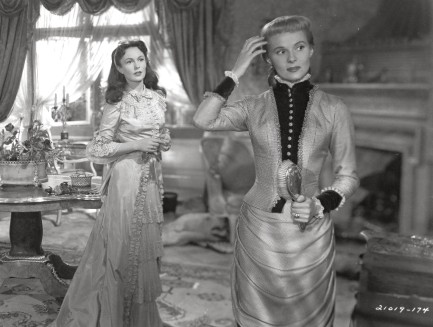
Looking at the promo poster for the Ray Milland/Ann Todd thriller So Evil My Love, we expected a standard 1940s crime drama, but we didn't look closely enough. The clothes reveal, if we'd used our eyes, that this is a period piece set in the late Victorian era. Milland plays a man sailing from Jamaica to England who picks up a case of malaria and is nursed back to health by recently widowed missionary Todd. Later, in Liverpool, he looks her up and moves into her boarding house. Milland is a painter, but he's more lucratively an art thief and forger. His real crime, and the reason he was leaving Jamaica, is a murder he committed. Trouble is soon to follow.
Once ensconced in Todd's rambling residence, Milland does the romantic full press, manipulating, flattering, and even dominating her until she falls in love with him. From that point it doesn't take much time or effort for Milland to draw poor, lonely Todd into his criminal schemes. Some viewers might become frustrated with her pliability and helplessness, but that's the 1890s for you. She eventually manages to act of her own volition, and her evolution into a woman who embraces power is what the movie is about. We thought it was good, for its type. It premiered in London today in 1948.
 Symons reflects on exactly how bad a man's life can be. 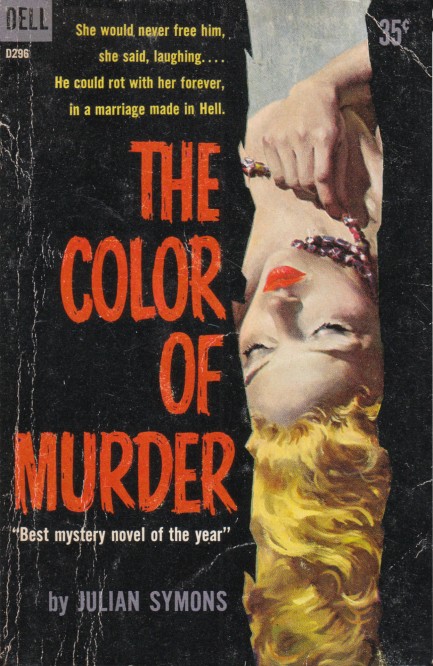
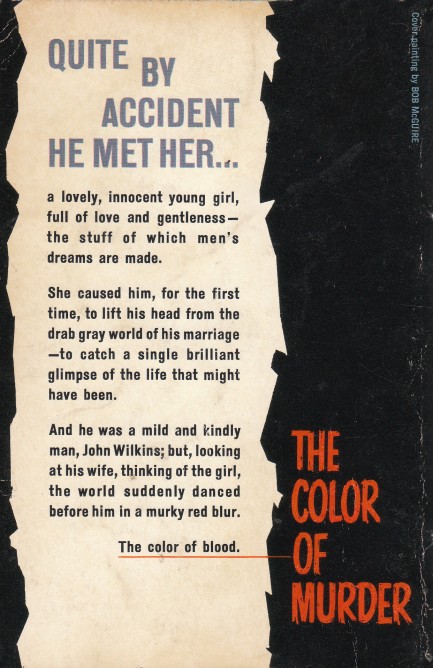
Looking for a bit more depth in your murder mysteries? 1957's The Color of Murder by British author Julian Symons takes a literary approach to the genre, examining the torturous existence of sad sack office drone John Wilkins, who hates his wife, covets the neighborhood librarian, and suffers from blackouts at times of stress (uh oh). Symons divides the novel roughly in half. In the first, Wilkins explains in first person to a psychologist how he came to be mired in a terrible life and loveless marriage, his account stopping before the murder (which if he actually committed, he'd presumably have blacked out anyway). The second half follows in third person the course of Wilkins' trial, with assorted twists, and there's an epilogue providing final focus. Whether or not Wilkins is a killer, he's a pitiable human. If you think you have an unsatisfactory life, read The Color of Murder to learn how well-off you really are. The cover art on this Dell edition is by Robert Maguire.
 She can Seymour in the cards than you can. 
Playing the virgin tarot reader Solitaire in 1973's James Bond film Live and Let Die, British actress Jane Seymour wore probably a dozen hairstyles, but we don't remember this one. It's ridiculous, but when you're beautiful you can get away with it. Since shifting her career into top gear with Bond, she's racked up acting credits in something like 170 films and television shows. While she's appeared on the silver screen plenty, she truly made her mark in television, playing everything from an Old West physician in Dr. Quinn, Medicine Woman to Lady Brett Ashley in a mini-series of The Sun Also Rises. There's little doubt she's one of the more enduring small screen stars of her generation. We doubt even Solitaire saw that coming.
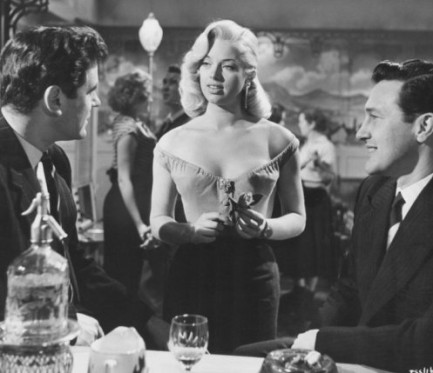
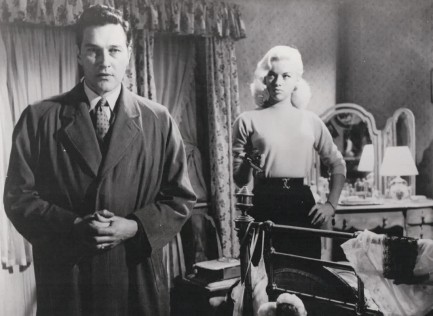
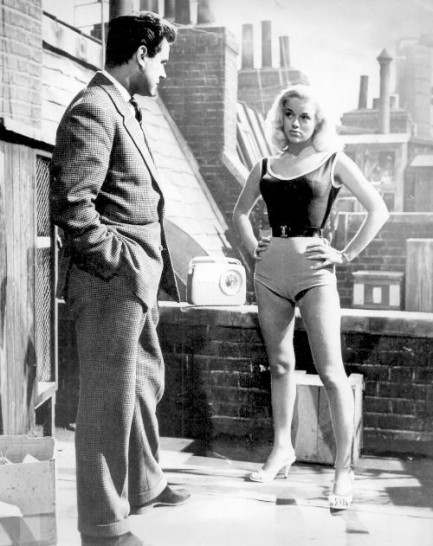
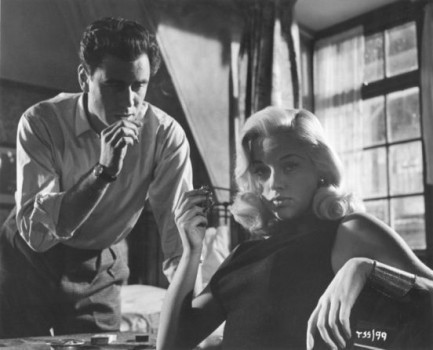
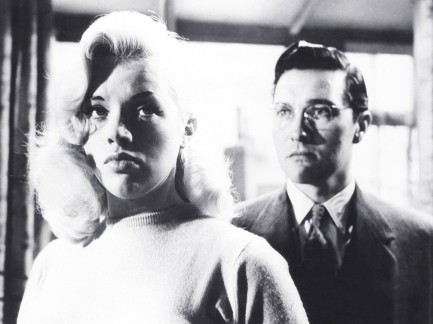
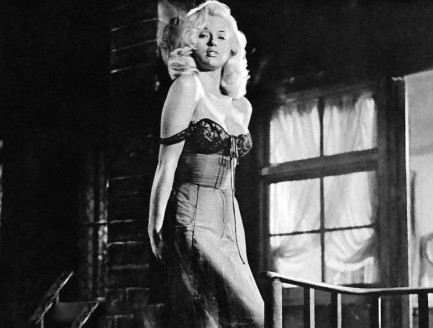
 There are no limits to what Diana Dors can convince men to do. 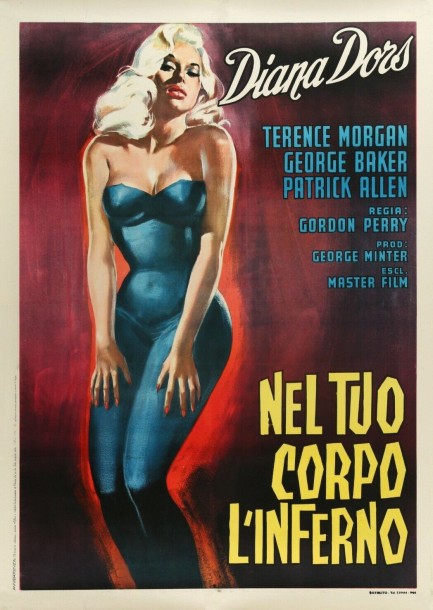 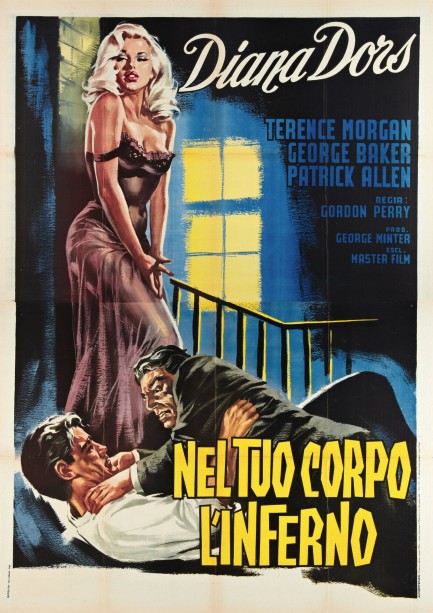
After all these years working on this website it remains a surprise when promotional posters of extremely high quality are uncredited, but such is the case with these two Italian beauties made for Nel tuo corpo l'inferno, a movie originally produced in England as Tread Softly, Stranger. The Italian title translates as “hell in the body,” which we rather like. It fits the plot, which revolves around George Baker avoiding a gambling debt by fleeing London to the small town where he was raised, only to find that his brother who lives there is also in debt, having stolen money from his employer. He's spent it on femme fatale Diana Dors, who's way out of his league, money-hungry, and willing to pit the brothers against each other if it improves her station in life.
Baker, being of sound mind and body, wants Dors badly. With just a little nudge, he and his brother are convinced by Dors to stage a heist. The phrase “corpus delecti” in legal terms means that a crime has to be proved to have actually occurred before anyone can be convicted of it, but in vintage cinema nobody has to prove anything because the scales of justice tend to be cosmic. As viewers, then, you know the brothers could be convicted by karma for just attempting the crime. They get the loot, but they certainly won't get to keep it—though how they lose it will come as a surprise. And if one of the brothers gets Dors, they probably won't get to keep her either. In mid-century crime movies thems the breaks. Tread Softly, Stranger premiered in Britain in 1958, and in Italy today in 1960.
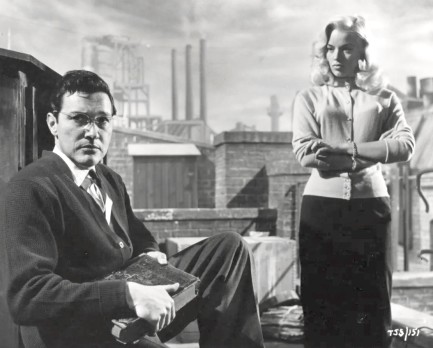       
 Love her and leave her coming after you for revenge. 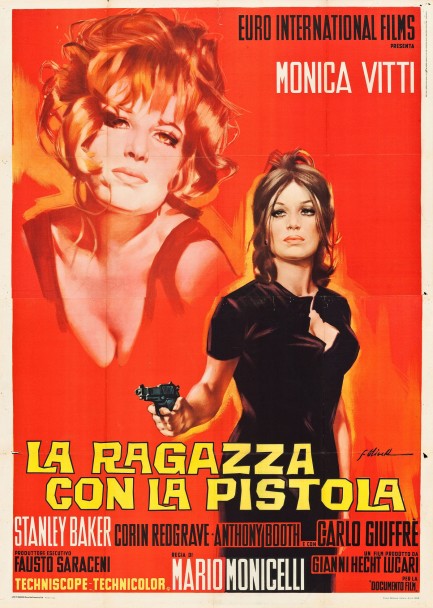
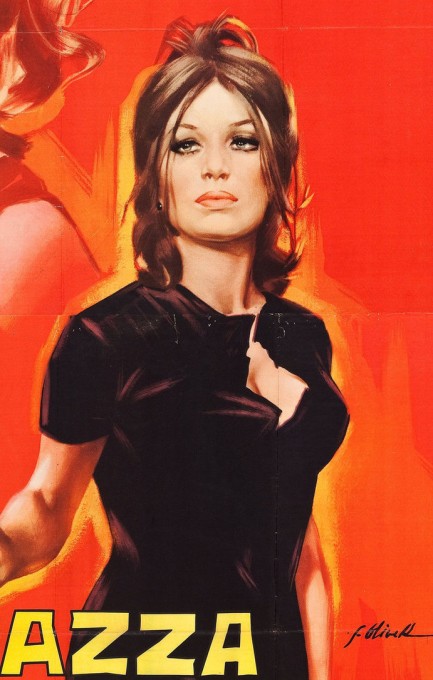
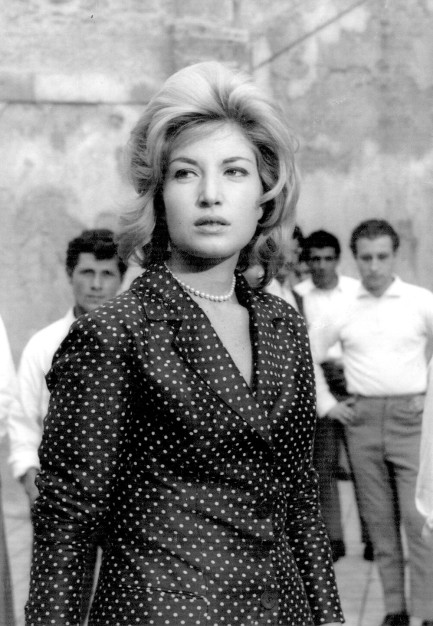
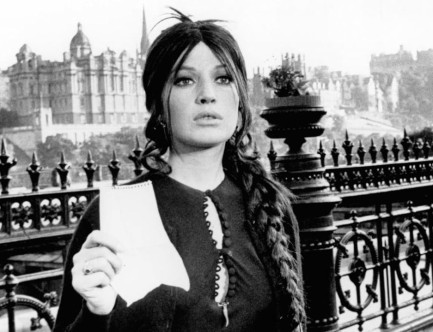
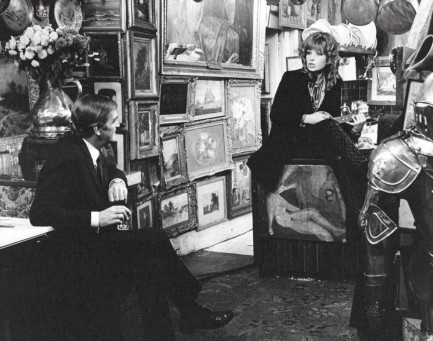
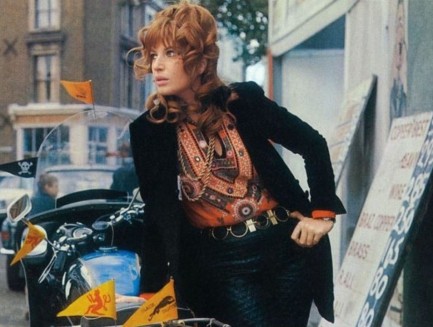
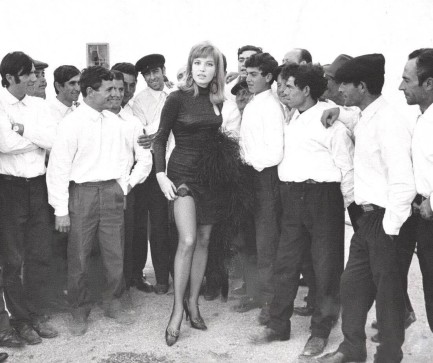
We didn't know La ragazza con la pistola, aka The Girl with a Pistol, was a comedy. Based on this beautiful poster painted by Giorgio Olivetti we never considered the possibility that it was anything other than a crime thriller. But mere seconds into our screening we realized it was a sort of screwball adventure. Sometimes you get fooled. Basically, Monica Vitti plays a Sicilian woman who is devirginized and abandoned by Carlo Giuffrè, is therefore labeled “dishonored” by her family and everyone in her village, and thus feels compelled to chase Giuffrè all the way to Edinburgh to kill him. Giuffrè manages to evade her, forcing her to follow him to Sheffield, Bath, and beyond (as she's tormented by a Sicilian chorus of wailing villagers during interstitial segments). So what you get here is a sort of wacky fish-out-of-water comedy. The movie is also a satire of traditional Italian social values. Though Vitti's character was a virgin, because she gave in to Giuffrè he automatically considers her a whore—that old paradox. Other explorations of outdated gender roles occur, including the idea of aggression versus resistance in romance. And it's eyebrow raising how men in this era—or at least in this movie—don't consider women to have possession of their own bodies. Vitti is pawed, harassed, and kidnapped—for comedic purposes, but still. The idea of using violence to retain honor pops up more than once too. All in all, La ragazza con la pistola is fascinating cultural exploration, legitimately funny in parts, headlined by one of Europe's great vintage stars. It's worth a look—even though it isn't a crime thriller. It premiered in Italy today in 1968.
   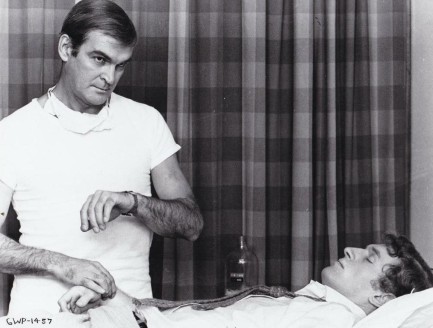 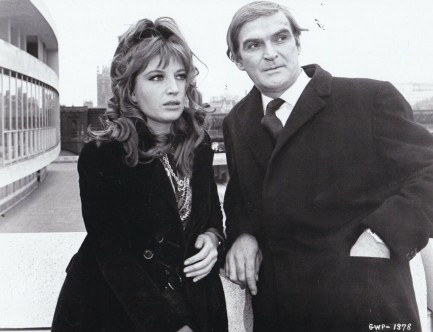   
 Susan George demonstrates the Fright or fight reflex. 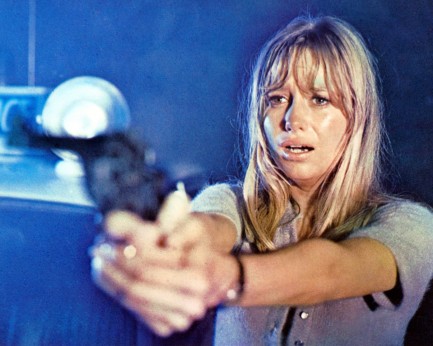
This fraught photo features British actress Susan George, who's not discussed today as much as she should be. She was a bold performer who appeared in movies too envelope pushing for at least 90% of actresses of this day and age. Several of her films are routinely described as controversial. The efforts we're thinking of are Straw Dogs, Dirty Mary Crazy Larry, Mandingo, and A Small Town in Texas. Not all of those were top notch, but they were all uncompromising. The above photo comes from her also intense 1971 fight-or-flight thriller Fright. We'll get back to George soon.
 She could tell them the secret but it would be a bad Korea move. 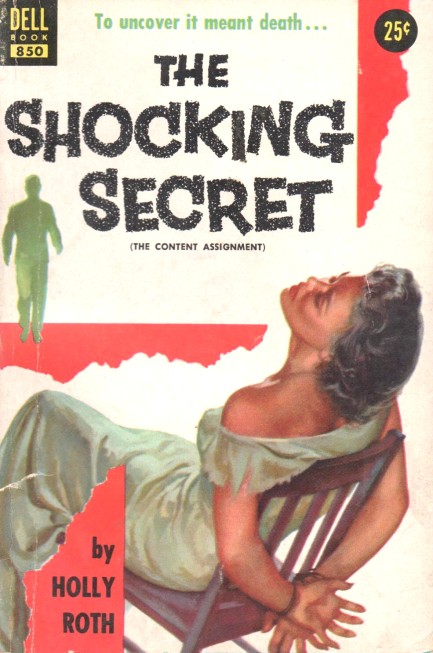
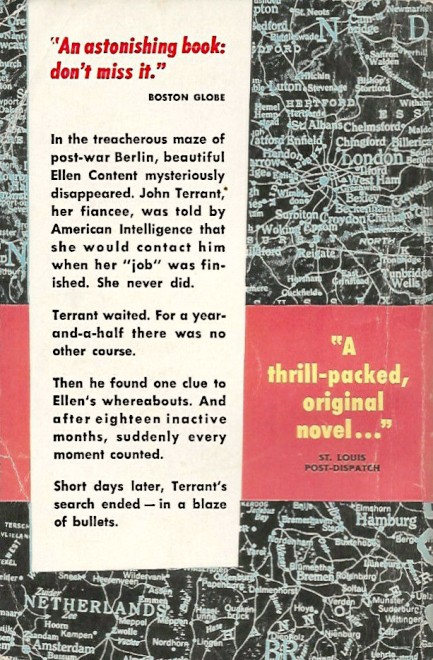
Holly Roth, who also wrote as P.J. Merrill and K.G. Ballard, originally published The Shocking Secret as The Content Assignment in 1954. This Dell edition came in 1955 with William Rose cover art. The story, set beginning in 1948, deals with John Terrant, a British reporter in Berlin whose American love Ellen Content is a CIA agent who disappears during a mission. Nearly two years later her name turns up in a newspaper story that says she's a dancer in New York City. So Terrant crosses the pond to track her down but ends up in the middle of the Cold War, with bad commies and the whole nine.
Roth infuses her tale with an Englishman in New York fish-out-of-water quality, which is occasionally amusing and adds interest, but in the end the entire enterprise comes across lightweight—which is to say it lacks menace and the proper amount of intellectual heft needed for a book about the political/ideological clash of the era. And another issue, though an admittedly nit-picky one, is that the surprise of the title, which we mostly gave away in our subhead, isn't all that shocking. Dell never should have renamed the book.
Moving on to Roth herself, she's one of those writers whose life had an eerie parallel with her fiction. Her 1962 novel Too Many Doctors is about a woman who falls off a ship and loses her memory. In 1964 Roth disappeared from her husband's yacht one stormy night off the coast of Morocco and was never seen again. Officially, her death was an accident. If we get ambitious maybe we'll read Too Many Doctors. While we can't recommend The Shocking Secret, we wouldn't be surprised if several of her other books are better. Her reputation would seem to suggest it.
 You're intimidated by this little thing? It's just a fully loaded .38 Special that I look for any excuse to use. 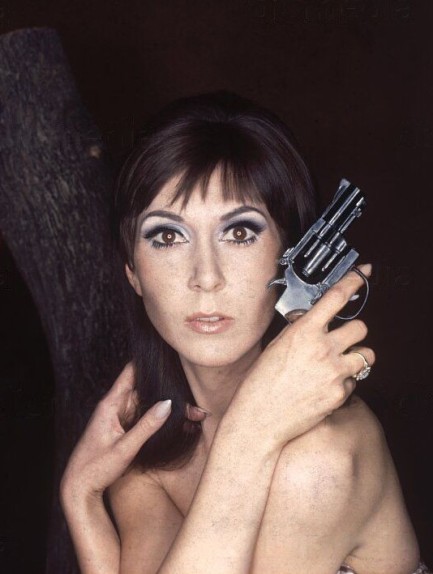
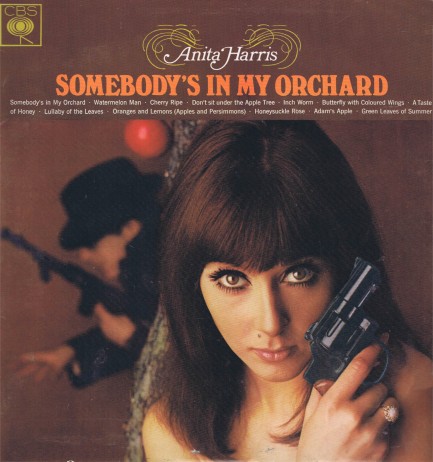
Even a dangerous weapon can't make doe-eyed British actress and singer Anita Harris look anything other than harmless. But ask the Pulp Intl. girlfriends and they say she looks completely mad. They say she has crazy eyes. Well, as far as we know she never harmed anyone unless you count a few bad acting performances. Harris appeared in such films as Love Is a Woman and Carry On Doctor, as well on numerous television shows, and as a singer charted several hits during the 1960s. Actually, one or two of those so-called hits are pretty hurtful too. Another frame from this photo session was used for the cover of her 1966 album Somebody's in My Orchard. Somebody she then blew away, we suppose.
 Okay, first of all he never listened to me. That's where the blame for this really starts. 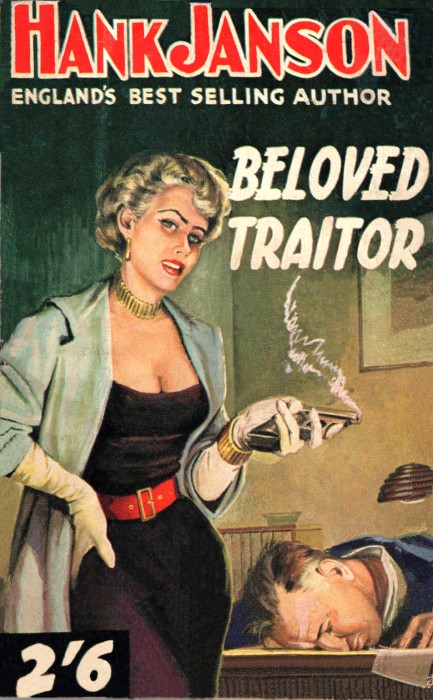
Above: an unusual cover for Hank Janson's novel Beloved Traitor, published by the British imprint Roberts and Vinter in 1960, with a lettering style the company used to good effect on other novels. The cover painting is by the Spanish artist Joaquin Chacopino Fabré, sometimes known as merely Chaco. We have two more good examples of his work here, and we'll see if we can dig up more later.
 You never know when your time is up. Usually. 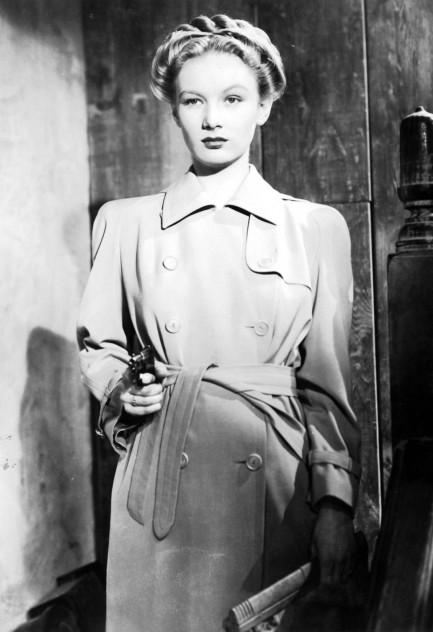
Above: Veronica Lake stars in a menacing promo photo made for her 1944 spy movie The Hour Before Dawn. She plays a pure femme fatale, a bad woman living in London as a double agent in the employ of the Third Reich. The movie was poorly reviewed, but we give this image five stars.

|
 |
The headlines that mattered yesteryear.
1986—Otto Preminger Dies
Austro–Hungarian film director Otto Preminger, who directed such eternal classics as Laura, Anatomy of a Murder, Carmen Jones, The Man with the Golden Arm, and Stalag 17, and for his efforts earned a star on Hollywood's Walk of Fame, dies in New York City, aged 80, from cancer and Alzheimer's disease. 1998—James Earl Ray Dies
The convicted assassin of American civil rights leader Martin Luther King, Jr., petty criminal James Earl Ray, dies in prison of hepatitis aged 70, protesting his innocence as he had for decades. Members of the King family who supported Ray's fight to clear his name believed the U.S. Government had been involved in Dr. King's killing, but with Ray's death such questions became moot. 1912—Pravda Is Founded
The newspaper Pravda, or Truth, known as the voice of the Communist Party of the Soviet Union, begins publication in Saint Petersburg. It is one of the country's leading newspapers until 1991, when it is closed down by decree of then-President Boris Yeltsin. A number of other Pravdas appear afterward, including an internet site and a tabloid. 1983—Hitler's Diaries Found
The German magazine Der Stern claims that Adolf Hitler's diaries had been found in wreckage in East Germany. The magazine had paid 10 million German marks for the sixty small books, plus a volume about Rudolf Hess's flight to the United Kingdom, covering the period from 1932 to 1945. But the diaries are subsequently revealed to be fakes written by Konrad Kujau, a notorious Stuttgart forger. Both he and Stern journalist Gerd Heidemann go to trial in 1985 and are each sentenced to 42 months in prison. 1918—The Red Baron Is Shot Down
German WWI fighter ace Manfred von Richthofen, better known as The Red Baron, sustains a fatal wound while flying over Vaux sur Somme in France. Von Richthofen, shot through the heart, manages a hasty emergency landing before dying in the cockpit of his plane. His last word, according to one witness, is "Kaputt." The Red Baron was the most successful flying ace during the war, having shot down at least 80 enemy airplanes. 1964—Satellite Spreads Radioactivity
An American-made Transit satellite, which had been designed to track submarines, fails to reach orbit after launch and disperses its highly radioactive two pound plutonium power source over a wide area as it breaks up re-entering the atmosphere.
|

|
|
It's easy. We have an uploader that makes it a snap. Use it to submit your art, text, header, and subhead. Your post can be funny, serious, or anything in between, as long as it's vintage pulp. You'll get a byline and experience the fleeting pride of free authorship. We'll edit your post for typos, but the rest is up to you. Click here to give us your best shot.
|
|