If you can’t be factual, at least be popular. 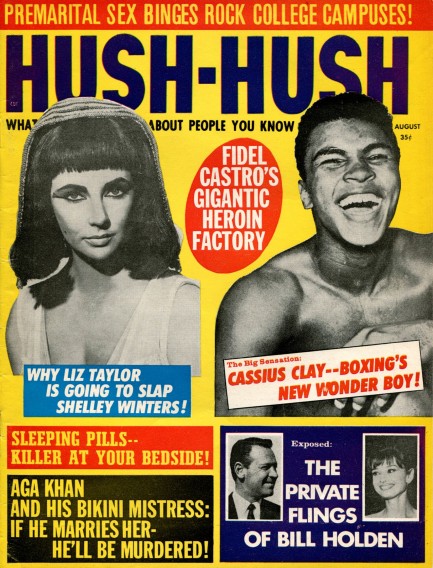
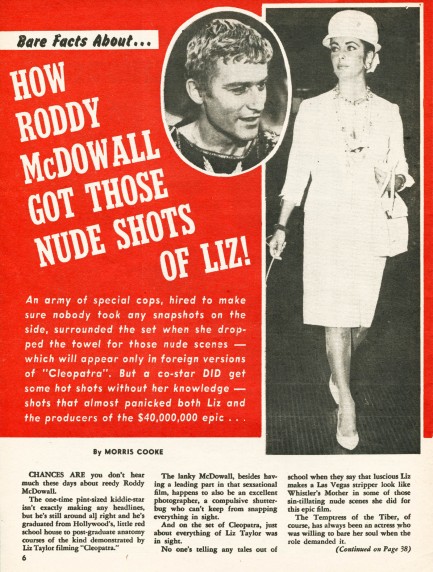
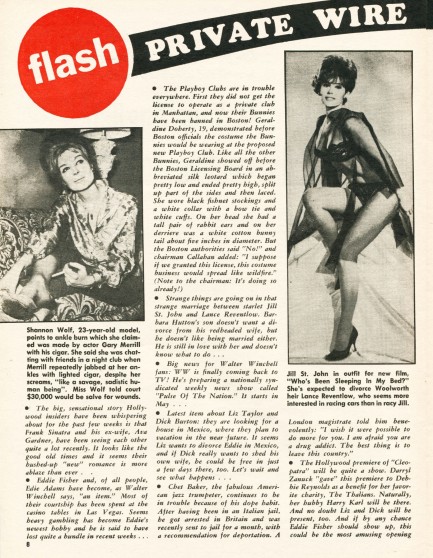
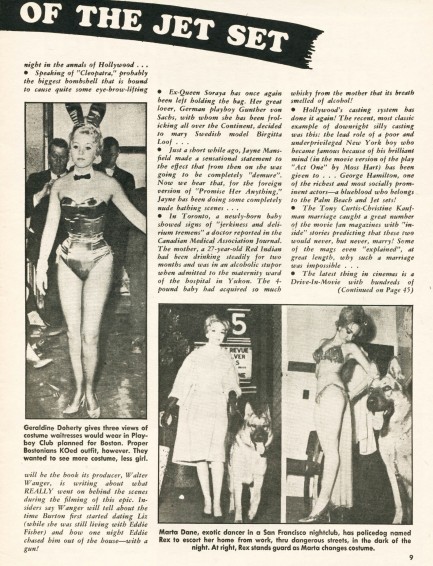
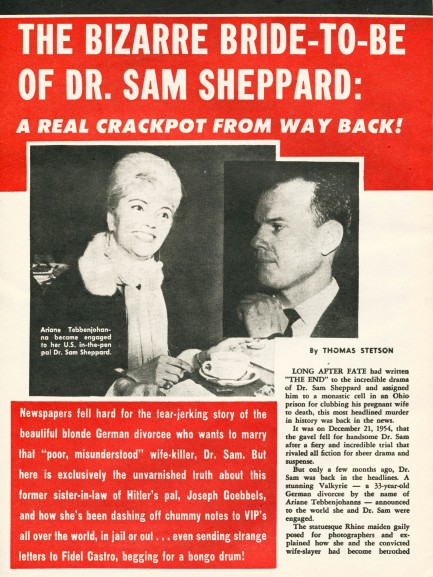
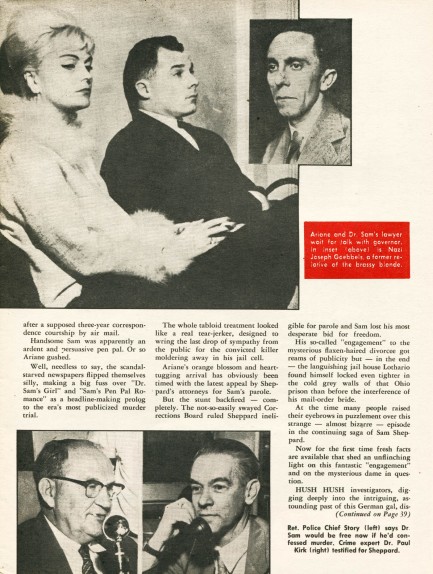
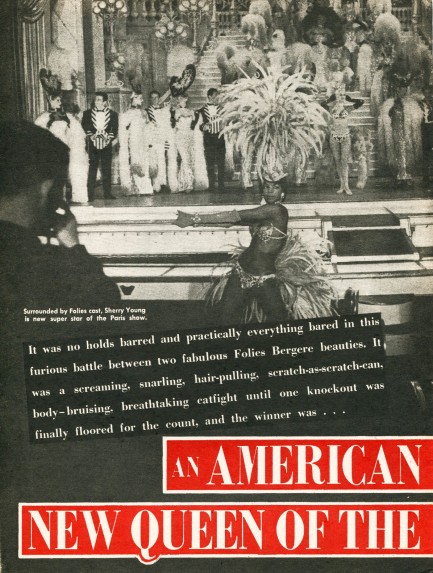
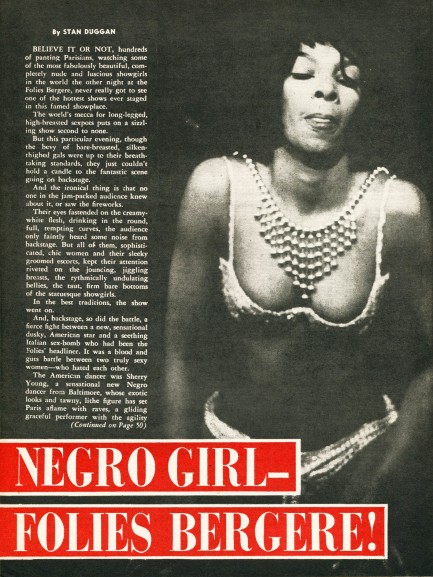
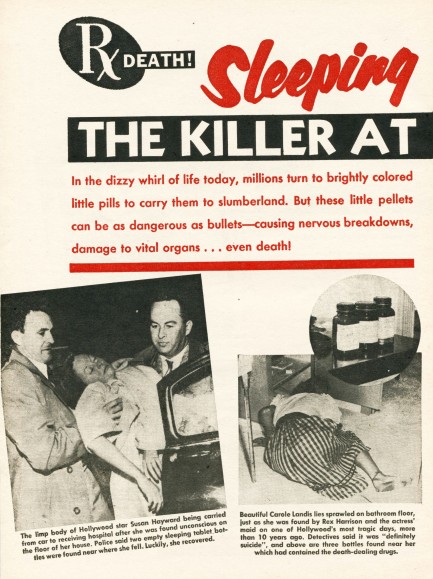
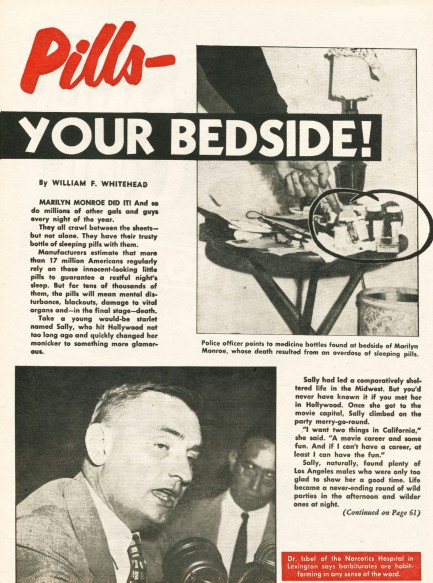
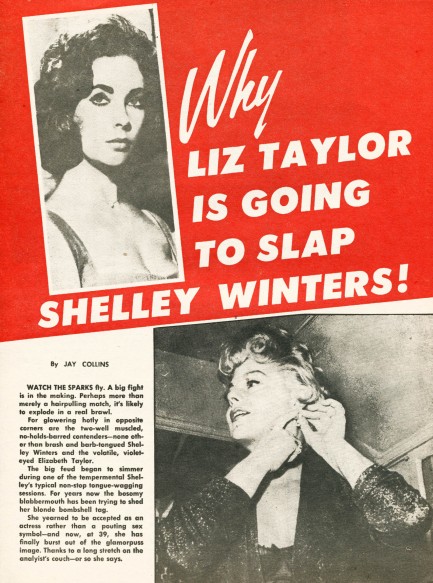
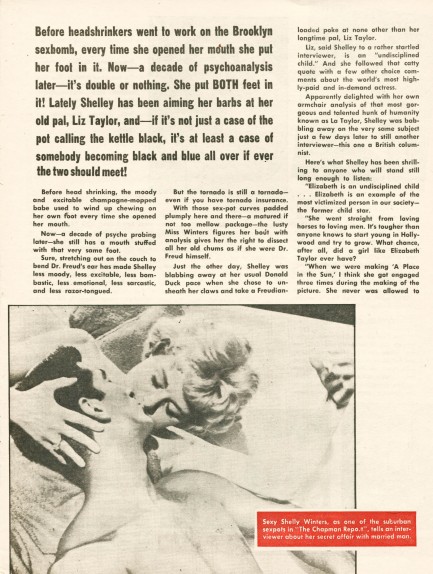
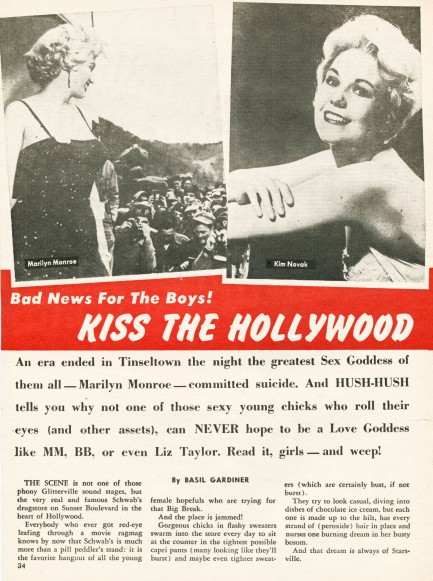
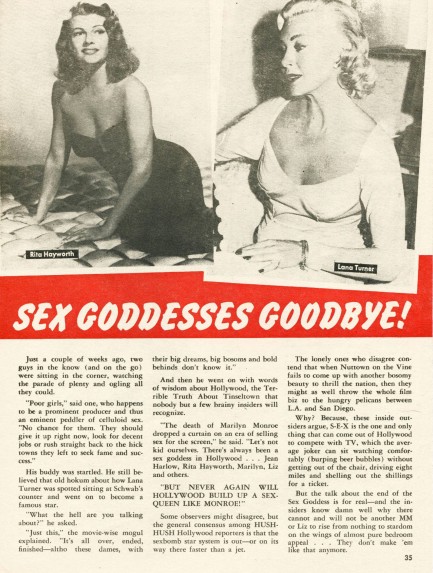
Hush-Hush magazine goes for broke in this issue from August 1963, offering up a slate of tales narrated in their usual breathless style. First, they tell us how Roddy McDowall took nude photographs of Elizabeth Taylor on the set of Cleopatra and tried to sell them, but was thwarted when she “erupted like Mount Vesuvius”. They then demonstrate the limits of their imaginations by telling us that Italian singer Silvana Blasi reacted like “an uncontrollable Mount Vesuvius” when an African-American dancer was hired at the Folies Bergère. Two volcano similes in one issue is bad enough, but the same mountain? For investigative journalism, Hush-Hush shows us photographs of a dead Carole Landis and an unconscious Susan Hayward, and concludes that sleeping pills are bad. And finally, the magazine stokes the fires of paranoia with two stories: in the first, they explain how Fidel Castro plans to conquer America with heroin, which he’s growing with the help of two-thousand Chinese advisors; in the second, they reveal that the second wife of Dr. Sam Sheppard is a Nazi who plans to revive the Third Reich, and that she’s being helped by—you guessed it—Fidel Castro, who is somehow a communist and a Nazi. Neat trick that. As we’ve mentioned before, though these stories are laughable, people actually believed them, and believed them by the millions, as evidenced by Hush-Hush’s sales figures. The lesson is clear: the choice between popularity and truth is really no choice at all.
 1954 murder results in fifty-year legal battle. 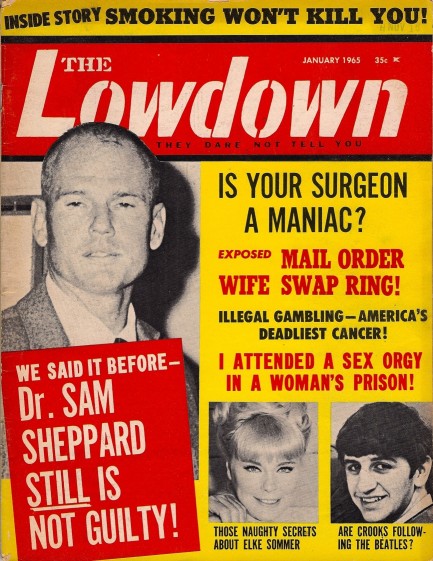
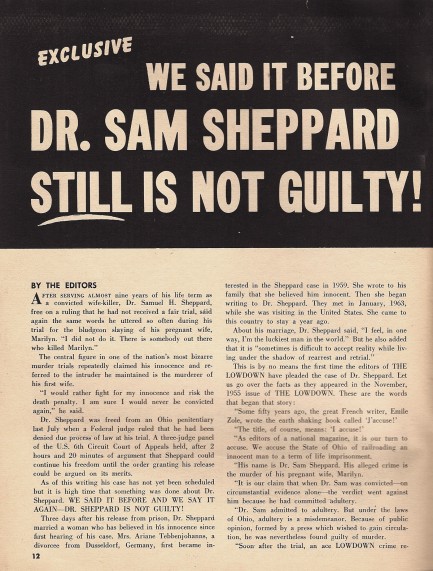
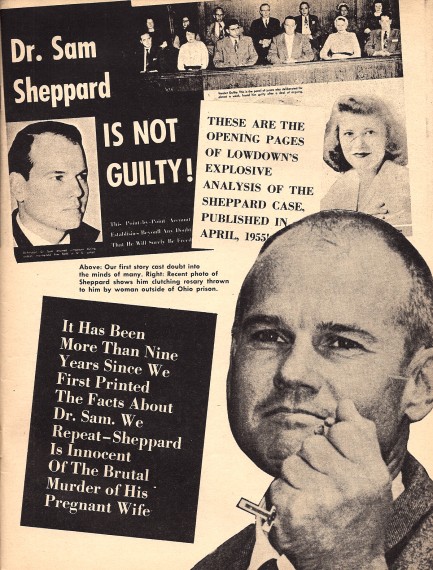
In this January 1965 issue of The Lowdown, editors take up the cudgel for convicted murderer Dr. Sam Sheppard, who was serving a life sentence for the bludgeoning murder of his wife, Marilyn. Dr. Sheppard claimed that, during the early morning hours of July 4, 1954, he was in his home sleeping on a downstairs daybed, when he awoke to his wife’s screams. He ran to her aid and was attacked by a “bushy-haired man” and knocked out. When he came to he chased the man outside, fought him again, and was again knocked out. When he awoke once more, the intruder was gone and his wife was dead, having been severely beaten and apparently sexually assaulted. Police searched for the bushy-haired suspect, but eventually decided their perp was the good doctor himself. At a trial later that year a jury agreed, and Sheppard was sent up for life. By the time Lowdown began advocating for Sheppard, he had already been granted a writ of habeas corpas, and was about to be granted a new trial due to massive publicity surrounding the first that may have tainted the original jury pool. When Sheppard was retried the next year—with none other than a young F. Lee Bailey acting as his defense lawyer—he was acquitted on the basis of reasonable doubt. However, the verdict did not clear Sheppard’s name to the satisfaction of some family members. Efforts to do that continued all the way until 2002, complete with DNA testing on the exhumed corpses of Sheppard, his wife, and her unborn fetus. Results: inconclusive. 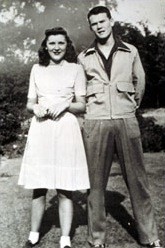 So you must be wondering why police focused on Sheppard in the first place. It wasn’t just because he was the husband, and his marriage was unhappy. Police investigators are very much like statisticians. Certain types of cases share certain traits, and the more traits a particular case shares with a certain category of cases, the more probable a certain conclusion begins to seem. An example: a home invader will nearly always immobilize the gravest threat first, meaning the man of the house; but in a staged domestic murder the man nearly always, somehow, is overlooked by the intruder, leading to a heroic rescue attempt that fails and results in injuries that are, somehow, never life-threatening. Another example: in a staged domestic murder the man will often remove clothing from the victim to imply that the motive was sexual assault by an intruder; but the rape is never consummated, for obvious reasons. So you must be wondering why police focused on Sheppard in the first place. It wasn’t just because he was the husband, and his marriage was unhappy. Police investigators are very much like statisticians. Certain types of cases share certain traits, and the more traits a particular case shares with a certain category of cases, the more probable a certain conclusion begins to seem. An example: a home invader will nearly always immobilize the gravest threat first, meaning the man of the house; but in a staged domestic murder the man nearly always, somehow, is overlooked by the intruder, leading to a heroic rescue attempt that fails and results in injuries that are, somehow, never life-threatening. Another example: in a staged domestic murder the man will often remove clothing from the victim to imply that the motive was sexual assault by an intruder; but the rape is never consummated, for obvious reasons. The list goes on. Suffice it to say, to the cops Marilyn Sheppard's killing seemed like a textbook staged domestic homicide, and they proceeded based on that assumption. But regardless, the evidence was never there for a conviction. Of that, there’s little dispute. Today, Sheppard’s innocence or guilt remains a hot topic in the Ohio town where he lived. And it probably always will be, if only because people there are reminded of the case every time The Fugitive appears on television. That’s right—if certain details of the story seem familiar, it’s because both the series and movie took inspiration from the Sheppard case. And there was one more important result. It catapulted F. Lee Bailey to national prominence as an attorney, a position he has held ever since in defending everyone from Patty Hearst to O.J. Simpson.
|
 |
The headlines that mattered yesteryear.
1967—First Space Program Casualty Occurs
Soviet cosmonaut Vladimir Komarov dies in Soyuz 1 when, during re-entry into Earth's atmosphere after more than ten successful orbits, the capsule's main parachute fails to deploy properly, and the backup chute becomes entangled in the first. The capsule's descent is slowed, but it still hits the ground at about 90 mph, at which point it bursts into flames. Komarov is the first human to die during a space mission. 1986—Otto Preminger Dies
Austro–Hungarian film director Otto Preminger, who directed such eternal classics as Laura, Anatomy of a Murder, Carmen Jones, The Man with the Golden Arm, and Stalag 17, and for his efforts earned a star on Hollywood's Walk of Fame, dies in New York City, aged 80, from cancer and Alzheimer's disease. 1998—James Earl Ray Dies
The convicted assassin of American civil rights leader Martin Luther King, Jr., petty criminal James Earl Ray, dies in prison of hepatitis aged 70, protesting his innocence as he had for decades. Members of the King family who supported Ray's fight to clear his name believed the U.S. Government had been involved in Dr. King's killing, but with Ray's death such questions became moot. 1912—Pravda Is Founded
The newspaper Pravda, or Truth, known as the voice of the Communist Party of the Soviet Union, begins publication in Saint Petersburg. It is one of the country's leading newspapers until 1991, when it is closed down by decree of then-President Boris Yeltsin. A number of other Pravdas appear afterward, including an internet site and a tabloid. 1983—Hitler's Diaries Found
The German magazine Der Stern claims that Adolf Hitler's diaries had been found in wreckage in East Germany. The magazine had paid 10 million German marks for the sixty small books, plus a volume about Rudolf Hess's flight to the United Kingdom, covering the period from 1932 to 1945. But the diaries are subsequently revealed to be fakes written by Konrad Kujau, a notorious Stuttgart forger. Both he and Stern journalist Gerd Heidemann go to trial in 1985 and are each sentenced to 42 months in prison.
|

|
|
It's easy. We have an uploader that makes it a snap. Use it to submit your art, text, header, and subhead. Your post can be funny, serious, or anything in between, as long as it's vintage pulp. You'll get a byline and experience the fleeting pride of free authorship. We'll edit your post for typos, but the rest is up to you. Click here to give us your best shot.
|
|