People are being eaten by sharks but the hipsters of the Mexican Riviera are too groovy to care. 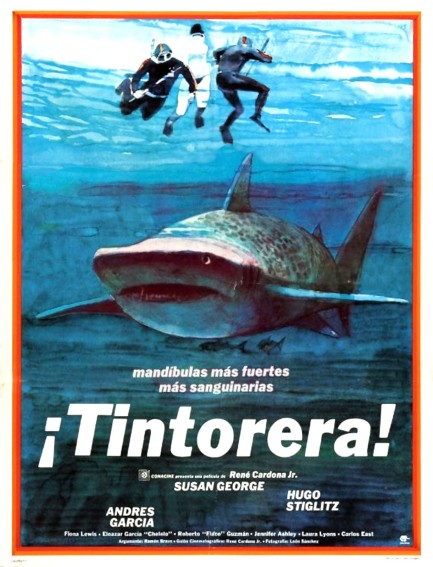
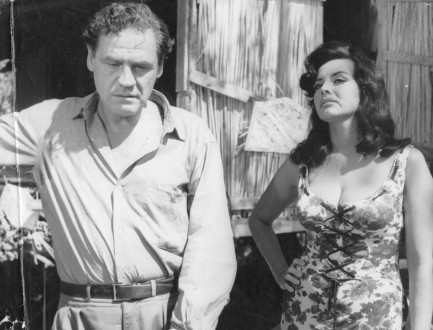
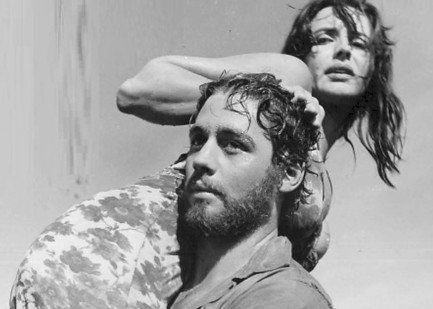
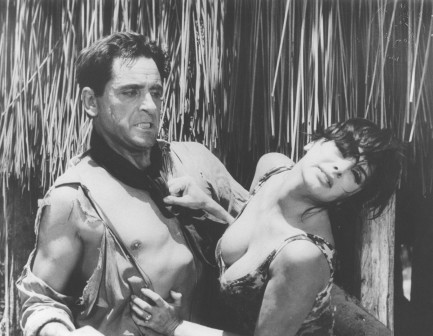
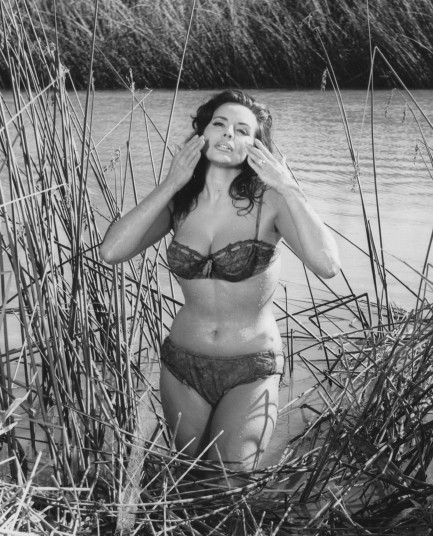
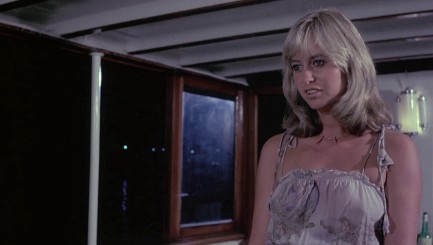
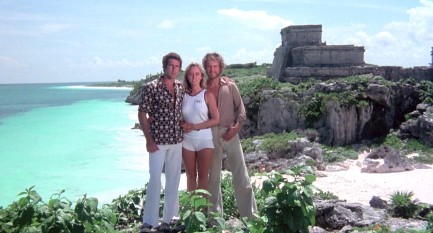
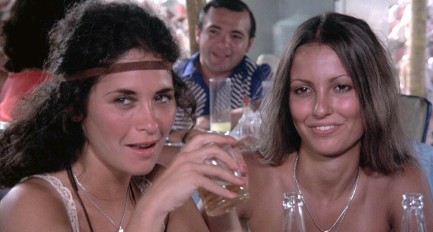
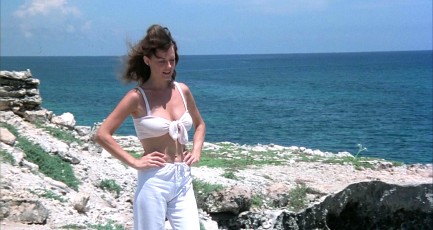
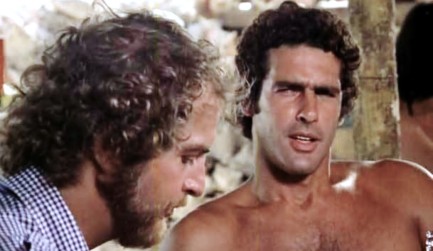
¡Tintorera!, for which you see a poster above, is often presumed to be within the pantheon of Jaws knockoffs, and that's true, but barely. There's a giant shark, and it eats a few people, but ¡Tintorera! couldn't be more different in tone than Spielberg's blockbuster. It's a counterculture movie set in and around Cancún, Tulum, and the Rivera Maya. A considerable amount of script is spent exploring free love and utopian lifestyles. Shark hunters Andrés Garcia and Hugo Stiglitz fashion an exclusive three-way relationship with Susan George. They also mix and match with Laura Lyons and Jennifer Ashley, and each bed down on consecutive nights with Fiona Lewis, which catalyzes a transformation from professional rivals to friends. Discussions of sexual sharing and finding new ways to live take up far more running time than anything to do with sharks.
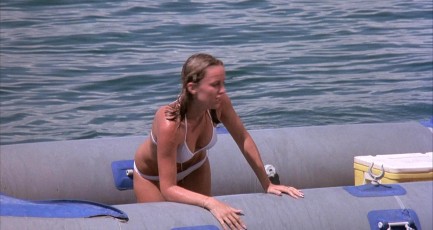
But sharks there indeed are—specifically, a large tiger shark whose first victim is Lewis. She's eaten during a nude swim, which is another resemblance to Jaws. But to give a sense of how different ¡Tintorera! really is, consider that Lewis appears to be the movie's star during its first half hour, and when she vanishes no trace of her is ever found and nobody much cares that she's gone. They assume she left the country. In cinema's imaginary countercultureworld, who has time to ask questions? The focus of the film shifts to Garcia and Stiglitz's rivalry-cum-friendship. Shortly afterward, Susan George arrives, and the focus shifts again, onto the aformentioned threesome. But then she leaves, and suddenly Lyons and Ashley are the main love interests. Then one of them is eaten too. This round robin approach, in our experience, is unique in a film that isn't anthological or episodic, and it's jarring, to be sure.
Another aspect of ¡Tintorera! that might jar is it usage of real sharks and extremely practical special effects. Many actual sharks are killed. A loggerhead turtle is killed via throat cutting and hung over the side of a boat to make a blood trail. We don't think the Mexican filmmakers Conacite Uno and Productora Filmica Real added a disclaimer to the credits about no animals being harmed. Somehow they got a shark to swim around with a fake human torso sticking out of its mouth. Another shark is made to carry around a human lower body trailing yards of intestines. We don't know how the filmmakers achieved these striking scenes, but they look very real. So if all of what we've written doesn't make the film's slender free love plot sound enticing, maybe watch it for the gory efx. You'll marvel. ¡Tintorera! premiered in Mexico today in 1977.
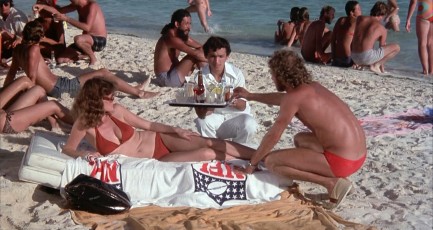 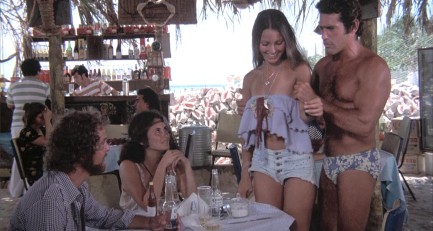        
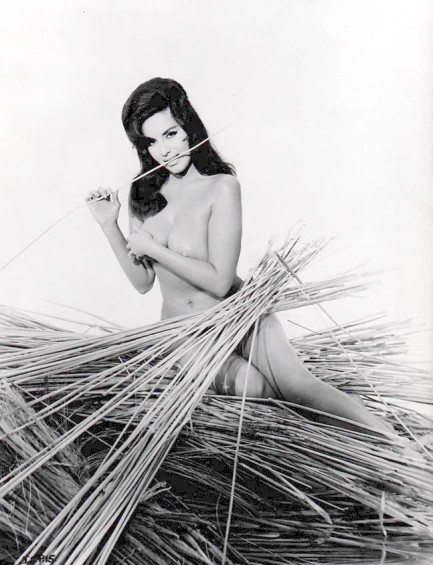
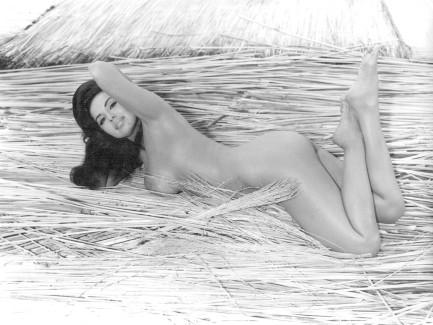
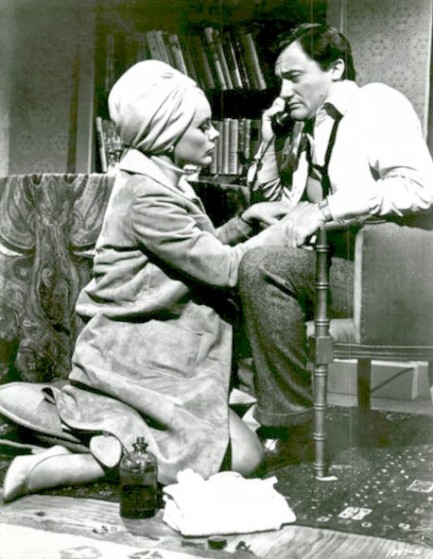
 Strange ideas from the minds and lenses of mid-century promo photographers. 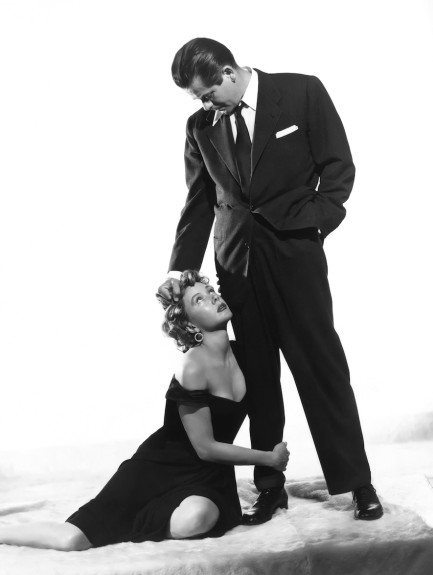 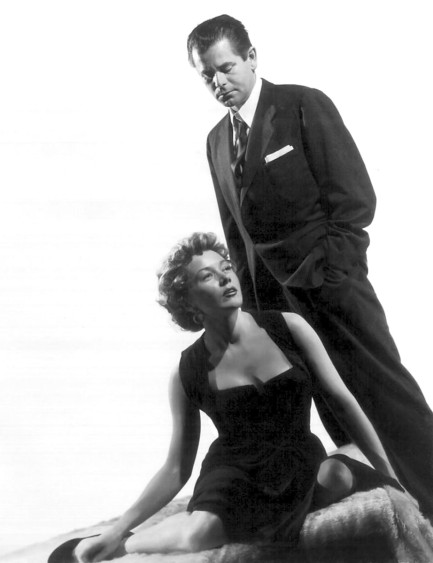 A while back we shared a promo photo of Glenn Ford and Gloria Grahame from 1953's The Big Heat that was meant to imply oral sex (it absolutely was, and you can see for yourself here). We commented on its weirdness, and noted that an actress would probably not be asked or made to pose that way today. The shot got us thinking about whether there were other kneeling promo shots from the mid-century era, and above you see two others from The Big Heat. Below we have more such shots, and while none are as jarring as that previous promo, they're all interesting. We assumed there would be few if any featuring kneeling males, but we found a couple. Even so, there are probably scores more kneeling actresses that we missed. While many of shots took the form they did to highlight the criminal/victim themes in their parent films, you still have to wonder what else—consciously or not—was in the various photograhers' minds. Anyway, just some food for thought this lovely Thursday. Ready, set discuss! 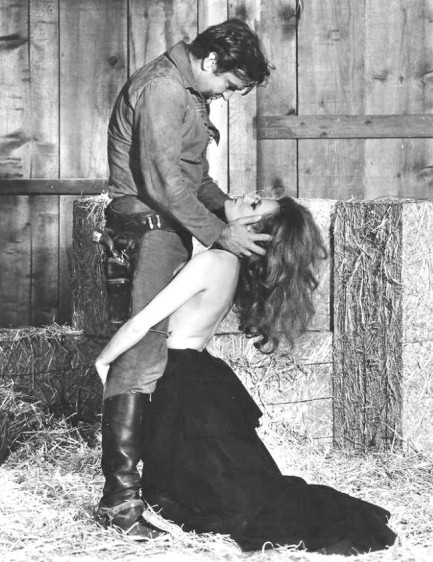 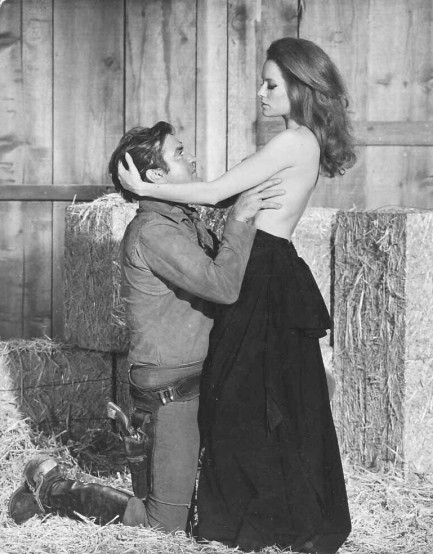 Rod Taylor and Luciana Pauluzzi swap subordinate positions for 1967's Chuka. Rod Taylor and Luciana Pauluzzi swap subordinate positions for 1967's Chuka.
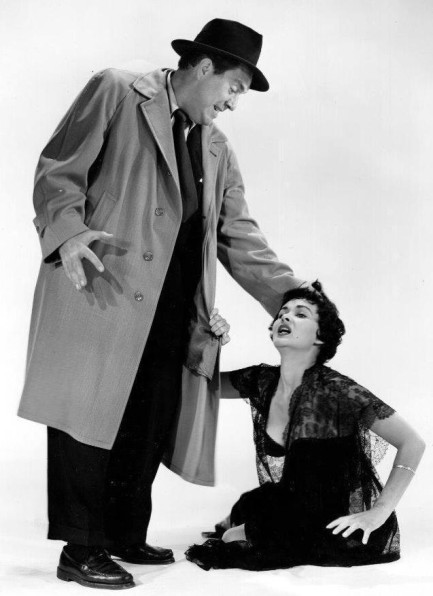 Edmund O'Brien goes for the time honored hair grab on Marla English for 1954's Shield for Murder. Edmund O'Brien goes for the time honored hair grab on Marla English for 1954's Shield for Murder.
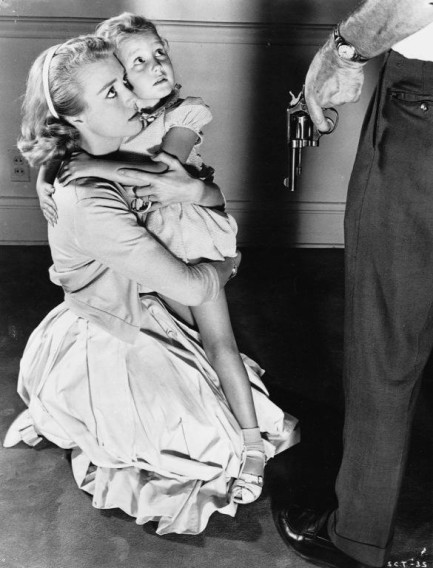 Inger Stevens and Terry Ann Ross for Cry Terror, an adaptation of a novel we talked about a few years ago. Inger Stevens and Terry Ann Ross for Cry Terror, an adaptation of a novel we talked about a few years ago.
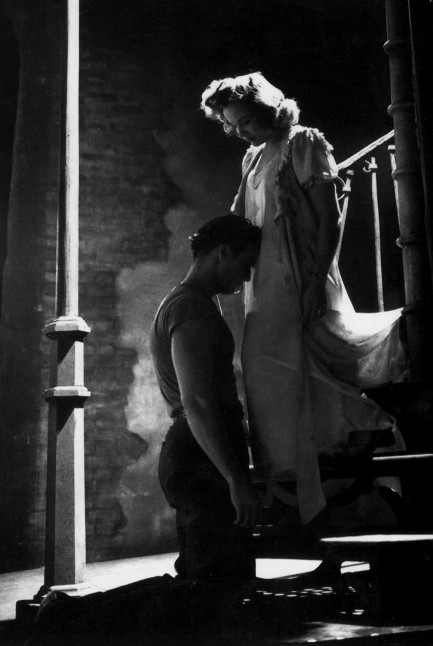 Kim Hunter soothes an overheated Marlon Brando in a promo for 1951's A Streetcar Named Desire. Kim Hunter soothes an overheated Marlon Brando in a promo for 1951's A Streetcar Named Desire.
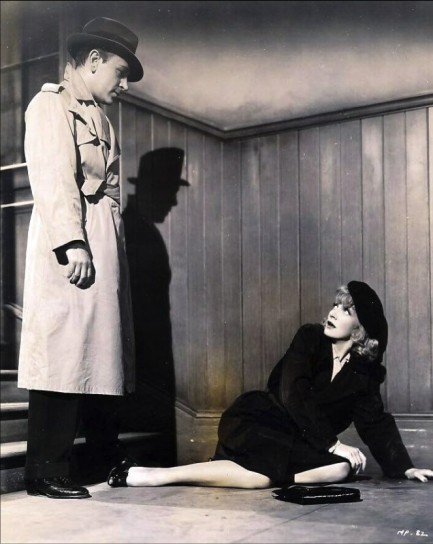 George Raft menaces Marlene Dietrich in the 1941 comedy Manpower. George Raft menaces Marlene Dietrich in the 1941 comedy Manpower.
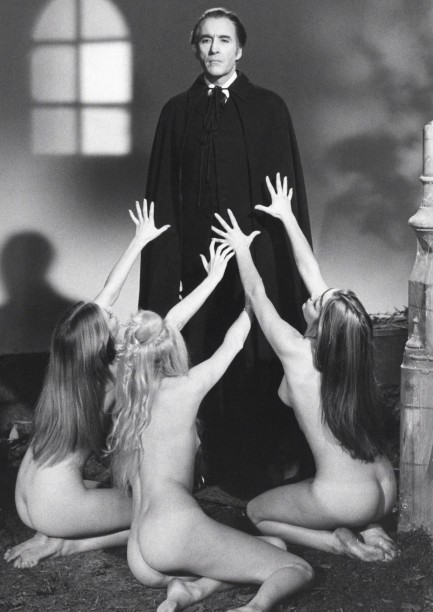 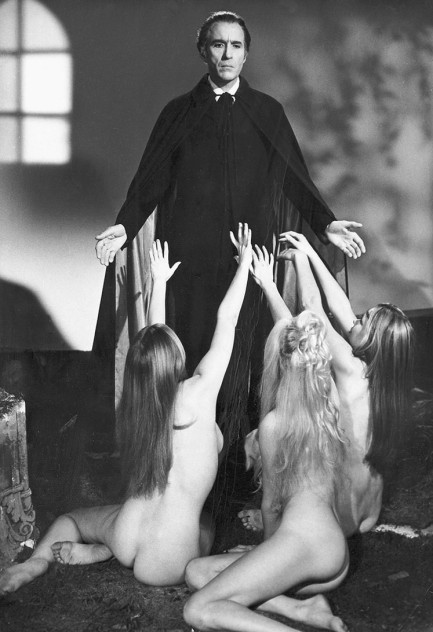 As promos go, these actually make sense. They show three unidentified models mesmerized by vampire Christopher Lee for 1970's Taste the Blood of Dracula. As promos go, these actually make sense. They show three unidentified models mesmerized by vampire Christopher Lee for 1970's Taste the Blood of Dracula.
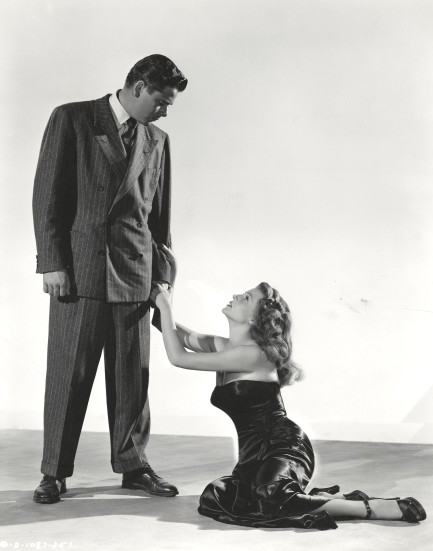 Glenn Ford is at it again, this time looming over Rita Hayworth for the 1946 classic Gilda. Glenn Ford is at it again, this time looming over Rita Hayworth for the 1946 classic Gilda. 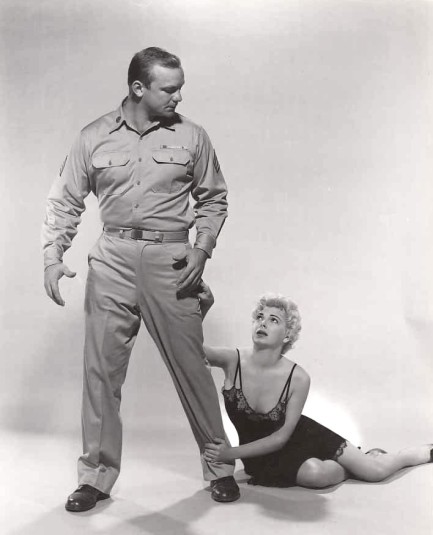 Aldo Ray and Barbara Nichols for 1958's The Naked and the Dead. Aldo Ray and Barbara Nichols for 1958's The Naked and the Dead.
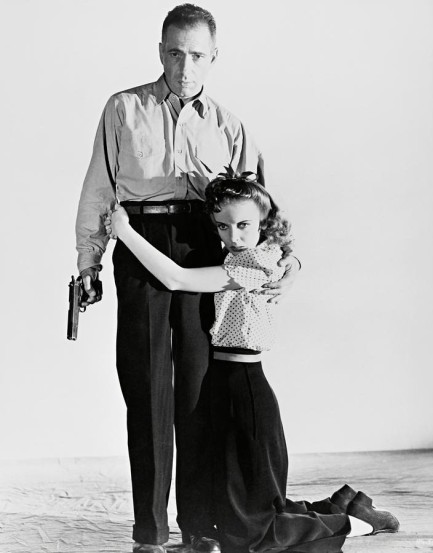 This one shows less domination and more protectiveness, as Humphrey Bogart prepares to defend Ida Lupino for High Sierra, 1941. This one shows less domination and more protectiveness, as Humphrey Bogart prepares to defend Ida Lupino for High Sierra, 1941.
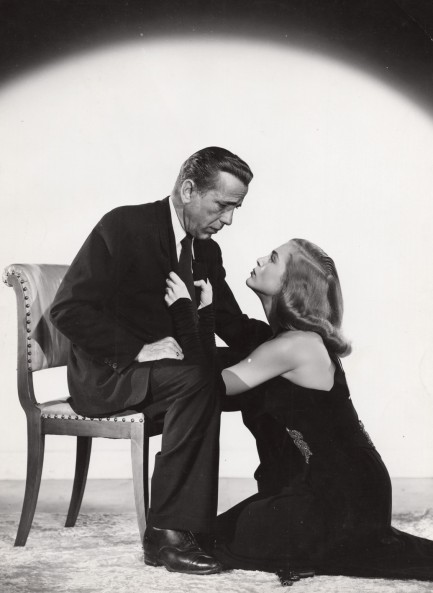 Humphrey once more. Here he's with Lizabeth Scott for Dead Reckoning, 1947. Humphrey once more. Here he's with Lizabeth Scott for Dead Reckoning, 1947.
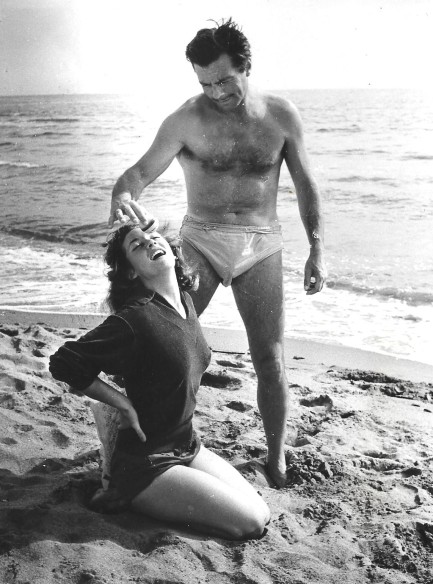 This shot shows Brazilian actress Fiorella Mari with an actor we can't identify in a movie we also can't identify. This shot shows Brazilian actress Fiorella Mari with an actor we can't identify in a movie we also can't identify.
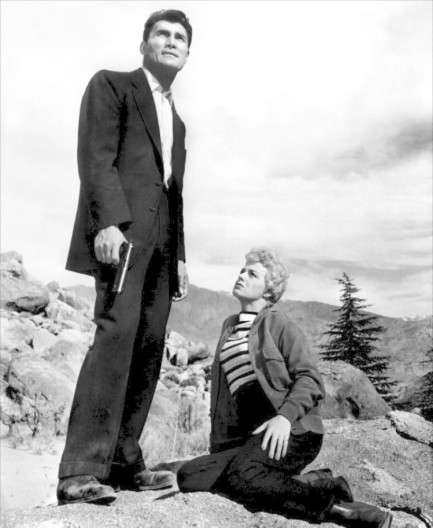 Shelly Winters and Jack Palance climb the highest mountain together for I Died a Thousand Times, 1955. Shelly Winters and Jack Palance climb the highest mountain together for I Died a Thousand Times, 1955.
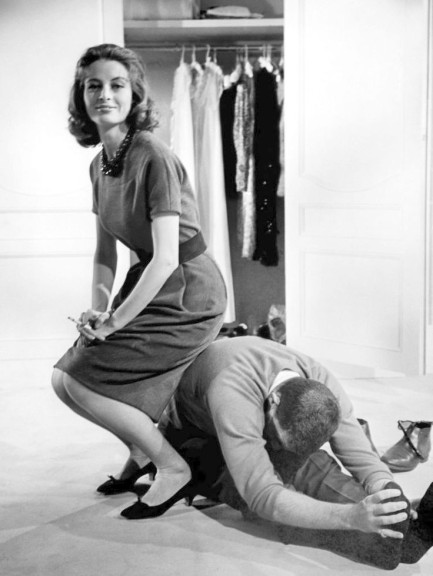 As we said, we didn't find as many examples of kneeling men, but we found this gem—Cappucine makes a seat of director Blake Edwards on the set of The Pink Panther in 1963. Does this count, though? While Edwards is subordinate, he isn't kneeling and it really isn’t a legit promo. As we said, we didn't find as many examples of kneeling men, but we found this gem—Cappucine makes a seat of director Blake Edwards on the set of The Pink Panther in 1963. Does this count, though? While Edwards is subordinate, he isn't kneeling and it really isn’t a legit promo.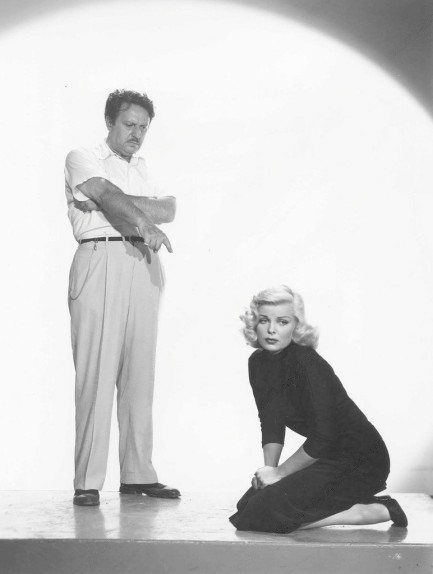 And lastly, in a curious example, Hugo Haas seems to tell Cleo Moore to stay in a shot made for 1953's One Girl's Confession. And lastly, in a curious example, Hugo Haas seems to tell Cleo Moore to stay in a shot made for 1953's One Girl's Confession.
 Doing her part to take a bite out of crime. 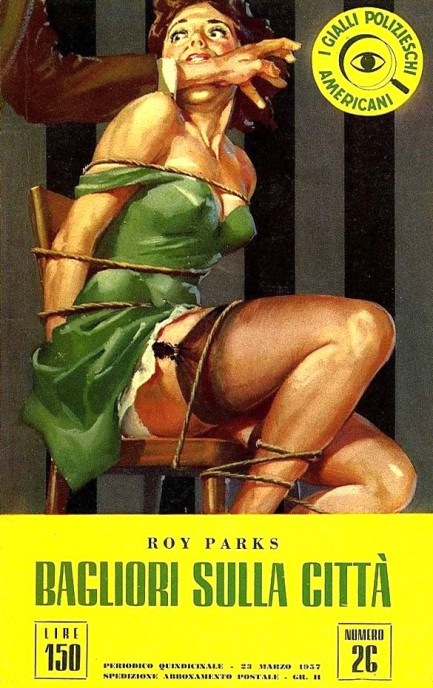
Above is the cover of Bagliori sulla città, written by Roy Parks for S.P.E.R.O.’s series I Gialli Polizieschi Americani, 1957. Parks was actually a writer named Mario Casacci, who also published novels as Bill Coleman, Mario Kasak, Rex Sheridan, and possibly others. He was also a noted screenwriter most famous for inventing, along with Alberto Ciambricco, the figure of Lieutenant Sheridan, who was a staple on Italian television through the 1960s and early 1970s, played by Ubaldo Lay. Casacci also participated on several soundtracks as a lyricist. The art here is from Averardo Ciriello, who we’ve featured before here and here on movie posters.
 You never know what you'll find if you go far enough up the Amazon. 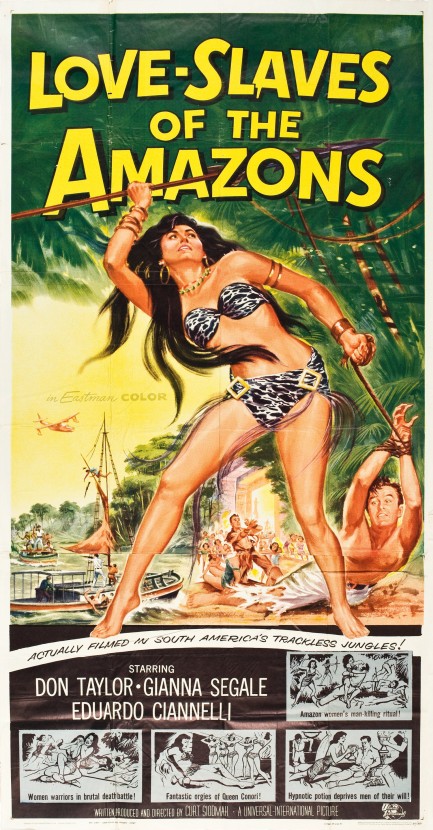 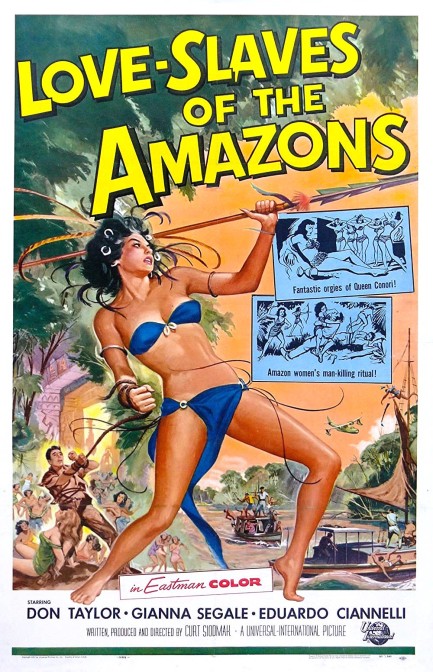
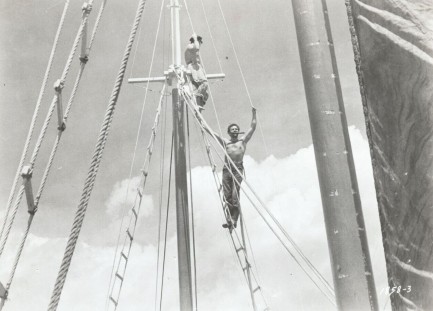
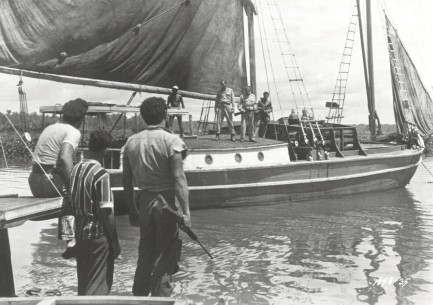
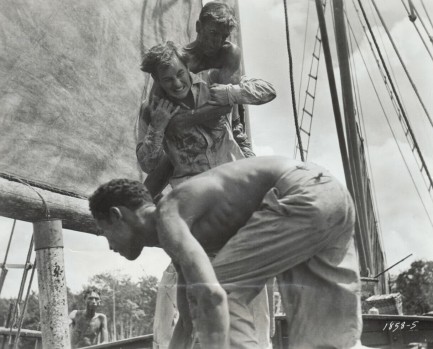
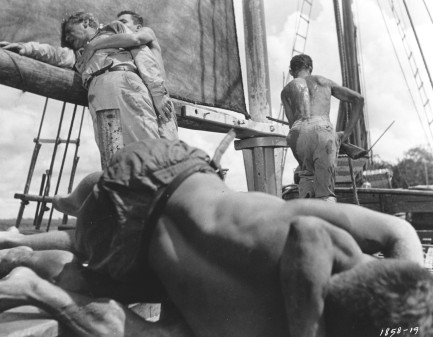
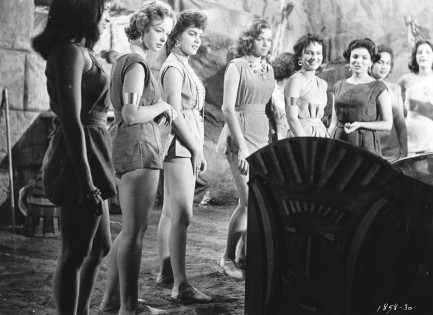
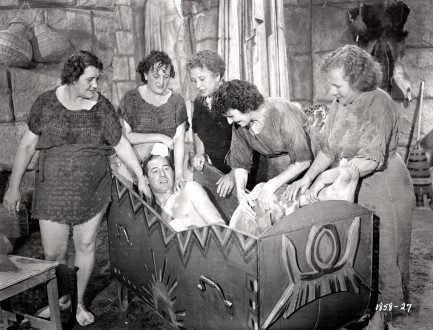
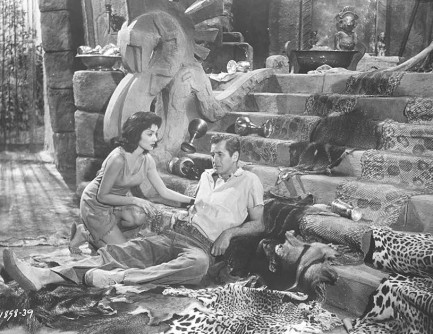
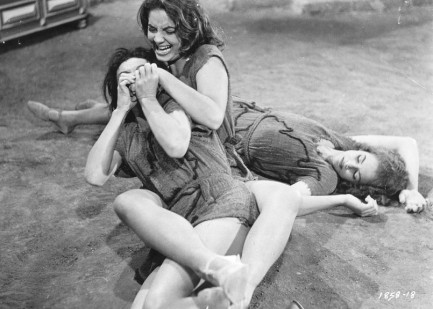
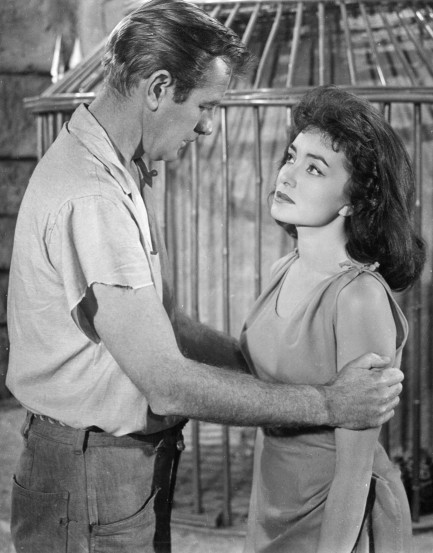
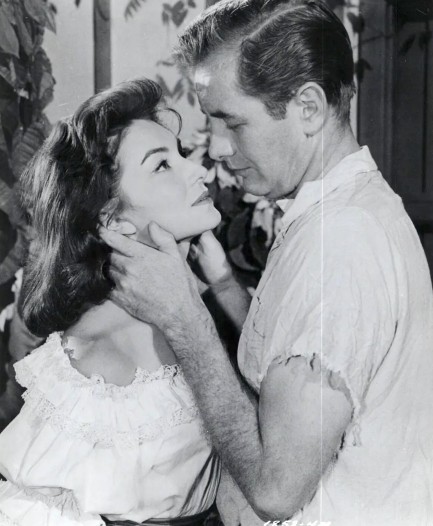
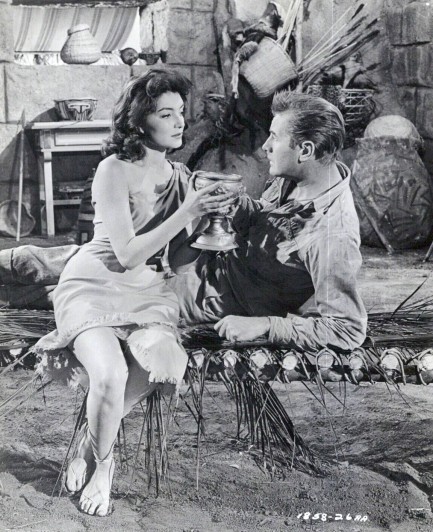
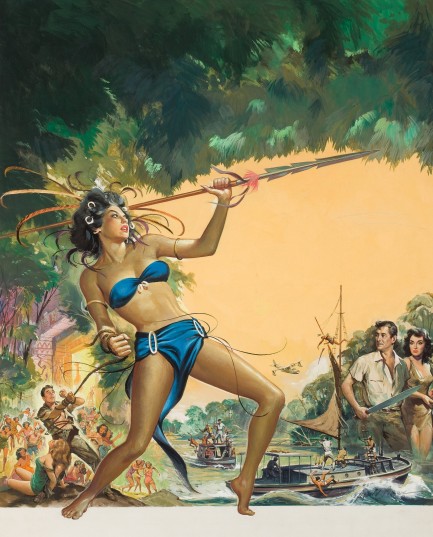
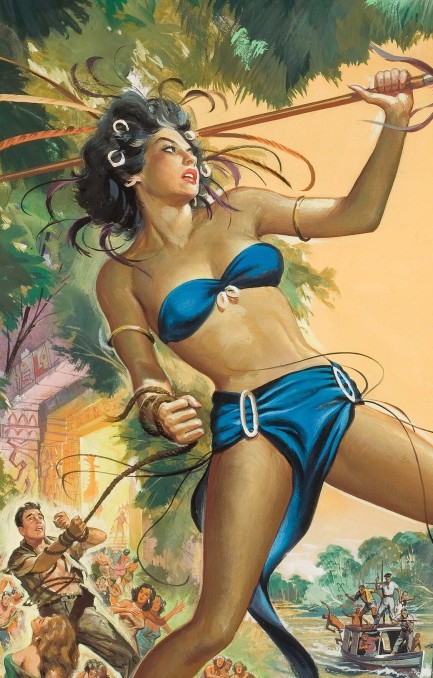
Written, produced, and directed by Curt Siodmak, who was behind numerous monster features, including Bride of the Gorilla and Curucu, the tropical adventure Love Slaves of the Amazon, which premiered today in 1957, is a full color production about the search for a lost realm of warrior women and their priceless treasures. In order for the expedition to take place, semi-crazy Eduardo Ciannelli must convince staid Don Taylor that the Amazons exist. He reveals a golden statue as proof, which he'd obtained on a previous foray into the jungle, and after some back and forth, sufficient funds for the journey are obtained. Unfortunately, rumors of gold and diamonds have piqued the interest of local ruffians, who plan to hijack the expedition.
Are there actually Amazons? You bet. French actress Anna Maria Nabuco is their queen. Are there love slaves? Yup, one poor exhausted one, anyway, and Taylor looks ripe as a replacement as far as Nabuco is concerned. And is there treasure? There's that too. The movie's plusses include a pitched battle between the expedition and the hijackers while both their boats are mired in river mud, and various exteriors actually shot in Manaus, Brazil and the nearby rain forest. Additionally, the poster art by Reynold Brown is tops. On the minus side, we felt that intermittent veerings into comedy were pointless and unfunny. But on the whole, Love Slaves of the Amazons was better than we expected. Does that mean it was good? Define “good.”
 Cold War spies make waves in the City of Canals. 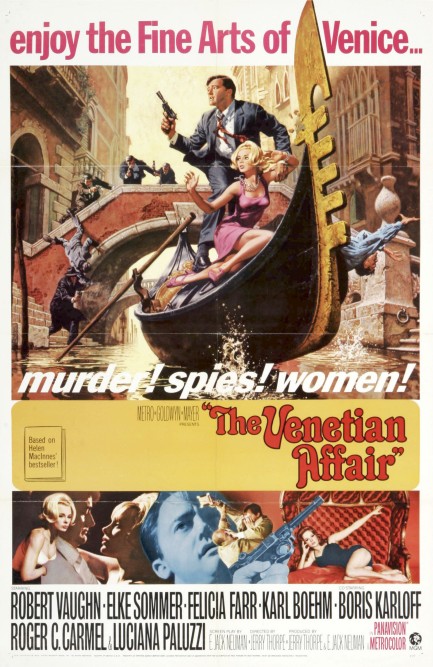
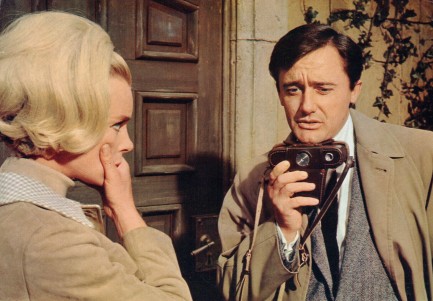
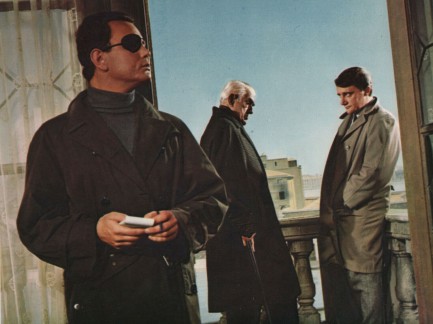
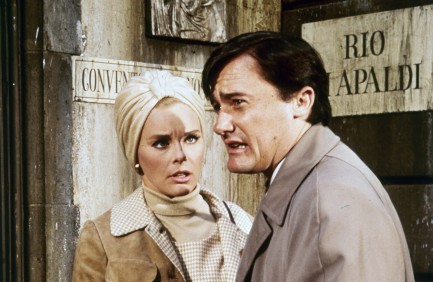
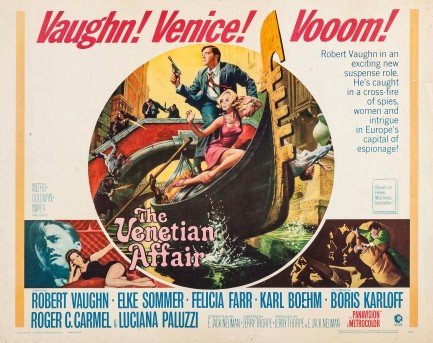
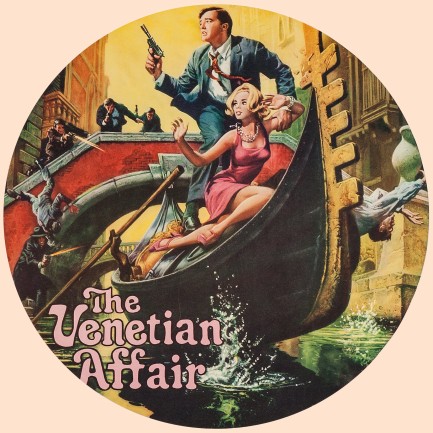
The Venetian Affair, which premiered today in 1966, has a rather interesting promo poster. It was painted by U.S. artist Frank McCarthy, who was big in paperback covers early in his career, moved into high-budget movie promos such as James Bond posters, and finally made a mark in realist fine art. We love this piece from him. There's a lot going on. If you check out his effort for You Only Live Twice here you'll see how dense and chaotic his work could be, same as above, where he has people falling off the bridge, off the gondola, and guns being brandished everywhere. In addition, his likenesses of the movie's stars are good. He was a major talent.
The first observation you might make while watching The Venetian Affair is that it would be impossible to make a similar movie in that city today. Nearly four million tourists visited Venice in 2022, making nearly every street—and certainly every site of special historical note—like the mass exodus from a just-completed football game. With that level of humanity about, closing parts of the city or main squares—while maybe possible—would not be practical or economical.
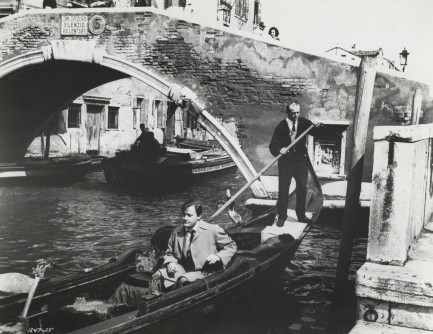
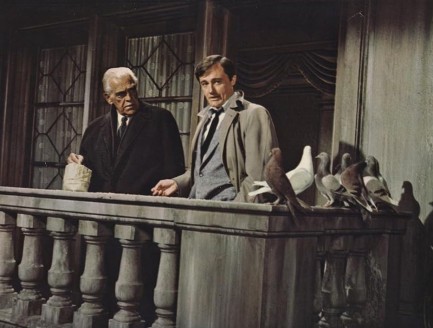
But The Venetian Affair was made back when quiet streets and dark corners existed. Old world architecture always makes for a good spy movie backdrop. That's exactly what you get in this adventure about a mind control drug being used to foment conflict between the U.S. and U.S.S.R. Robert Vaughn stars as a former CIA agent who was fired after he married Elke Sommer, who was suspected of being a double agent. Vaughn never found out whether that was true because he and Sommer were torn apart by turbulent events. But when a bomb blows up a Venice political conference and Sommer is thought to be involved, the CIA drags Vaughn back into its clutches to find Sommer, as well as the crucial clue that might explain the bombing.
Vaughn is a cool and composed actor, any movie with Sommer is one we'll watch, and co-stars Felicia Farr, Luciana Paluzzi, Ed Asner, and the venerable Boris Karloff are all enticements, but we can't say The Venetian Affair is a scintillating example of a Cold War spy flick. It's such a fertile sub-genre, one that produced some of the best movies of 1950s through 1970s. Even against the beautiful Venice backdrop it mostly falls flat due to a screenplay that never hits any highs. But that doesn't mean you shouldn't watch it. Though it lacks highs, it also lack any serious lows. You can spend your time worse ways. Plus—Sommer. What more do you need?
  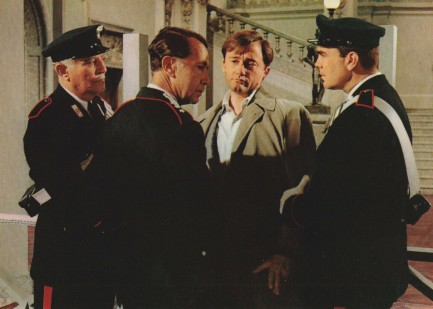 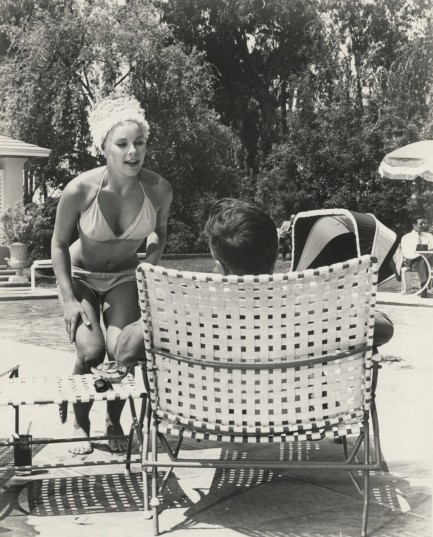 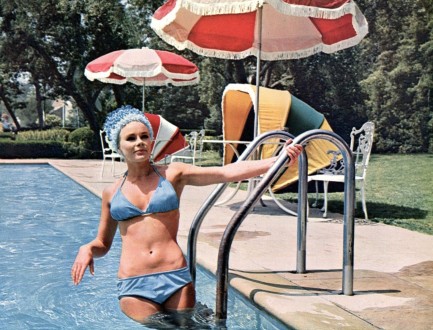 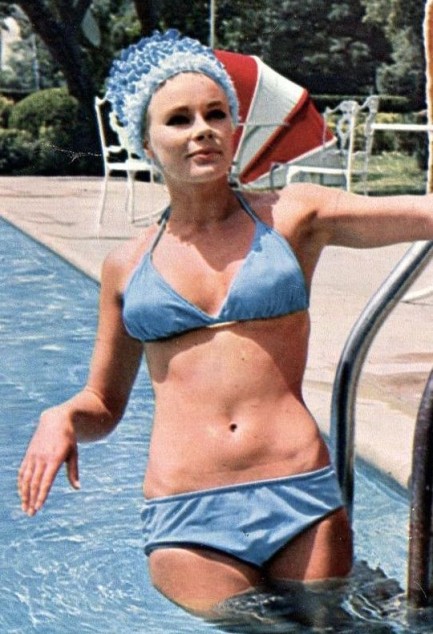 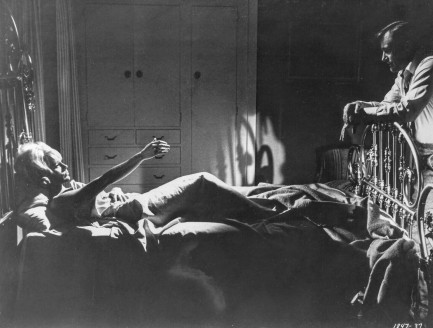 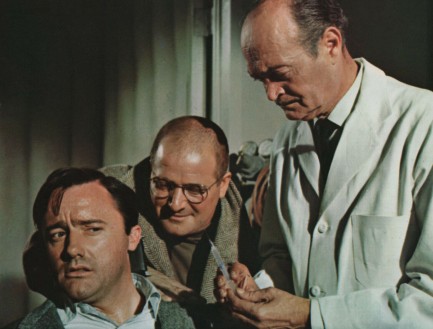 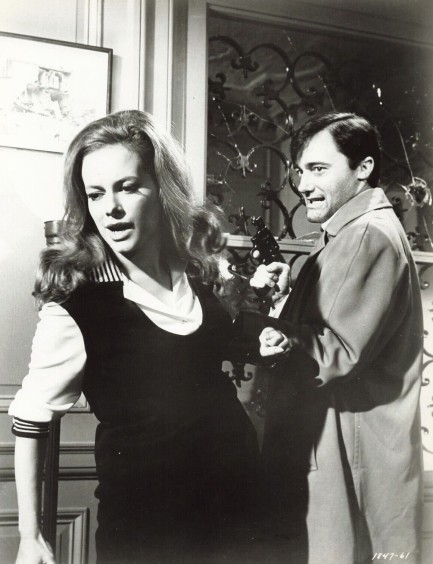 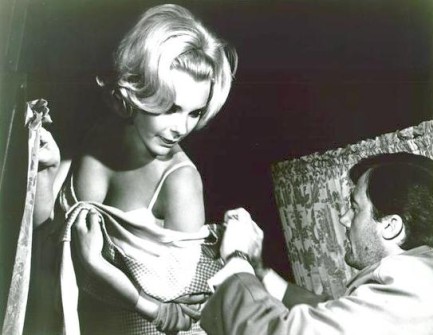     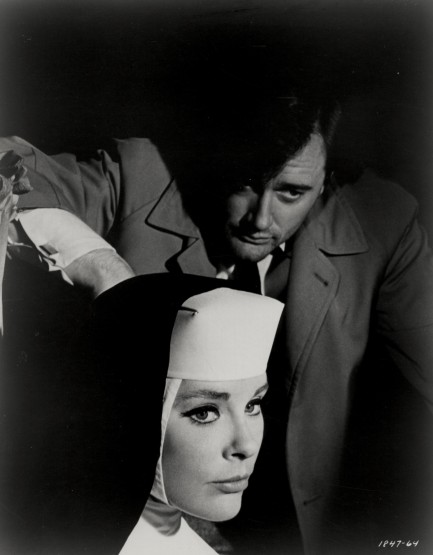 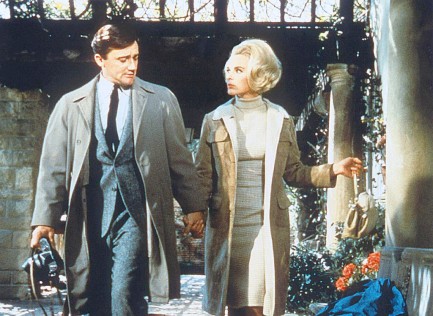 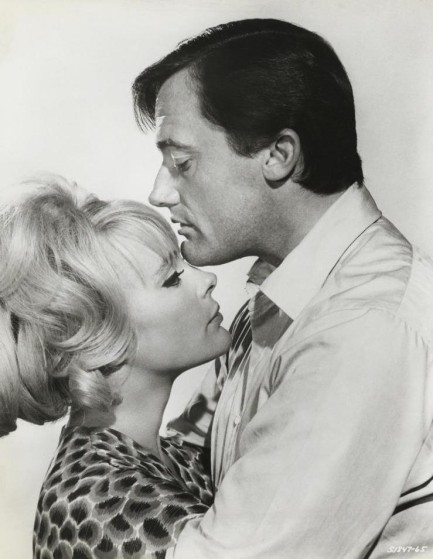 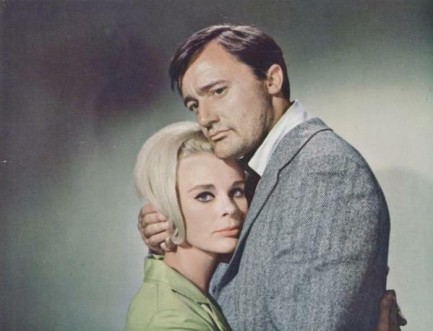  
 When Isabel Sarli enters paradise the snakes come crawling. 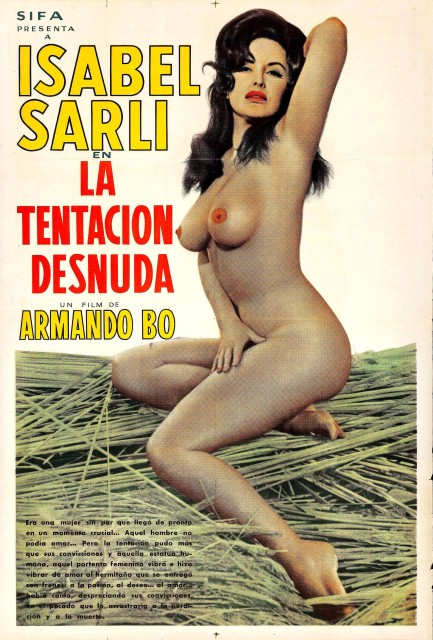
 We often describe posters in glowing terms but this effort for the Argentinian sexploitation drama La tentación desnuda is a legit stunner. The movie, which starred international sex symbol Isabel Sarli, premiered today in 1966, and in that year we can't imagine where this provocative promo was displayed. If anywhere. We often describe posters in glowing terms but this effort for the Argentinian sexploitation drama La tentación desnuda is a legit stunner. The movie, which starred international sex symbol Isabel Sarli, premiered today in 1966, and in that year we can't imagine where this provocative promo was displayed. If anywhere.
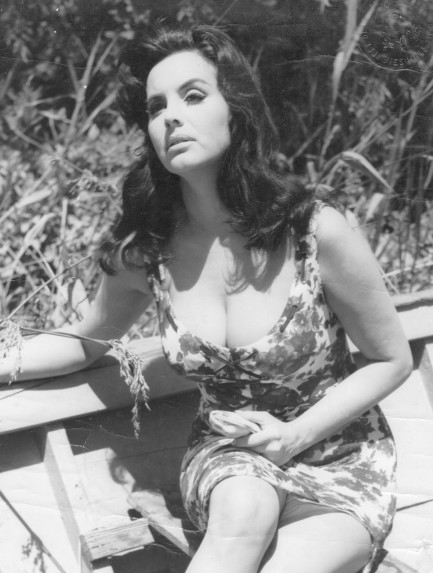
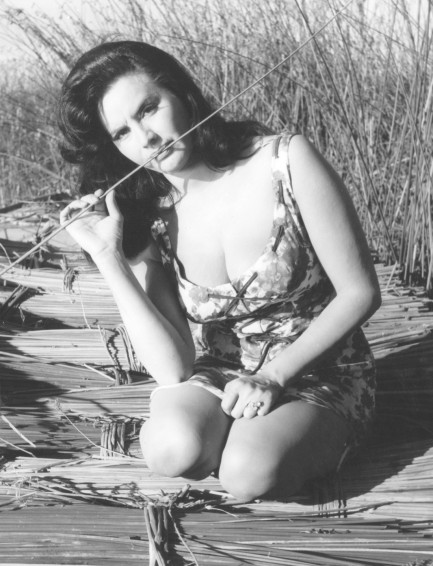
At first we thought it was a recently made fan creation, but we changed our minds. The fold lines look real, and while those can be created in Photoshop, fan art is almost always too lazy for such touches. Sarli's breasts don't look quite like in real life because the designer painted on a pair of weird cherry nipples, but we've seen that happen with posters before. Otherwise the art matches perfectly a promo shot made by photographer Olga Masa for the movie, but at a much higher resolution.
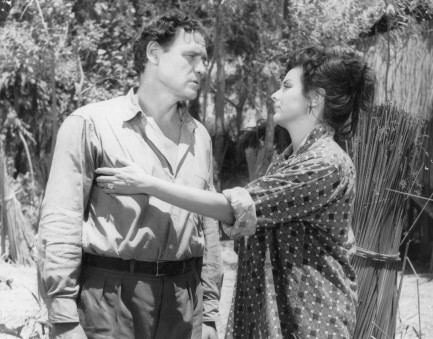
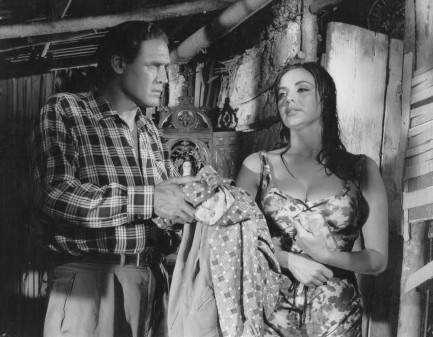
La tentación desnuda delivers in melodramatic but engrossing style exactly what the title suggests, and shows yet again why Sarli was such a massive star. Plotwise she falls off a boat, drags herself from the water, and wanders blindly to hermit Armando Bo's riverside shack, where she's given shelter and food. Bo harvests sugar cane and hangs out playing his harp, trying to find, “freedom, to be absolutely free,” and to “live spiritually, near the river, the trees, the birds,” but Sarli laughingly upsets his singular existence in a big way by questioning his beliefs and showing lots of skin. She sticks around when Bo promises to demonstrate the merits of his ascetic lifestyle, but other men who live and work on the river have different ideas for Sarli—and they don't involve holistic simplicity.
If the plot seems very similar to 1953's La red you'd be right. Femmes fatales bringing chaos to edenic enclaves was a popular theme in Latin American cinema. This iteration, for the year it was released, is very daring, yet another example of what was going on outside the censored environment within the U.S., where motion picture themes were constrained by the Production Code. Meanwhile, in militarily ruled Argentina, Sarli was going fully nude—a few times, in the case of this film. We guess Juan Carlos Onganía and company liked a litle skin. Even dictators get boners.
Sarli may embody tentación, but she doesn't try to tempt the men around her, aside from Bo, who's the only one she wants. But her preferences mean nothing. Soon everyone is fighting over her, hauling her around like hand luggage on a commuter flight. She's even worth torturing and killing over, as things develop. Men, right? But they'll pay for their hubris. And because Biblical metaphor is strong with this film, there's even a bit of mysticism involved. Maybe that's why the dictatorship tolerated it—that type likes hamhanded religious tropes even more than boners. Well, we'll tolerate Sarli anytime too. You'll be seeing her again.
 Listen, humans are a delicacy. They don't taste very good, but eating them is about status. 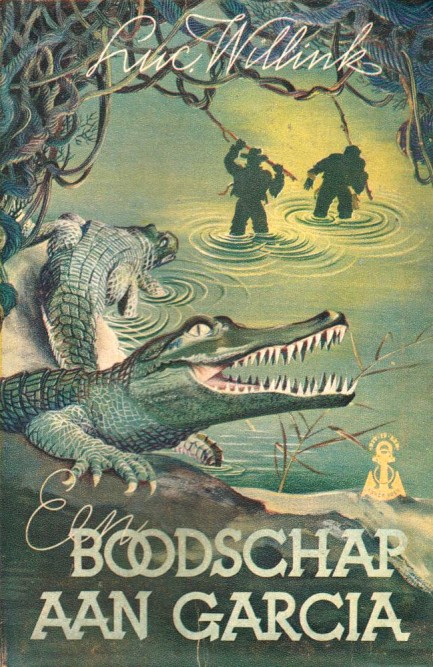
We wanted to revisit Dutch illustrator Piet Marée, whose style is so unusual it's very much worth another look. There's nothing biographical out there about him, as far as we can find. But we love his work. Een boodschap aan Garcia, which means, “a message to Garcia,” was written by Luc Willink, aka Lucas Willink, aka Clifford Semper, and published by Hague based Anker-Boekenclubin in 1950. How it relates to Elbert Hubbard's dramatized 1916 essay of the same name (which resulted in a 1936 Barbara Stanwyck movie) is unknown to us. We can tell you it's the same story—U.S. soldier Andrew S. Rowan carries a secret message from President William McKinley to Calixto García, a rebel hiding in the mountains of Cuba, before the Spanish American War. But the point here is Marée's art. We love it. We'll try to dig up more from him to share later.
 Gangster life has great benefits but the retirement plan leaves a lot to be desired. 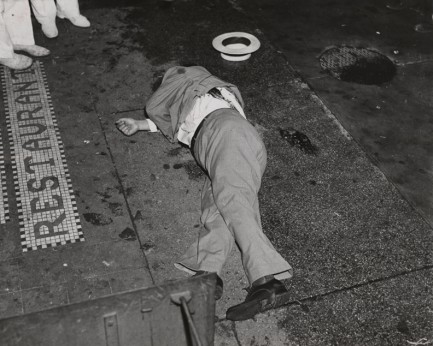 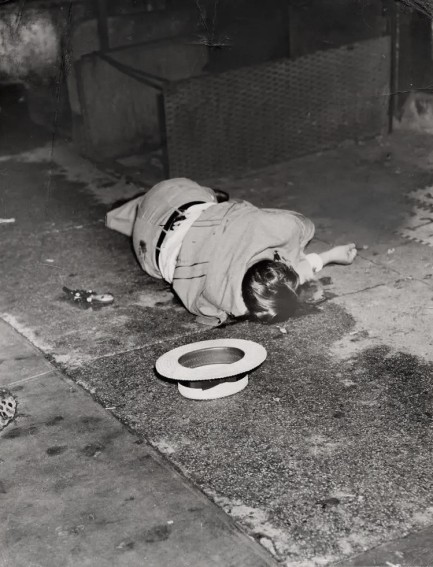
It seems like the same lesson is imparted by nearly every vintage Mafia photo we run across—ambition is a double-edged sword. Dominick Didato, aka Terry Burns, who you see above in a photo made by Arthur Fellig, aka Weegee, lies dead on a New York City street where he was gunned down today in 1936. He was killed for interfering with rackets run by Lucky Luciano. It was a low percentage play. Luciano was literally the most powerful mobster in the U.S. at the time, and as the saying goes, you come at the king, you best not miss.
 Look, I've found something! I bet this advances the plot! 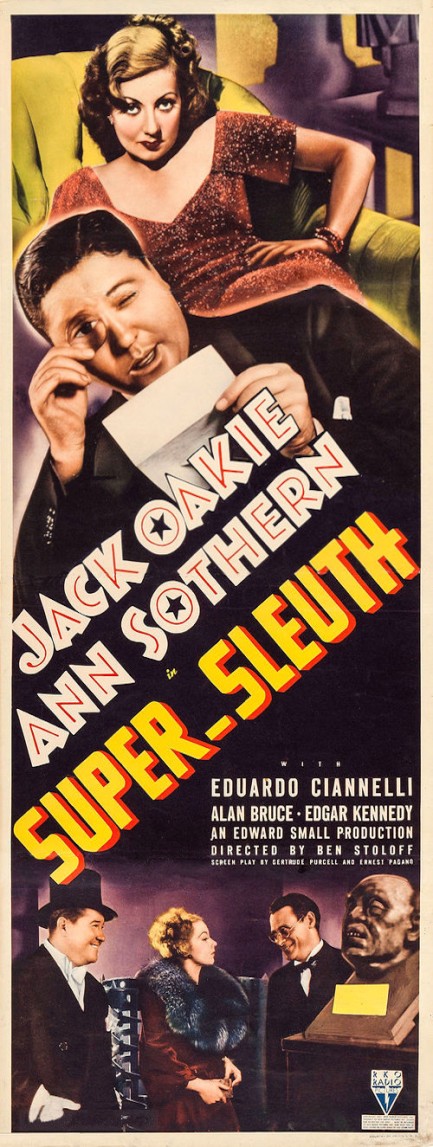
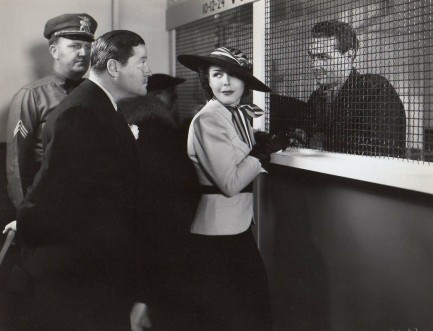
Here's another nice panel length poster for the 1937 mystery comedy Super-Sleuth. The term "door panel," which is a commonly used designation, is a bit deceptive. These are nowhere near the size of a door. The dimensions are twenty by sixty, or sometimes fourteen by thirty-six—in any case around three times taller than wide. The dimensions of this one aren't actually quite there. It's closer to two-point-five-to one. Close enough, as far as we're concerned. Anyway, we've been unearthing a lot of this style of promo lately, and we like them because the arrangement of visual elements and text are pleasing to our amateur eyes.
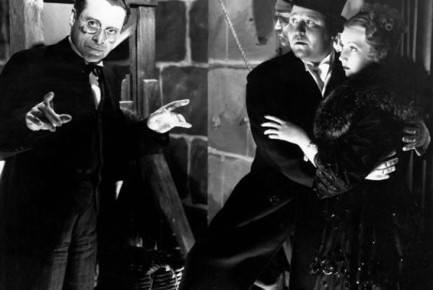
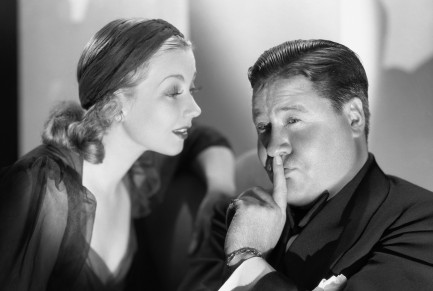
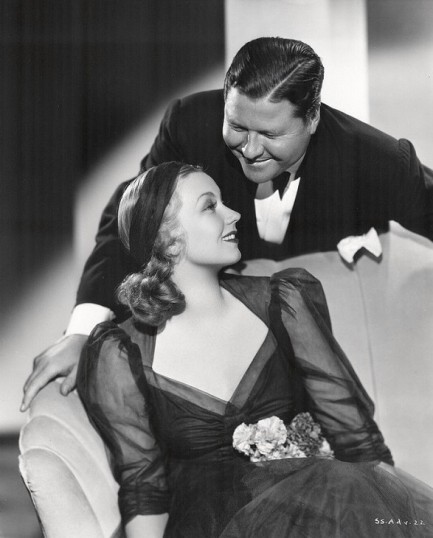
In the movie, an egotistical actor played by Jack Oakie, whose signature character is a sleuth, criticizes the LAPD and ends up in a press feud with them. He's been critical because he and other Hollywood stars have been receiving threatening letters from “the Poison Pen,” but the cops have no idea who's sending them. Oakie gets his chance to prove whether he can be a real life sleuth when there's a shooting on his movie set. While Super-Sleuth is billed as slapstick mystery, the mystery part is not delivered. There's only ever one true suspect. We suppose it's difficult to write in red herrings and twists when a film is 75 minutes long. Still, having the sinister and secretive weirdo be the murderer is a little too elementary.
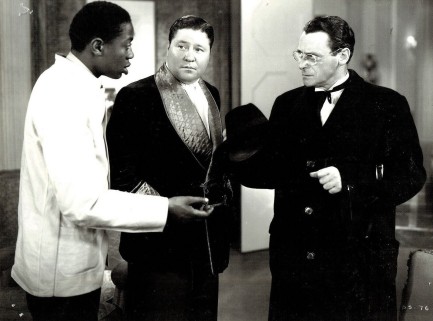
Though many of the characters, including Oakie, are buffoons, there's also, it must be noted, a ridiculous black stereotype played by Willie Best, who sometimes acted under the moniker Sleep 'n' Eat. He's often reviled for his portrayals now, but in a 1934 interview he said, “What's an actor going to do? Either you do it or get out.” It's the dilemma of all actors—do your level best with what you're given or end up on the do-not-hire list. Super-Sleuth doesn't give its actors a lot to work with, but Oakie, Best, the beautiful Ann Sothern and the rest put their all into it and the result is a passable slapstick (non) mystery with a handful of genuine laughs. It premiered in the U.S. today in 1937.
 *psst* Ever since Claudine got hold of that speargun the look in her eye really worries me. 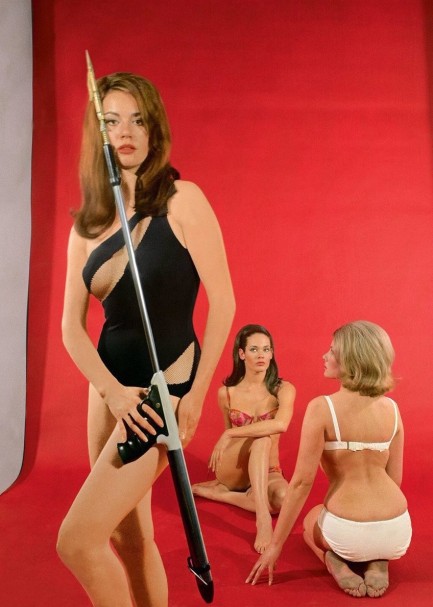
The James Bond flick Thunderball produced an unusually fertile crop of excellent promo images, owing largely to the three actresses you see above—Claudine Auger, Martine Beswick, and Luciana Paluzzi. It's Auger who's posing with the speargun, and there are other good shots of her wielding it. If Beswick and Paluzzi are worried, it's possibly because they suspect they won't survive the film. In early Bond adventures only one of his many love interests usually survived, and in Thunderball that's Auger. Her reward? A little thunderballing.

|
 |
The headlines that mattered yesteryear.
1939—Batman Debuts
In Detective Comics #27, DC Comics publishes its second major superhero, Batman, who becomes one of the most popular comic book characters of all time, and then a popular camp television series starring Adam West, and lastly a multi-million dollar movie franchise starring Michael Keaton, then George Clooney, and finally Christian Bale. 1953—Crick and Watson Publish DNA Results
British scientists James D Watson and Francis Crick publish an article detailing their discovery of the existence and structure of deoxyribonucleic acid, or DNA, in Nature magazine. Their findings answer one of the oldest and most fundamental questions of biology, that of how living things reproduce themselves. 1967—First Space Program Casualty Occurs
Soviet cosmonaut Vladimir Komarov dies in Soyuz 1 when, during re-entry into Earth's atmosphere after more than ten successful orbits, the capsule's main parachute fails to deploy properly, and the backup chute becomes entangled in the first. The capsule's descent is slowed, but it still hits the ground at about 90 mph, at which point it bursts into flames. Komarov is the first human to die during a space mission. 1986—Otto Preminger Dies
Austro–Hungarian film director Otto Preminger, who directed such eternal classics as Laura, Anatomy of a Murder, Carmen Jones, The Man with the Golden Arm, and Stalag 17, and for his efforts earned a star on Hollywood's Walk of Fame, dies in New York City, aged 80, from cancer and Alzheimer's disease. 1998—James Earl Ray Dies
The convicted assassin of American civil rights leader Martin Luther King, Jr., petty criminal James Earl Ray, dies in prison of hepatitis aged 70, protesting his innocence as he had for decades. Members of the King family who supported Ray's fight to clear his name believed the U.S. Government had been involved in Dr. King's killing, but with Ray's death such questions became moot.
|

|
|
It's easy. We have an uploader that makes it a snap. Use it to submit your art, text, header, and subhead. Your post can be funny, serious, or anything in between, as long as it's vintage pulp. You'll get a byline and experience the fleeting pride of free authorship. We'll edit your post for typos, but the rest is up to you. Click here to give us your best shot.
|
|



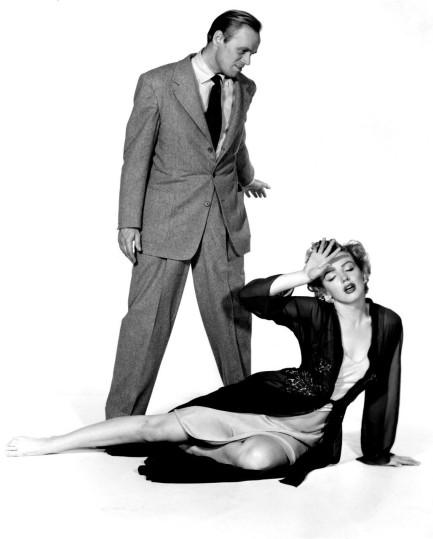 Marilyn Monroe swoons as Richard Widmark snarls for Don't Bother To Knock, 1952.