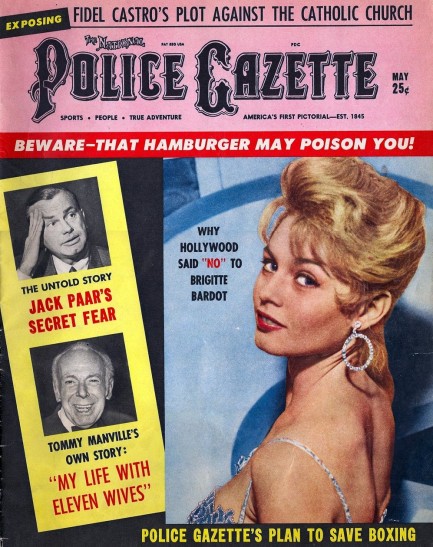
 Did Hollywood really freeze out the most popular starlet in the world? 
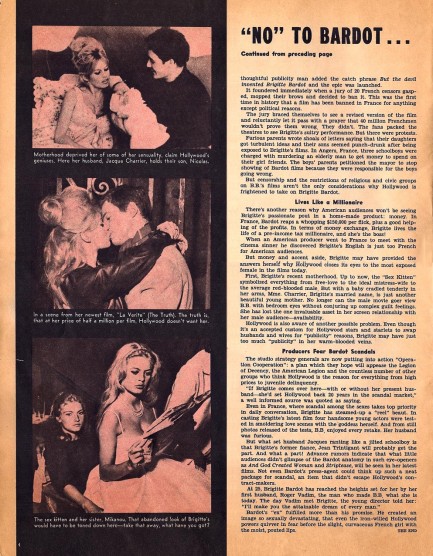
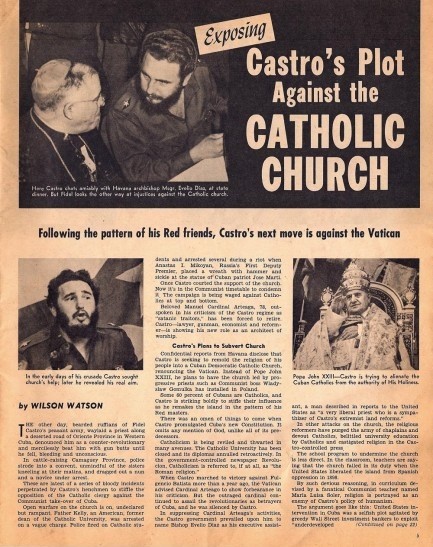
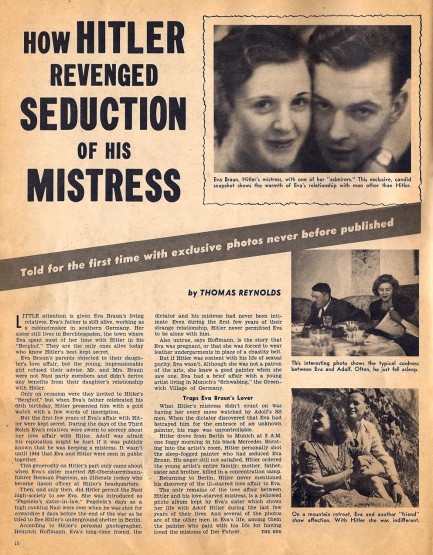
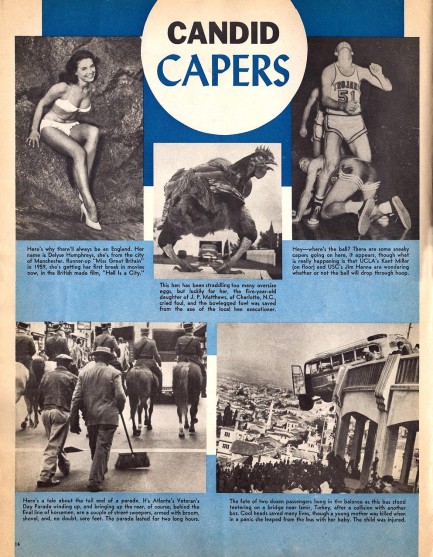
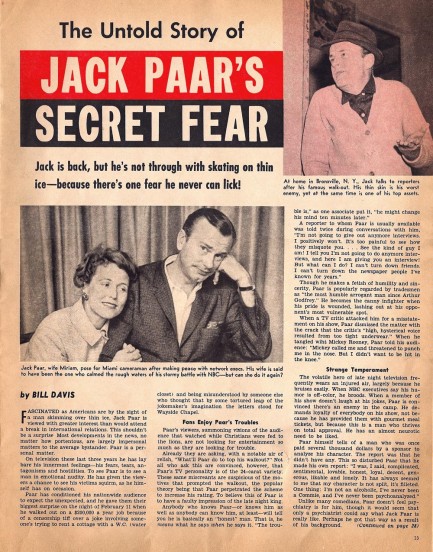
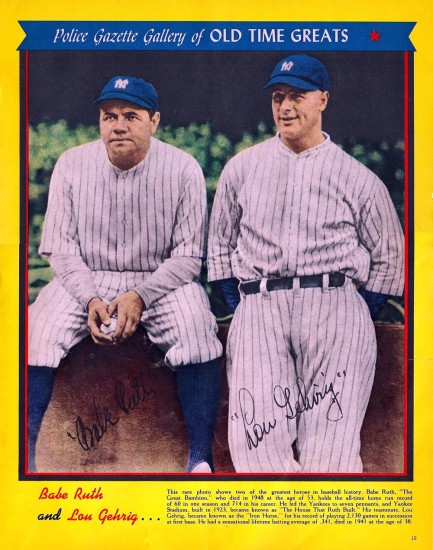
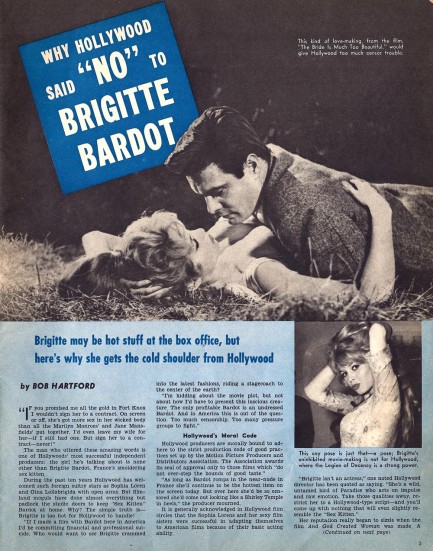
The National Police Gazette reveals on this cover from today in 1960 that Hollywood said no to Brigitte Bardot. The accompanying story quotes an unnamed independent producer, who says that the problem is that Bardot's deficient acting skills limited her to sex kitten roles, but American censorship meant Hollywood couldn't make those kinds of movies. He adds that, at $150,000 salary per project, Bardot is too expensive for Hollywood. A second “well-informed source” tells Gazette that studios are afraid of Bardot’s unbridled sexuality, claiming that her image is “so sexually devastating, that [Hollywood] quivers in fear before the slight, curvaceous French girl with the moist, pouted lips.” So, basically two of three reasons Police Gazette gives for Bardot not featuring in Hollywood films have to do with the influence of legions of American prudes. So maybe it wasn’t really a case of Hollywood saying no to Bardot as much as it was saying yes to sexual repressives. Bardot, it should be noted, simply continued on as the biggest star in the world. Elsewhere in this issue you get the plot-of-the-month attributed to Fidel Castro, tales of Adolf Hitler and Eva Braun, Jack Paar’s fears, and a nice portrait of Babe Ruth and Lou Gehrig. Scans of all that below, and more Gazette coming soon.       
Cuba, France, Police Gazette, Fidel Castro, Brigitte Bardot, Babe Ruth, Lou Gehrig, Jack Paar, Eva Braun, cinema, tabloid
|
 |
The headlines that mattered yesteryear.
1942—Ted Williams Enlists
Baseball player Ted Williams of the Boston Red Sox enlists in the United States Marine Corps, where he undergoes flight training and eventually serves as a flight instructor in Pensacola, Florida. The years he lost to World War II (and later another year to the Korean War) considerably diminished his career baseball statistics, but even so, he is indisputably one of greatest players in the history of the sport. 1924—Leopold and Loeb Murder Bobby Franks
Two wealthy University of Chicago students named Richard Loeb and Nathan Leopold, Jr. murder 14-year-old Bobby Franks, motivated by no other reason than to prove their intellectual superiority by committing a perfect crime. But the duo are caught and sentenced to life in prison. Their crime becomes known as a "thrill killing", and their story later inspires various works of art, including the 1929 play Rope by Patrick Hamilton, and Alfred Hitchcock's 1948 film of the same name. 1916—Rockwell's First Post Cover Appears

The Saturday Evening Post publishes Norman Rockwell's painting "Boy with Baby Carriage", marking the first time his work appears on the cover of that magazine. Rockwell would go to paint many covers for the Post, becoming indelibly linked with the publication. During his long career Rockwell would eventually paint more than four thousand pieces, the vast majority of which are not on public display due to private ownership and destruction by fire.

|

 |
|
It's easy. We have an uploader that makes it a snap. Use it to submit your art, text, header, and subhead. Your post can be funny, serious, or anything in between, as long as it's vintage pulp. You'll get a byline and experience the fleeting pride of free authorship. We'll edit your post for typos, but the rest is up to you. Click here to give us your best shot.
|
|