 What was it Shakespeare wrote about rough winds and May? 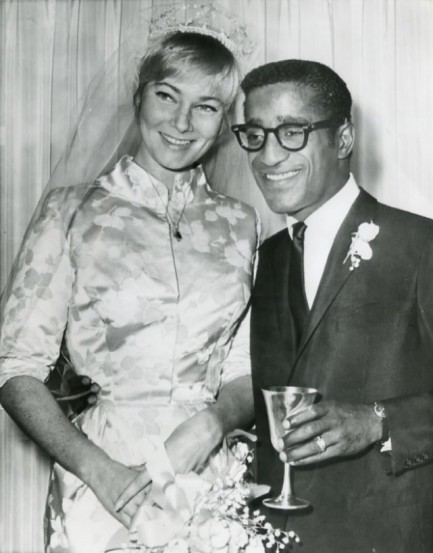
Above is a publicity photo of American singer/actor/comedian Sammy Davis, Jr. with his Swedish bride, actress May Britt. The shot dates from today in 1960, and as you might guess, that was a very bad time for mixed couples. Sammy had for years been making tabloid headlines for dating white women ranging from Tinseltown icon Kim Novak to Canadian singer Joan Stuart, but when he announced plans to marry Britt, a chunk of the general public lost its collective mind. He faced racist banners and chants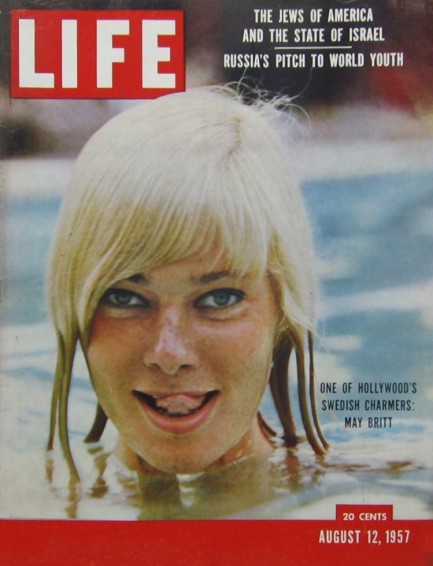 in London, received rafts of hate mail, and was confronted in Los Angeles with the bizarre spectacle of three men marching outside the Huntington Hartford Theater in nazi regalia. Even two admirers, John and Robert Kennedy, allegedly asked Frank Sinatra to tell Davis to delay the wedding until after the 1960 presidential election. in London, received rafts of hate mail, and was confronted in Los Angeles with the bizarre spectacle of three men marching outside the Huntington Hartford Theater in nazi regalia. Even two admirers, John and Robert Kennedy, allegedly asked Frank Sinatra to tell Davis to delay the wedding until after the 1960 presidential election. Professionally, Britt had to choose between her career and Davis, because it was quite clear that she would never be hired in Hollywood if she married him. Some websites suggest that she lost little because she was a minor talent at best, but she had appeared in over a dozen films and had made the cover of Life magazine twice before even meeting Sammy, so her expectations of a strong run in Hollywood were in no way delusional. Obviously, she chose love over career, and wed Davis at his home in the Hollywood Hills. Some of the guests at the reception included Peter Lawford, Diana Dors, Barbara Rush, Janet Leigh, Leo Durocher, Shirley MacLaine, Milton Berle, and Edward G. Robinson, Jr. The marriage lasted eight years—not long in the real world perhaps, but an eternity by Hollywood standards. 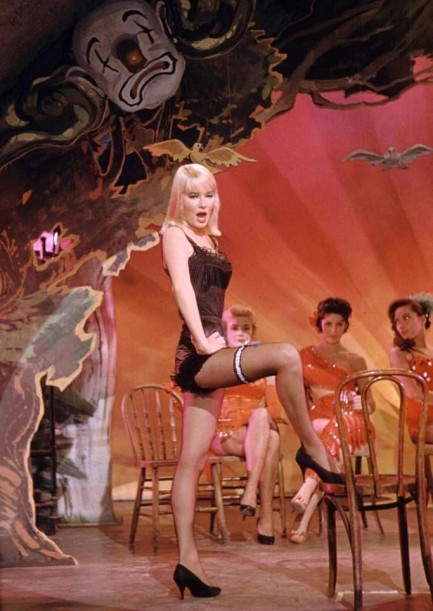 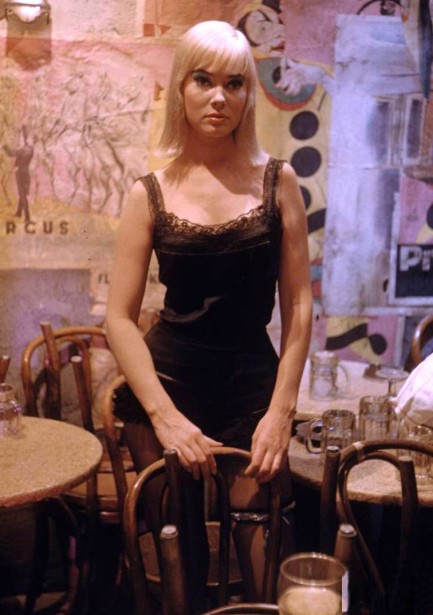
|
 |
The headlines that mattered yesteryear.
1939—Batman Debuts
In Detective Comics #27, DC Comics publishes its second major superhero, Batman, who becomes one of the most popular comic book characters of all time, and then a popular camp television series starring Adam West, and lastly a multi-million dollar movie franchise starring Michael Keaton, then George Clooney, and finally Christian Bale. 1953—Crick and Watson Publish DNA Results
British scientists James D Watson and Francis Crick publish an article detailing their discovery of the existence and structure of deoxyribonucleic acid, or DNA, in Nature magazine. Their findings answer one of the oldest and most fundamental questions of biology, that of how living things reproduce themselves. 1967—First Space Program Casualty Occurs
Soviet cosmonaut Vladimir Komarov dies in Soyuz 1 when, during re-entry into Earth's atmosphere after more than ten successful orbits, the capsule's main parachute fails to deploy properly, and the backup chute becomes entangled in the first. The capsule's descent is slowed, but it still hits the ground at about 90 mph, at which point it bursts into flames. Komarov is the first human to die during a space mission. 1986—Otto Preminger Dies
Austro–Hungarian film director Otto Preminger, who directed such eternal classics as Laura, Anatomy of a Murder, Carmen Jones, The Man with the Golden Arm, and Stalag 17, and for his efforts earned a star on Hollywood's Walk of Fame, dies in New York City, aged 80, from cancer and Alzheimer's disease. 1998—James Earl Ray Dies
The convicted assassin of American civil rights leader Martin Luther King, Jr., petty criminal James Earl Ray, dies in prison of hepatitis aged 70, protesting his innocence as he had for decades. Members of the King family who supported Ray's fight to clear his name believed the U.S. Government had been involved in Dr. King's killing, but with Ray's death such questions became moot.
|

|
|
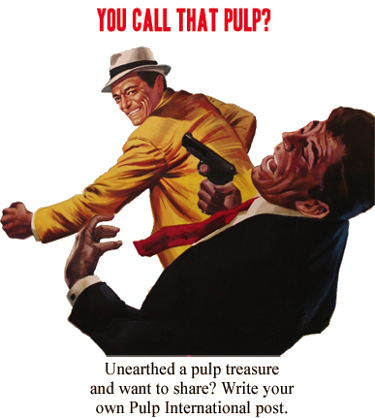
It's easy. We have an uploader that makes it a snap. Use it to submit your art, text, header, and subhead. Your post can be funny, serious, or anything in between, as long as it's vintage pulp. You'll get a byline and experience the fleeting pride of free authorship. We'll edit your post for typos, but the rest is up to you. Click here to give us your best shot.
|
|